
NextCure’s ADC Pipeline and Avere Merger: Strategic Pivot, Clinical Uncertainty, and the Search for Oncology Differentiation
NextCure faces a high-stakes transition as it pursues a merger with Avere Therapeutics, seeks to monetize a focused ADC pipeline, and navigates financial and regulatory headwinds. Execution on clinical progress, merger integration, and capital access will determine whether the company can convert early-stage assets and collaborations into a viable oncology platform.
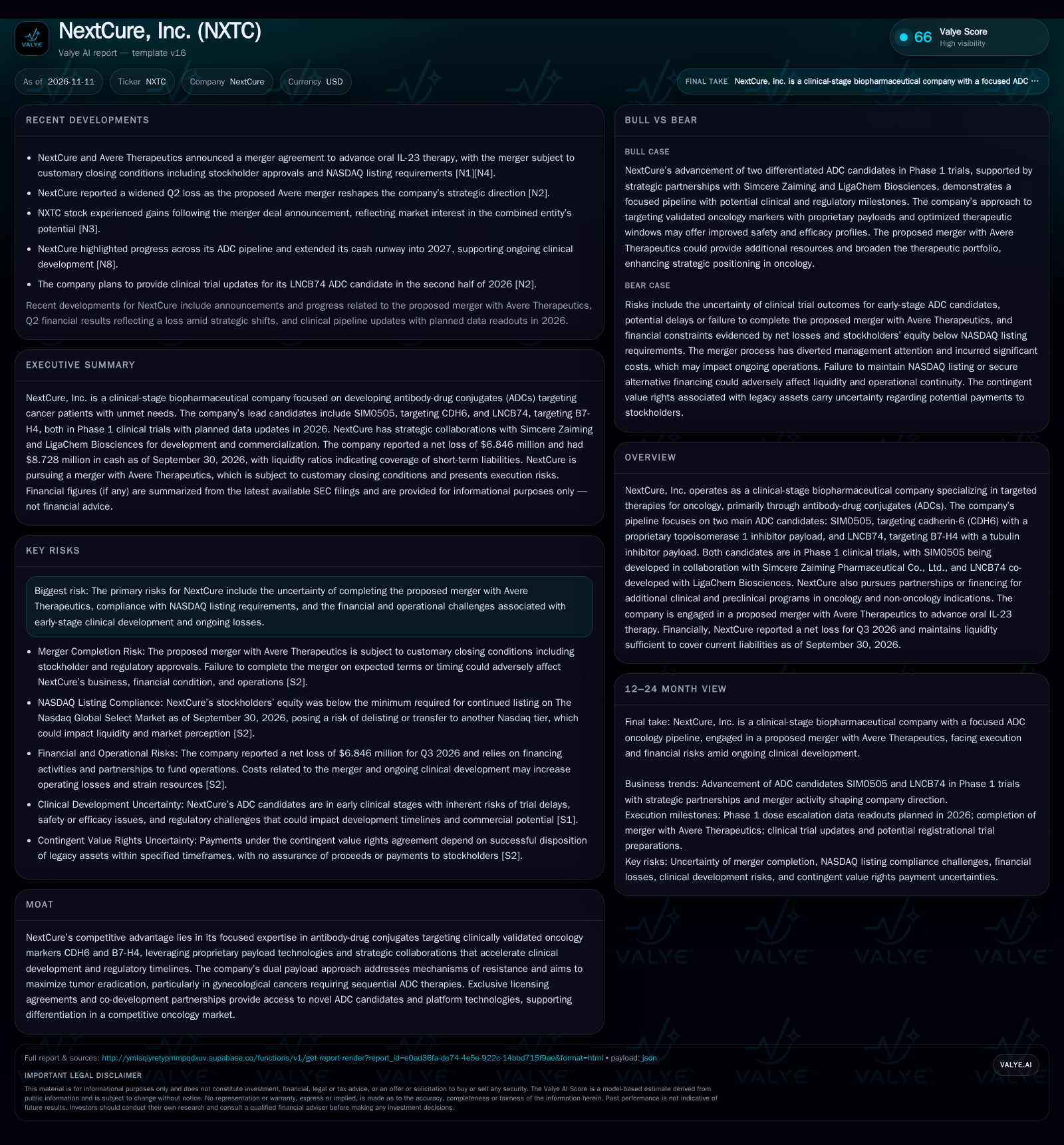
NextCure is advancing two antibody-drug conjugate (ADC) candidates in Phase 1 trials and is in the process of merging with Avere Therapeutics to expand into oral IL-23 therapy. The company has not generated product revenue, reported a net loss for Q3 2026, and faces NASDAQ listing compliance risks. The merger’s completion, clinical trial progress, and ability to secure additional funding are pivotal to the company’s trajectory. [S2] [N1] [N4]
NextCure, Inc. stands at a strategic inflection point as it navigates the complexities of clinical-stage oncology drug development and a transformative merger with Avere Therapeutics. With two antibody-drug conjugate candidates in Phase 1 trials and no product revenue to date, the company’s future depends on successful clinical results, execution of the Avere merger, and access to capital. The combination of scientific ambition, operational restructuring, and capital constraints creates both opportunity and significant risk, with the next 12–24 months likely to determine whether NextCure becomes a differentiated oncology player or succumbs to the challenges endemic to early-stage biopharma. [S2] [N1] [N4]
NextCure’s Strategic Reset: ADC Pipeline, Merger Ambitions, and Capital Position
NextCure is a clinical-stage biopharmaceutical company focusing on antibody-drug conjugates (ADCs) for oncology, with its two lead candidates—SIM0505 (targeting CDH6) and LNCB74 (targeting B7-H4)—currently in Phase 1 trials. Both programs are developed through partnerships, with Simcere Zaiming and LigaChem Biosciences, respectively, providing external expertise and risk-sharing. The company has not generated product revenue and reported a net loss of $6.846 million for Q3 2026, with $8.728 million in cash as of September 30, 2026. [S2]
NextCure is also engaged in a proposed merger with Avere Therapeutics, aiming to expand its portfolio into oral IL-23 therapy. The merger is subject to customary closing conditions, including stockholder approvals and NASDAQ listing requirements. The company’s stockholders’ equity was below the minimum NASDAQ threshold as of the latest reporting period, raising the risk of delisting or a transfer to a lower tier if the situation is not remedied. [S2] [N1] [N4]
The company’s operational focus has shifted toward supporting collaboration arrangements, managing legacy assets, and executing strategic transactions—especially the merger with Avere. The outcome of these efforts will fundamentally shape NextCure’s future direction, access to capital, and ability to advance its pipeline.
How NextCure’s Pipeline, Partnerships, and Funding Model Shape Its Economic Outlook
NextCure’s economics are currently defined by high R&D intensity, partnership-dependent development, and the absence of product revenue. The company’s ADC candidates are in Phase 1, a stage where expenses are driven by preclinical and early clinical trials, regulatory preparation, and manufacturing scale-up. These costs are largely fixed in the near term, creating negative operating leverage until successful trial outcomes allow for later-stage development or out-licensing.
Strategic collaborations with Simcere Zaiming and LigaChem Biosciences may provide milestone payments, cost-sharing, or future royalty streams if the programs advance. However, the commercial terms and revenue-sharing structure have not been disclosed; thus, the ultimate economics remain uncertain. If successful, ADCs targeting validated markers in oncology can command premium pricing, but competition for payer budgets and regulatory hurdles are significant.
The company has paused additional ATM (at-the-market) equity sales since the Avere merger announcement and is evaluating financing alternatives in light of the proposed transaction. The merger, if completed, could bring additional resources and a pipeline diversification effect, but will also introduce integration costs and execution risk. [S2]
The company’s ability to transition from R&D-heavy outflows to meaningful revenue generation depends on: (1) positive clinical data enabling out-licensing or commercial launch, (2) successful merger integration and new asset development, and (3) ongoing access to capital markets or non-dilutive funding.
Competing in ADC Oncology: NextCure’s Differentiation and Market Headwinds
NextCure operates in the highly competitive field of oncology ADCs, where numerous biopharmaceutical companies target similar indications and markers. The company’s focus on cadherin-6 (CDH6) and B7-H4—validated but crowded oncology targets—means differentiation will depend on demonstrating superior safety, efficacy, or dosing convenience compared to both existing ADCs and emerging immuno-oncology modalities.
The proprietary payloads (topoisomerase 1 inhibitor for SIM0505 and tubulin inhibitor for LNCB74) may provide mechanistic advantages if they can overcome resistance or toxicity seen with first-generation ADCs. However, these claims remain unproven until clinical data mature. Exclusive licensing and co-development partnerships could accelerate development and provide access to new platforms, but also tether NextCure’s fortunes to partner execution and negotiation outcomes.
Major competitors include large pharmaceutical companies with deep pipelines, late-stage assets, and commercial infrastructure, as well as smaller biotechs innovating in next-generation ADCs, bispecifics, and cell therapies. Substitution risk is high if new therapies demonstrate superior outcomes or cost-effectiveness. NextCure’s ability to carve out a defensible niche will likely hinge on clinical differentiation, partnership leverage, and agility in responding to evolving oncology standards.
What Success Could Look Like: Clinical Wins, Merger Synergy, and Platform Expansion
A favorable outcome for NextCure would begin with positive Phase 1 safety and efficacy data from SIM0505 and LNCB74, validating the company’s scientific approach and attracting potential licensing or co-development deals with larger biopharma partners. Early signals of differentiated activity—such as activity in resistant tumors or improved toxicity profiles—would increase the likelihood of advancing to Phase 2 and enhance negotiating leverage.
Completion of the Avere merger on schedule would diversify the asset base, potentially accelerate pipeline progress, and create a broader platform for both oncology and immunology innovation. If the combined entity secures additional funding (via equity, partnerships, or non-dilutive grants) and maintains NASDAQ listing, it could support more robust clinical development and opportunistic in-licensing.
Confirmation of this scenario would include: (1) timely merger closing and integration updates; (2) positive headline clinical results or regulatory designations (e.g., Fast Track); (3) new partnership or licensing deals; and (4) evidence of capital raised on favorable terms. Conversely, absence of clinical progress or capital access would falsify the upside case.
Strategic Uncertainty Persists as NextCure Pursues Merger and Clinical Progress
The most plausible near-term scenario is one of continued uncertainty and volatility. NextCure may complete the Avere merger with some delay, integrating new assets while continuing to support its ADC collaborations. Clinical progress in Phase 1 will likely be incremental, with early safety and pharmacokinetic data emerging before clear efficacy signals. The company will remain dependent on external funding—either through additional equity, milestone payments from partners, or asset monetization.
NASDAQ listing compliance will remain a persistent risk unless the company can shore up stockholders’ equity through merger synergies or new capital. Operational focus will be split between advancing clinical programs, managing the integration process, and meeting public company obligations.
This scenario is confirmed by incremental clinical updates, timely but qualified merger progress, and periodic financing events that prevent operational disruption but do not resolve long-term sustainability. Evidence that would falsify the base case includes merger failure, clinical program discontinuation, or an inability to access capital.
Where the Thesis Breaks: Merger Failure, Clinical Setbacks, and Capital Exhaustion
The adverse scenario for NextCure involves one or more critical failures: (1) the Avere merger is delayed, fails to close, or triggers protracted regulatory or shareholder challenges; (2) Phase 1 trials for SIM0505 and LNCB74 produce inconclusive or negative results, leading to program discontinuation or partner withdrawal; and (3) the company is unable to raise additional capital, forcing severe cost cuts, asset fire sales, or even delisting from NASDAQ.
Such events would erode management credibility, damage partnership prospects, and likely lead to a loss of strategic optionality. Stockholder value could be further impaired by the contingent value rights structure, which only provides payouts if legacy assets are successfully monetized within tight timelines—a scenario that becomes remote if operational continuity is threatened.
Downside confirmation would come from merger termination notices, negative clinical or regulatory headlines, failed financing attempts, or NASDAQ delisting actions. The company’s ability to avoid this trajectory depends on rapid execution, positive clinical signals, and maintaining access to capital markets.
Concrete Milestones and External Triggers That Will Define NextCure’s Outcome
Merger closing progress: Announcements regarding satisfaction of closing conditions, shareholder votes, and integration planning will determine whether the Avere transaction proceeds on schedule. [N1] [N4]
Phase 1 trial updates: Early safety, pharmacokinetic, and (if disclosed) efficacy data for SIM0505 and LNCB74 will be critical for validating the ADC pipeline and partnership value. [S1] [S2]
NASDAQ listing status: Any communications regarding compliance, transfer to a lower tier, or delisting will directly affect market access and investor confidence. [S2]
New financing events: Equity raises, partnership milestone payments, or non-dilutive funding would test the company’s ability to extend its operational runway. [S2]
Partnership announcements: Updates on the status, structure, or expansion of current collaborations (Simcere Zaiming, LigaChem) would clarify risk-sharing and commercial upside.
Asset monetization or legacy program disposition: Progress on selling or licensing intellectual property and legacy clinical assets will impact the contingent value rights outcome. [S2]
Management turnover or restructuring: Any changes in leadership or further cost-cutting activities would signal shifts in strategic direction or operational stress.
If disclosed, forward cash burn projections and updates to cash forecast models would help assess the risk of near-term capital exhaustion.
Disclaimer: This is research-only, informational analysis and not investment advice. It may include AI-generated interpretation and general industry context. Always verify important details using primary sources.

Comments