
VOC Energy Trust: Royalty Model Endures, but Commodity Volatility and Production Decline Test Distribution Stability
VOC Energy Trust’s pure-play royalty structure provides exposure to oil and gas cash flows with minimal operational risk, but the trust’s fortunes hinge on commodity prices and the performance of underlying assets it does not control. As distributions persist, the durability of revenue—amid sector headwinds and finite reserves—remains at the core of the investment debate.
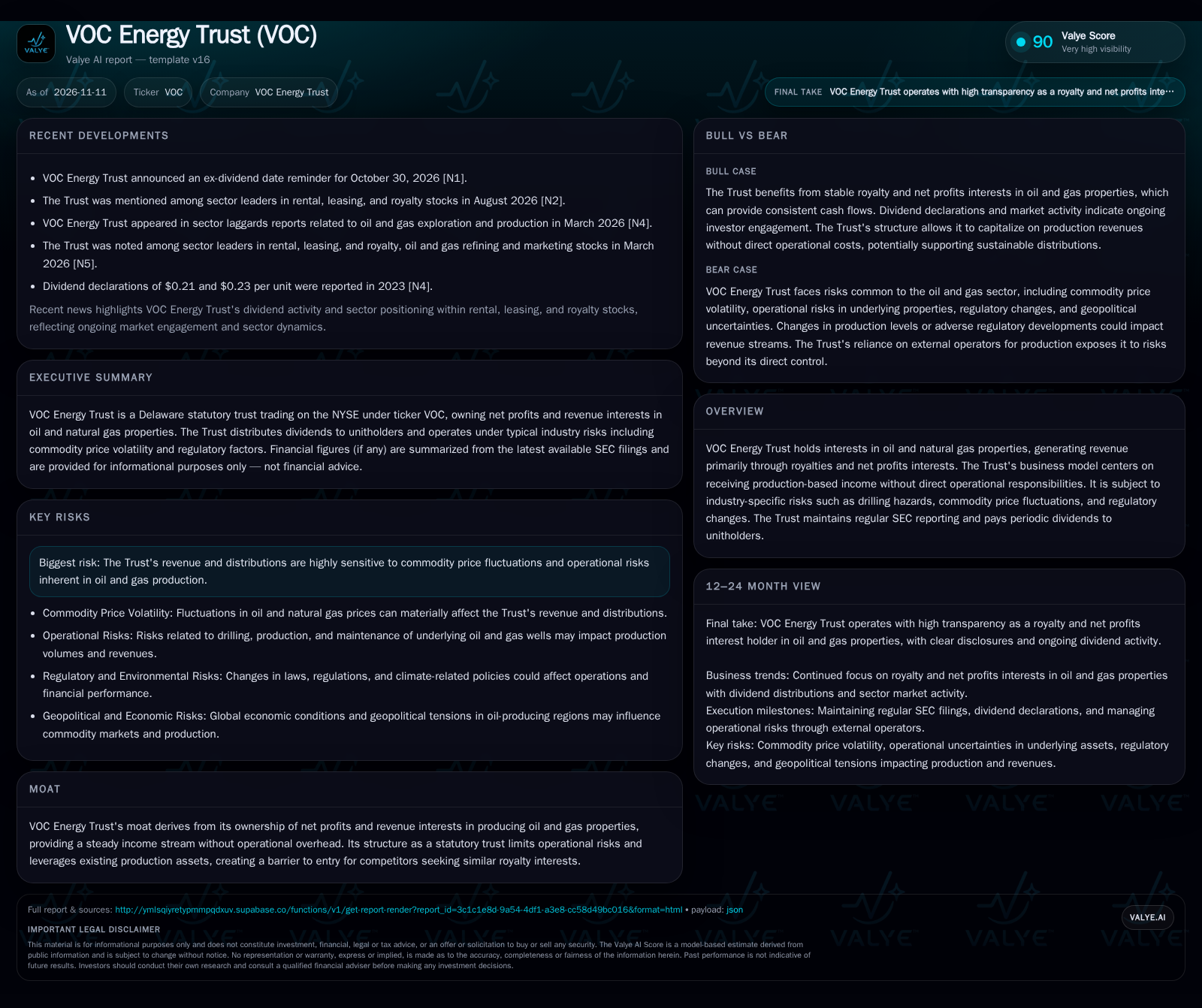
VOC Energy Trust owns net profits and royalty interests in oil and gas properties, distributing production-based income to unitholders. The trust’s revenue is highly sensitive to commodity price swings and production trends in its underlying assets, with no direct control over operations. Persistent distributions offer near-term yield, but long-term sustainability depends on the life and productivity of the wells, as well as external market and regulatory forces. The cited source reports dividend-related activity; that disclosure alone does not establish dividend-policy continuity, management confidence, or a material constraint on capital flexibility. [S1] [N1]
VOC Energy Trust exemplifies the royalty trust model in the U.S. energy sector: it receives a share of oil and gas production revenues from a portfolio of properties but does not own, operate, or replenish those assets. The trust’s income is distributed directly to unitholders, offering an attractive yield profile in periods of commodity strength. However, with no operational control and a finite asset base, VOC’s ability to sustain distributions over time is inherently uncertain—especially as oil and gas markets face persistent price swings, regulatory scrutiny, and the inexorable decline of mature wells. The investment case thus hinges on the interplay between near-term cash flow visibility and long-term asset depletion risk. [S1] [N1]
Recent Distribution Activity and Trust Structure Define VOC’s Near-Term Outlook
VOC Energy Trust continues to operate as a Delaware statutory trust, trading on the NYSE and holding 17 million units of beneficial interest as of March 2026. The trust’s core business is the ownership of net profits and revenue interests in oil and natural gas properties, entitling it to a share of production revenues after deducting costs. This structure enables the trust to distribute cash flows to unitholders without engaging in operational activities or capital expenditures. The cited source reports dividend-related activity; that disclosure alone does not establish dividend-policy continuity, management confidence, or a material constraint on capital flexibility. However, the trust’s latest filings report no material changes in risk factors, underscoring the persistence of commodity price, operational, and regulatory risks that could impact future payouts. [S1] [N1]
How VOC Energy Trust Converts Production Revenue into Distributable Cash
VOC Energy Trust’s economic engine is built on the receipt of royalties and net profits interests from producing oil and gas wells. The trust does not incur drilling, completion, or maintenance costs directly; instead, it receives a proportion of net revenue—production proceeds after the deduction of operating and development expenses—passed through from operators. This asset-light model provides high operating leverage to commodity price movements: increases in oil and gas prices flow disproportionately to the trust’s bottom line, while downturns can quickly compress distributable income.
Unlike operating companies, VOC bears minimal fixed costs and does not require significant capital outlays, making it a pure passthrough vehicle. However, this model also means the trust is exposed to the natural decline of its underlying reserves and production volumes, with limited recourse to offset declines through reinvestment or development. The absence of capital expenditures reduces downside from capex overruns but also precludes participation in potential upside from new drilling or enhanced recovery. Distributions are determined by actual net revenues received in a given period, making them inherently variable and sensitive to both commodity prices and well performance.
Royalty Trust Model: Advantages and Vulnerabilities in a Shifting Energy Landscape
VOC Energy Trust’s competitive position is defined less by traditional market rivalry and more by its unique structural attributes compared to both upstream operators and other royalty trusts. The trust’s moat stems from its established royalty and net profits interests in producing assets, which can provide steady cash flows without operational risk. This model insulates unitholders from the direct uncertainties of drilling and development, but also limits upside and introduces vulnerability to asset depletion.
In a broader context, VOC competes for investor capital against other energy royalty trusts, master limited partnerships, and yield-oriented energy vehicles. Its relative simplicity and transparency are strengths, but the absence of asset renewal mechanisms puts it at a disadvantage versus entities that can reinvest in new wells or expand their asset base. The principal external threats are substitutes such as renewable energy royalty structures and alternative yield vehicles, as well as sectoral shifts driven by decarbonization and regulatory changes.
Commodity Price Recovery and Production Resilience Could Extend Distribution Runway
A favorable scenario for VOC Energy Trust would involve a sustained rally in oil and natural gas prices, potentially driven by global supply constraints, geopolitical tensions, or a rebound in demand. Higher realized prices would directly boost net revenues and, by extension, distributable cash flows to unitholders. If the operators of the underlying assets can also stabilize or modestly increase production—through maintenance, infill drilling, or efficiency gains—VOC could see an extended period of robust distributions, even as natural decline persists.
Evidence that would confirm this scenario includes sequential growth in reported distributions, positive revisions to reserve life estimates, and disclosures of stable or rising production volumes from the underlying properties. Conversely, a sharp drop in commodity prices, or evidence of accelerating production decline, would quickly falsify the upside case.
Yield Remains, but Gradual Production Decline and Market Volatility Erode Long-Term Value
The most plausible outcome is that VOC Energy Trust continues to generate variable distributions, with income levels fluctuating alongside commodity prices and the performance of its legacy asset base. Over time, natural production decline is likely to outpace any incremental improvements from operator maintenance, resulting in a gradual erosion of cash flows and, by extension, the trust’s market value.
This scenario is confirmed by ongoing, but fluctuating, quarterly distributions, and a lack of new asset additions or material positive reserve revisions in filings. Should commodity prices remain in a moderate range and production declines prove manageable, the trust may continue to offer an attractive, if shrinking, yield to income-oriented investors. However, any acceleration in decline rates or adverse regulatory change would challenge this equilibrium.
Commodity Slump or Operational Setbacks Could Trigger Steep Drop in Distributions
In a negative scenario, a significant decline in oil and natural gas prices—whether due to global oversupply, demand destruction, or macroeconomic shocks—would rapidly reduce VOC’s net revenues and force a sharp cut in distributions. This risk is compounded by the trust’s lack of operational control: if third-party operators reduce investment in maintenance or shut in wells, production volumes could fall faster than anticipated.
Regulatory developments—such as stricter environmental rules or unfavorable tax changes—could further impair cash flows or accelerate asset depletion. Evidence for this scenario would include a sudden reduction or suspension of distributions, negative revisions to reserve estimates, or disclosures of well shut-ins or operator distress. A prolonged period of low commodity prices would be especially damaging, as it would erode both near-term yield and the trust’s residual value.
Factors That Will Determine the Future of VOC’s Yield and Asset Base
Trends in quarterly and annual distributions per unit, as reported in SEC filings, will provide direct evidence of the trust’s cash flow health.
Disclosed production volumes and realized commodity prices from the underlying oil and gas properties—if provided—would clarify the drivers of revenue variability.
Reserve life estimates and any changes to proved reserves will indicate the remaining productive capacity of the trust’s asset base.
Any announcements from the operators regarding drilling activity, maintenance, or well shut-ins could signal changes in future production profiles.
Updates on regulatory or environmental developments affecting oil and gas production in the trust’s operating regions would help gauge external risk exposure.
A useful metric would be the ratio of distributable cash flow to underlying net production volumes, clarifying sensitivity to both price and volume changes.
If disclosed, changes in the trust’s cost deductions or net profits interest calculation methods could affect distributable income.
Disclaimer: This is research-only, informational analysis and not investment advice. It may include AI-generated interpretation and general industry context. Always verify important details using primary sources.

Comments