
Fortitude Gold Corp: Low-Cost Nevada Mining Meets Exploration Ambition Amid Sales Volatility
Fortitude Gold’s latest results highlight operational profitability, significant Nevada land holdings, and a new joint venture to expand its resource base. However, sharp sales declines and sector-wide cost and regulatory risks raise questions about the sustainability of its low-cost model and its ability to convert exploration potential into long-term value.
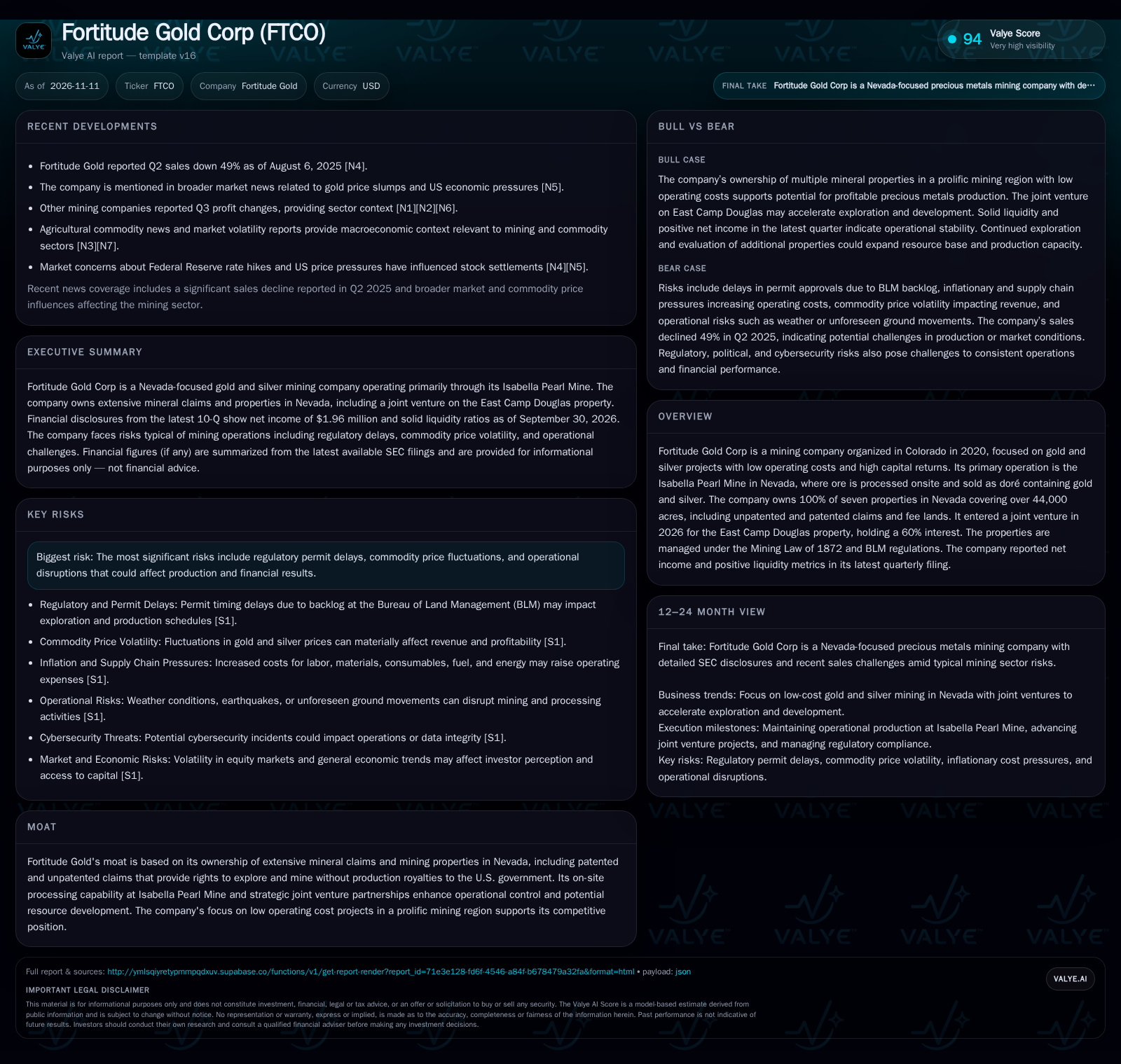
Fortitude Gold Corp posted Q3 2026 net income and maintains a reported current ratio, driven by operations at its Isabella Pearl Mine. The recent East Camp Douglas joint venture expands its Nevada footprint, but the company faces recent sales declines and sector headwinds. The question is whether its low-cost focus and new projects can offset commodity, regulatory, and operating risks in a volatile mining landscape. [S1] [S2]
Fortitude Gold Corp’s latest quarter demonstrates the continued viability of its low-cost mining strategy, with net profitability and reported liquidity position despite a challenging gold price environment. The company’s aggressive Nevada land position and recent joint venture signal ambitions for growth beyond its flagship Isabella Pearl Mine. Yet, recent steep sales declines and the sector’s ongoing exposure to regulatory, cost, and commodity headwinds mean that Fortitude’s ability to sustain and scale its returns is far from assured. The next phase will test whether its operational discipline and exploration pipeline can weather both external shocks and internal execution risks.
Recent Profitability, Expanding Asset Base, and Sales Volatility
Fortitude Gold reported net income of $1.96 million and EPS of $0.07 for Q3 2026, with $8.5 million in cash and a current ratio of 3.5 as of September 30, 2026 [S2]. These figures suggest the company is currently operating profitably and maintains a cushion of liquidity. The company owns 100% of seven Nevada mining properties, recently expanding its portfolio through a 60% joint venture at East Camp Douglas, which covers over 5,500 acres [S1]. However, the company experienced a 49% decline in sales in Q2 2025, underlining significant volatility in its revenue stream [N5]. Operational risks, regulatory delays, and gold price pressures remain active concerns [S1].
Low-Cost Mining Model and Financial Leverage
Fortitude Gold’s core economics depend on its ability to efficiently extract and process gold and silver from Nevada properties, primarily the Isabella Pearl Mine. The company’s stated focus is on projects with low operating costs and high capital returns [S1]. Onsite processing allows for control over costs and potentially higher margins versus miners reliant on third-party facilities. The company reported cash and liquidity metrics for the period; these figures do not by themselves establish operating runway, investment capacity, financial flexibility, or financing capacity.
Gold mining is inherently capital-intensive, requiring upfront investment in exploration, permitting, equipment, and ongoing sustaining capital. Operating leverage cuts both ways: cost inflation or lower realized gold prices could quickly erode margins, while any production scale-up (if successful) would magnify profitability. The company’s ability to maintain low per-ounce costs as it expands beyond Isabella Pearl is a critical test for its model.
The sustainability of Fortitude Gold’s low-cost mining model hinges not only on operational efficiency but also on its capacity to manage capital allocation prudently amid fluctuating commodity prices. Given gold’s cyclical nature, the company’s financial resilience depends on maintaining a flexible cost structure that can adjust to price downturns without compromising essential exploration and development activities. Moreover, the interplay between fixed and variable costs is critical; a high proportion of fixed costs can amplify operating leverage, intensifying earnings volatility. Therefore, a granular understanding of cost behavior and the ability to optimize capital expenditure timing are key to preserving margins and ensuring long-term viability.
Nevada Asset Concentration and Strategic Partnerships as Differentiators
Fortitude Gold’s competitive position rests on its concentration in Nevada—a top-tier jurisdiction for gold mining thanks to favorable geology, established infrastructure, and relatively stable regulatory frameworks. Owning 100% of seven properties, including both patented and unpatented claims, gives the company a degree of security and flexibility not enjoyed by operators with royalty or lease encumbrances [S1]. The recent joint venture at East Camp Douglas demonstrates a willingness to share risk and accelerate resource development, potentially leveraging partner capital or expertise.
However, the company operates in a highly competitive landscape populated by both junior explorers and much larger, better-capitalized producers. Its ability to compete depends on sustaining low costs, successfully advancing exploration, and managing regulatory complexities. The lack of production royalties to the U.S. government is an advantage, but inflationary pressures, labor competition, and periodic permitting delays can erode this edge. Substitution risk is low for gold itself, but high for investor capital, which may flow to larger or more diversified miners if Fortitude’s costs rise or output falters.
Fortitude Gold’s Nevada concentration provides a strategic advantage through proximity to established infrastructure and a skilled labor force, which can reduce logistical and operational risks compared to more remote jurisdictions. However, this geographic focus also exposes the company to localized regulatory changes and environmental scrutiny that could disproportionately affect its portfolio. Partnerships, such as the joint venture at East Camp Douglas, serve not only to share financial risk but also to incorporate complementary technical expertise, potentially accelerating resource delineation and permitting processes. Nonetheless, reliance on partners introduces governance complexities and potential misalignment of incentives, which require careful management to preserve project momentum and value creation.
If Exploration Success and Cost Control Drive Production Growth
The most favorable outcome for Fortitude Gold is a scenario where exploration at existing and JV properties (such as East Camp Douglas) translates into new reserves and resources, enabling a step-up in production while holding operating costs low. If the company can replicate the cost structure of Isabella Pearl at additional sites, operating leverage could drive rapid earnings expansion—especially if gold prices stabilize or rise.
Evidence that would confirm this scenario includes: sustained or growing gold output; reserve/resource upgrades; successful permitting and development milestones at new properties; and cost-per-ounce metrics remaining stable or improving. Expansion funded primarily through operating cash flow, rather than dilutive equity or expensive debt, would further validate the model. Falsification would come from stalled exploration, rising per-ounce costs, or persistent permitting delays that keep new projects from contributing to the bottom line.
Operational Discipline Maintains Modest Profitability, but Growth Is Uneven
The most plausible path is one where Fortitude continues to generate modest profits from Isabella Pearl and incremental contributions from its existing Nevada portfolio, but faces ongoing volatility in revenue and margins due to commodity price swings, permitting bottlenecks, and inflationary pressures. Exploration and development at JV properties may progress, but likely at a measured pace given sector-wide permitting and funding constraints.
Confirmation would come from stable quarterly production, continued positive net income, and measured progress on new project milestones without significant cost overruns or regulatory setbacks. Conversely, a pattern of irregular sales, cost creep, or delayed expansion would indicate the company is struggling to convert its asset base into consistent value.
Permitting, Cost Inflation, or Gold Price Shocks Undermine Viability
Adverse outcomes could result from a combination of regulatory delays (such as BLM backlog), persistent inflation in input costs (labor, energy, consumables), and/or a sustained downturn in gold prices. These factors could compress margins, potentially turning current profits into losses and forcing the company to curtail development or seek dilutive financing. The sharp Q2 2025 sales drop already demonstrates Fortitude’s exposure to operational and market shocks.
Downside confirmation would include negative cash flow, declining production, rising per-ounce costs, missed development milestones, or disclosure of regulatory setbacks. Extended periods of low gold prices or cost spikes could threaten the sustainability of operations, especially if exploration fails to replenish reserves or unlock new high-return projects.
In a scenario where permitting delays become protracted, Fortitude Gold may face increased holding costs and deferred revenue generation, which can strain liquidity and investor confidence. Inflationary pressures, particularly in labor and energy, could erode the company’s cost advantage, forcing operational cutbacks or efficiency compromises. Additionally, a sustained downturn in gold prices would reduce cash flow, limiting the company’s ability to fund exploration and capital projects internally, thereby increasing dependence on external financing. This could result in dilution or higher interest burdens, further compressing returns. The company’s ability to adapt its operational footprint and prioritize high-return projects under such stress would be a critical determinant of survival.
Testing Fortitude’s Low-Cost Thesis and Growth Ambitions: What to Track Next
Quarterly gold and silver production volumes and realized prices, to assess operational stability and revenue trends.
Cost-per-ounce metrics (if disclosed), which would indicate whether Fortitude is able to sustain its low-cost advantage amid inflation.
Permitting and regulatory milestone progress for both existing operations and new projects, especially at East Camp Douglas.
Updates on reserve and resource estimates, particularly if exploration at JV or wholly owned properties yields material upgrades.
Capital expenditure trends and funding sources—reliance on operating cash flow versus external financing or asset sales.
JV partner contributions at East Camp Douglas and timing of HLM’s required $40 million exploration spend, which affects economic interest allocation [S2].
Disclosure of any major operational disruptions, weather events, or supply chain issues impacting production or project timelines.
Changes in Nevada mining policy or BLM administrative timelines that could alter the risk/reward profile for project development.
Disclaimer: This is research-only, informational analysis and not investment advice. It may include AI-generated interpretation and general industry context. Always verify important details using primary sources.

Comments