
Braveheart Bio: Single-Asset Ambition, Clinical Milestones, and the Capital-Intensive Path to HCM Disruption
Braveheart Bio’s exclusive bet on BHB-1893 for hypertrophic cardiomyopathy positions it for high clinical and commercial reward—but leaves the company exposed to the full spectrum of clinical, regulatory, and execution risks typical of single-asset biotech models. With positive one-year data, a robust reported cash balance, and mounting operating losses, the next two years will test its ability to convert pipeline momentum into regulatory approval and a credible commercial launch.
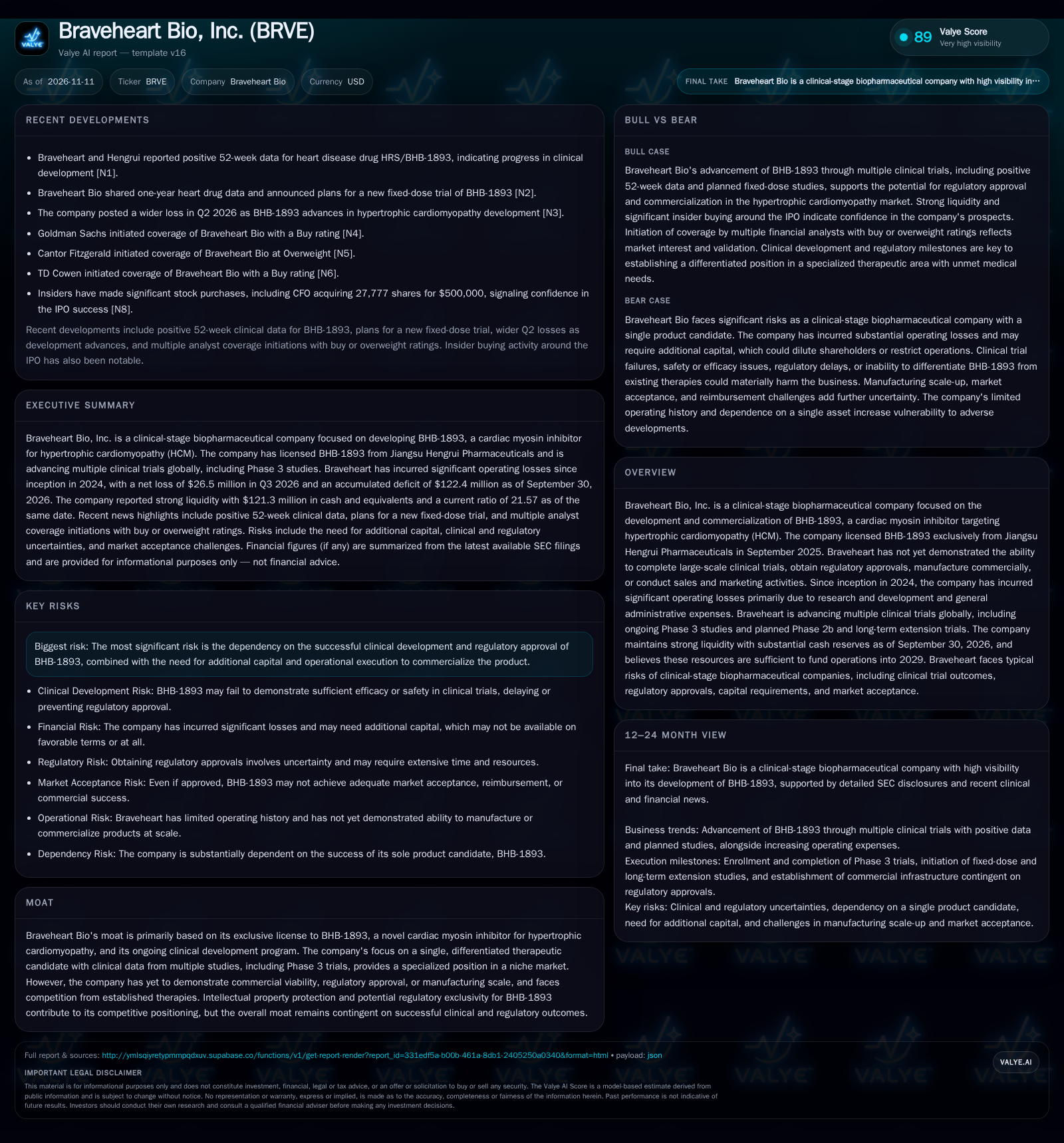
Braveheart Bio is advancing BHB-1893—a cardiac myosin inhibitor licensed from Jiangsu Hengrui—through late-stage clinical trials for hypertrophic cardiomyopathy (HCM). The company reported positive 52-week data, reported liquidity position with $121.3 million in cash as of September 2026, and a net loss of $26.5 million for Q3 2026. Its future hinges on clinical outcomes, regulatory approvals, and the ability to build commercial infrastructure from scratch. Analyst coverage is bullish, but Braveheart remains a high-risk, high-reward story highly sensitive to clinical and capital milestones. [S1] [N1] [N2]
Braveheart Bio, Inc. embodies the high-stakes clinical-stage biotech archetype: a single-asset, single-focus company betting its future on the success of BHB-1893, a cardiac myosin inhibitor targeting hypertrophic cardiomyopathy (HCM). With positive one-year clinical data and a cash-rich balance sheet following its 2026 IPO, Braveheart is well-positioned to fund ongoing global late-stage trials. Yet the company has never brought a drug to market, faces mounting losses, and must build its commercial infrastructure from scratch if BHB-1893 wins approval. The next 18–24 months will determine whether Braveheart’s clinical momentum can translate into regulatory success and eventual market entry—or whether it will confront the pitfalls that have stalled many high-profile biotech hopefuls before.
Recent Clinical Progress and Financial Position: Setting the Stage for a Binary Outcome
Braveheart Bio’s development of BHB-1893 for hypertrophic cardiomyopathy (HCM) is the company’s sole operational focus, following its exclusive license of the asset from Jiangsu Hengrui in September 2025. The company recently reported positive 52-week clinical data for BHB-1893, supporting the drug’s continued progression in global Phase 3 trials and prompting plans for a new fixed-dose study. These advances have coincided with a substantial increase in operating expenses: Braveheart posted a net loss of $26.5 million in Q3 2026 and an accumulated deficit of $122.4 million as of September 30, 2026. The company reported cash and liquidity metrics for the period; these figures do not by themselves establish operating runway, investment capacity, financial flexibility, or financing capacity. Multiple financial analysts have initiated coverage with positive ratings, and significant insider equity purchases occurred at IPO, signaling internal and external confidence. However, Braveheart has not yet demonstrated the ability to complete pivotal trials, gain regulatory approval, or commercialize at scale. [S1] [N1] [N2] [N4] [N5] [N6] [N8]
How a Single-Asset Biotech Could Capture Value: Economics of Cardiac Myosin Inhibition
Braveheart Bio’s business model is a classic high-risk, high-reward biotech play: all resources are concentrated on advancing BHB-1893 through late-stage clinical development, regulatory approval, and ultimately commercialization for HCM. If BHB-1893 is approved, revenue would likely be driven by premium pricing typical of novel cardiovascular therapies targeting rare or severe conditions, with initial uptake among specialized cardiology centers and academic hospitals. The economics hinge on volume (patient penetration in obstructive and non-obstructive HCM), price (potential for orphan or specialty drug pricing), and mix (expansion to additional HCM subtypes or adjacent indications over time).
Operating leverage could be substantial if Braveheart transitions from a pure R&D entity to a commercial-stage company: fixed costs for R&D and SG&A would be spread over growing sales, especially if BHB-1893 achieves broad adoption. However, substantial upfront investment is required to build sales, marketing, and distribution infrastructure—none of which currently exists. Manufacturing scale-up may require further capital outlays and technical expertise, with risks around cost of goods and supply chain complexity. The reliance on a single product means that all future cash flows are contingent on clinical and regulatory milestones, with little margin for error. If BHB-1893 encounters setbacks, Braveheart’s economics could deteriorate rapidly, as there are no alternative revenue streams or pipeline assets to absorb shocks.
Assessing Braveheart’s Moat: IP, Clinical Differentiation, and the Shadow of Established Therapies
Braveheart Bio’s competitive position rests on its exclusive license to BHB-1893 and the strength of its intellectual property, as well as the potential for regulatory exclusivity if the drug is approved. The HCM market is specialized but increasingly competitive: established therapies (such as beta-blockers, calcium channel blockers, and septal reduction procedures) remain first-line, while other cardiac myosin inhibitors have entered or are advancing through late-stage development. Braveheart’s moat will depend on demonstrating either superior efficacy, improved safety, or dosing convenience relative to current standard of care and emerging myosin inhibitors.
Switching costs in this therapeutic area can be high for established patients, but new, disease-modifying therapies with strong evidence can rapidly shift prescriber behavior—especially in rare diseases with unmet need. If BHB-1893 demonstrates clear differentiation in pivotal trials, it could secure a valuable position; if not, it risks being a second- or third-line option. The company’s lack of commercial infrastructure and experience is a disadvantage relative to larger, established competitors. Regulatory exclusivity and orphan drug status could provide a temporary moat, but long-term defensibility will require ongoing innovation and successful market execution.
What Success Would Look Like: From Clinical Data to Regulatory Approval and Commercial Uptake
The bull case for Braveheart Bio assumes that BHB-1893 delivers robust efficacy and safety in its global Phase 3 trials, leading to regulatory approvals in major markets for both obstructive and non-obstructive HCM. Positive 52-week data and the initiation of a fixed-dose trial suggest momentum, but ultimate validation will require statistically and clinically meaningful outcomes in the pivotal studies. If successful, Braveheart would need to rapidly build or partner for commercial infrastructure, access reimbursement, and educate the market.
Confirmation of the upside path would include: (1) positive top-line Phase 3 results; (2) acceptance and approval filings with the FDA and ex-U.S. regulators; (3) clear signs of payer reimbursement at premium price points; and (4) early commercial traction with HCM specialists and patient advocacy groups. Strategic partnerships or out-licensing could accelerate uptake and reduce the capital burden. The scenario could be falsified by negative or inconclusive trial results, regulatory setbacks, or inability to secure reimbursement at economically viable levels. [N1] [N2]
Incremental Progress, Mounting Costs: The Most Likely Trajectory for Braveheart in 2027–28
The most plausible path is a period of continued clinical execution, with Braveheart advancing BHB-1893 through global Phase 3 trials and reporting interim or top-line results over the next 12–24 months. Expenses will remain high as the company supports multiple studies, scales pre-commercial activities, and invests in manufacturing readiness. If trial results are positive but not transformative, Braveheart may pursue a staged commercial rollout or seek partnerships with established pharma companies to mitigate risk and leverage existing sales channels.
This scenario would be confirmed by steady enrollment and completion of ongoing trials, timely initiation of planned studies (such as the fixed-dose and extension trials), and maintenance of reported liquidity position to avoid dilutive financings before key data readouts. Evidence against the base case would be major trial delays, cost overruns, or early signals of safety or efficacy concerns.
Single Asset, Single Shot: How Clinical or Regulatory Failure Could Unravel the Thesis
The primary risk to Braveheart Bio is binary: failure of BHB-1893 in late-stage clinical trials, emergence of significant safety signals, or inability to meet regulatory endpoints would immediately undermine the investment case, as the company has no other assets in development. Even modest setbacks—such as trial delays, regulatory questions, or mixed efficacy data—could force Braveheart to seek additional capital on unfavorable terms, dilute existing shareholders, or pivot to out-licensing the asset.
This downside scenario would be confirmed by negative or inconclusive Phase 3 trial results, FDA or EMA rejection or major requests for additional data, or evidence that the drug cannot be differentiated from existing or emerging therapies. Financially, a rapid burn of cash reserves without a clear path to approval would make the company vulnerable to distressed financings or strategic alternatives. [S1]
Milestones and Metrics That Will Define Braveheart’s Pivotal Phase
Top-line efficacy and safety data from the global Phase 3 LIONHEART-HCM trial: This is the single most important catalyst for the company’s future.
Initiation and enrollment pace of the planned Phase 2b fixed-dose (TRUEHEART-HCM) and global Phase 3 (NOBLEHEART-HCM) studies: Delays or enrollment shortfalls would signal execution risk.
Progress toward regulatory submissions in the U.S., EU, and China: Acceptance of filings would indicate clinical credibility and regulatory readiness.
Updates on manufacturing scale-up and supply chain development: Evidence of readiness to produce commercial quantities would help test the thesis.
Commercial infrastructure buildout or partnership announcements, if disclosed: Any move to establish sales and marketing presence or secure strategic alliances would mark a transition to commercial-stage operations.
Cash burn and liquidity trends: Quarterly updates on cash position and projected runway would clarify the company’s need for additional financing.
Reimbursement discussions and payer feedback, if disclosed: Early signals of pricing and market access potential would help validate the commercial thesis.
Any emergence of safety concerns or adverse regulatory communications: These would quickly challenge the company’s ability to proceed.
Disclaimer: This is research-only, informational analysis and not investment advice. It may include AI-generated interpretation and general industry context. Always verify important details using primary sources.

Comments