
Finwise Bancorp: Fintech Partnerships, Credit Risk, and the Challenge of Scaling Digital-First Banking
Finwise Bancorp’s national fintech-driven loan origination model has delivered meaningful asset and income growth, but rising credit loss provisions and heavy reliance on third-party partnerships raise questions about the durability of its economics as integration and risk management come into sharper focus.
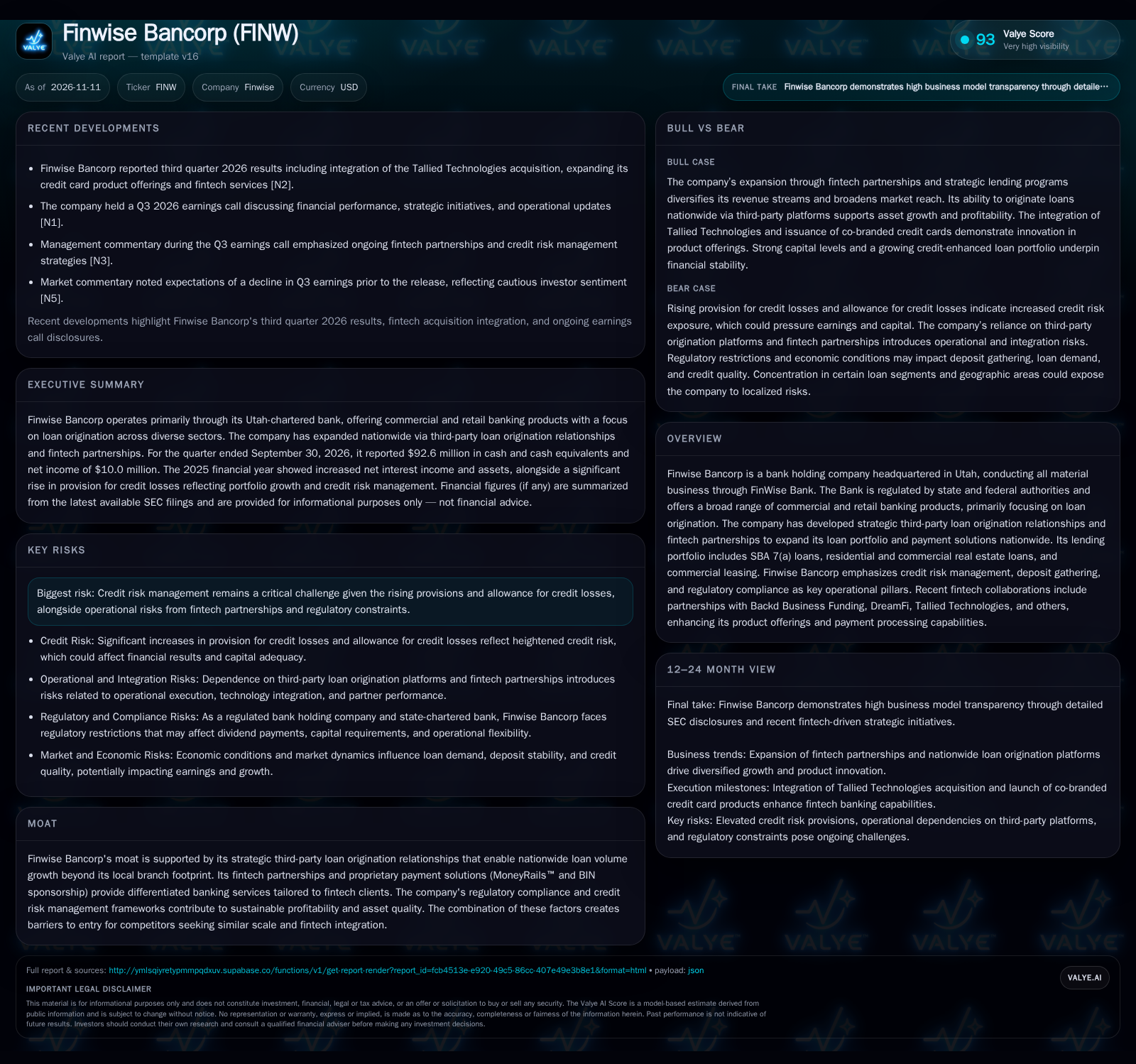
Finwise Bancorp’s expansion via fintech partnerships and third-party loan origination has driven nationwide growth in assets and income, with Q3 2026 net income of $10.0 million and cash of $92.6 million. However, sharply higher credit loss provisions and a declining net interest margin signal rising credit risk and margin compression. The Tallied Technologies integration expands product breadth, but operational and regulatory risks remain central to the investment debate. Ongoing execution on fintech integration, credit quality, and deposit mix will be critical to sustaining the current growth trajectory. [S1] [S2] [N1] [N2] [N3]
Finwise Bancorp has built a distinctive business model by leveraging fintech partnerships and third-party platforms to originate loans and gather deposits well beyond its single-branch Utah footprint. This strategy has powered significant growth in assets and profit, as evidenced by the company’s $10.0 million net income and $92.6 million in cash for Q3 2026. However, the sharp rise in credit loss provisions and a narrowing net interest margin reveal a business increasingly exposed to credit risk and the complexities of scaling technology-enabled lending. As Finwise integrates new fintech acquisitions and expands its product suite, the sustainability of its risk-adjusted returns and operational resilience will be put to the test. [S1] [S2] [N2] [N3]
Recent Financials and the Credit Risk Overhang
As of September 30, 2026, Finwise Bancorp reported $92.6 million in cash and cash equivalents and quarterly net income of $10.0 million, with basic and diluted EPS of $0.76 and $0.73, respectively. [S2] The company’s total assets reached $977.1 million at year-end 2025, supported by what management describes as strong capital levels. [S1] However, the financial picture is clouded by a substantial increase in the provision for credit losses, which jumped to $38.6 million in 2025 from $11.6 million in 2024, and a corresponding rise in the allowance for credit losses from $13.2 million to $36.8 million over the same period. [S1]
How Finwise Makes Money: Origination, Spread, and the Cost of Growth
Finwise’s core economics center on originating loans—across SBA, real estate, and commercial segments—often via fintech and third-party platforms, then earning interest income on these assets. Net interest income for 2025 was $72.2 million, with a net interest margin (NIM) of 9.23%, down from 9.99% the prior year. [S1] The company’s high NIM reflects a mix of higher-yielding loans, likely offset by the cost of funding via brokered and programmatic deposits, as well as credit enhancement structures. The decline in margin suggests that as Finwise shifts toward lower-risk borrowers and grows credit-enhanced portfolios, yield compression and greater competition for quality loans may erode profitability.
Provision for credit losses is now a material cost, rising sharply alongside loan growth—this dynamic can swing net income meaningfully, especially if economic conditions deteriorate or new fintech-originated portfolios underperform. Operating leverage is plausible if loan origination volumes continue to rise and technology-driven platforms scale efficiently, but rising regulatory, compliance, and integration costs may offset some fixed-cost advantages. The need to maintain elevated capital and liquidity buffers, given regulatory scrutiny and the risk profile of fintech-driven lending, could also limit the company’s ability to aggressively reinvest or return capital.
Fintech Partners as a Double-Edged Sword in the Digital Lending Arena
Finwise’s national reach, achieved through partnerships with fintechs and third-party originators, differentiates it from traditional community banks limited by branch networks. These relationships provide access to diverse loan demand pools, rapid product development, and exposure to digital-native customers. The integration of Tallied Technologies and partnerships with firms like Backd, DreamFi, and Plannery expand Finwise’s product suite—particularly in credit card and API-driven payment solutions. [S1] [N2]
However, this model introduces counterforces: reliance on external partners creates operational dependencies, technology integration risk, and the potential for misaligned underwriting incentives. Competitors include digitally enabled banks, fintech lenders, and larger regional banks with proprietary technology stacks. Substitute products—such as direct fintech lending, neobank offerings, and embedded finance platforms—could compete for both customers and deposits, especially if Finwise’s partners choose to shift relationships or build in-house capabilities. Regulatory compliance and brand reputation are also at risk if partner-driven loan quality or customer experience deteriorate.
If Finwise’s Fintech Flywheel Gains Traction
Under a favorable scenario, Finwise successfully integrates Tallied Technologies, expands its suite of co-branded credit cards and API-enabled banking services, and leverages its fintech partnerships to originate higher volumes of high-quality loans nationwide. The company’s risk management processes—incorporating both quantitative and qualitative factors—prove effective, allowing provision for credit losses to moderate as new portfolios season and underwriting tightens. Net interest margin stabilizes as Finwise optimizes its funding mix, attracts more low-cost deposits, and maintains pricing power in niche lending segments.
Confirmation of this scenario would include sustained growth in net interest income, stable or improving NIM, and a declining trend in credit loss provisions as a percentage of loans. Evidence of successful partner integration, new product launches, and expanding deposit relationships would further support the bull case. A useful falsification would be persistent or rising credit losses despite portfolio seasoning, or partner churn that disrupts origination volumes.
Balancing Growth Ambitions with Credit Discipline
The most plausible path is one in which Finwise continues to grow via fintech partnerships and third-party origination, but must navigate persistent credit risk and margin compression. Loan volumes rise, but the mix shifts toward lower-yield, lower-risk assets as management prioritizes credit quality over pure growth. Provision for credit losses remains elevated relative to historical norms, though not necessarily at 2025’s peak, as new lending programs season and economic headwinds persist. Net interest margin trends moderately lower unless deposit costs can be contained or pricing improves.
Supporting evidence would be stable asset growth, modest but positive net income, and allowance for credit losses stabilizing as a percentage of loans. If disclosed, data on new partner launches, credit card adoption rates, and the share of low-cost versus brokered deposits would help test the thesis. A negative deviation would be acceleration in credit losses, partner attrition, or regulatory actions that curtail product offerings or deposit gathering.
When Credit Costs and Partner Risks Outweigh Scale
In an adverse scenario, rapid loan growth through fintech and third-party channels results in higher-than-expected credit losses as new portfolios underperform or economic conditions worsen. Provision for credit losses continues to rise, pressuring net income and eroding capital buffers. Integration challenges or partner misalignment disrupt origination volumes, while deposit costs increase due to reliance on brokered or institutional sources. Regulatory scrutiny intensifies, potentially restricting new product launches or requiring higher capital reserves.
This scenario would be confirmed by further increases in provision and allowance for credit losses, negative earnings surprises, or material partner/customer attrition. Early warning signs include deteriorating loan performance metrics, abrupt changes in deposit composition, or disclosure of regulatory interventions. A useful test would be tracking vintage loss rates of newly originated fintech loans and monitoring the stability of key partner relationships.
What Will Prove Out Finwise’s Fintech Banking Thesis?
Quarterly trend in provision for credit losses and allowance for credit losses as a share of total loans—persistent elevation would challenge the sustainability of current growth.
Net interest margin trajectory—further compression or stabilization would indicate whether pricing power or funding costs are under control.
Volume and performance of newly integrated fintech-originated portfolios, especially those from Tallied Technologies—if disclosed, vintage loss rates or delinquency trends would help assess underwriting effectiveness.
Growth and composition of deposit base—share of low-cost core deposits versus brokered or institutional sources would reveal funding resilience.
New product launches and adoption rates for co-branded credit cards and API-driven banking services—a useful metric would be customer acquisition or transaction volume growth if disclosed.
Partner concentration and churn—any loss or renegotiation of major fintech or origination partners could signal operational fragility.
Regulatory capital ratios and any new supervisory actions—tightening requirements or adverse findings would directly impact growth capacity and risk appetite.
Disclaimer: This is research-only, informational analysis and not investment advice. It may include AI-generated interpretation and general industry context. Always verify important details using primary sources.

Comments