
Strategic Storage Trust VI: Portfolio Growth, Capital Limits, and Sponsor Reliance in Self Storage
With a diversified North American portfolio and active preferred stock programs, Strategic Storage Trust VI relies heavily on affiliated management and alternative capital channels after terminating its primary offering.
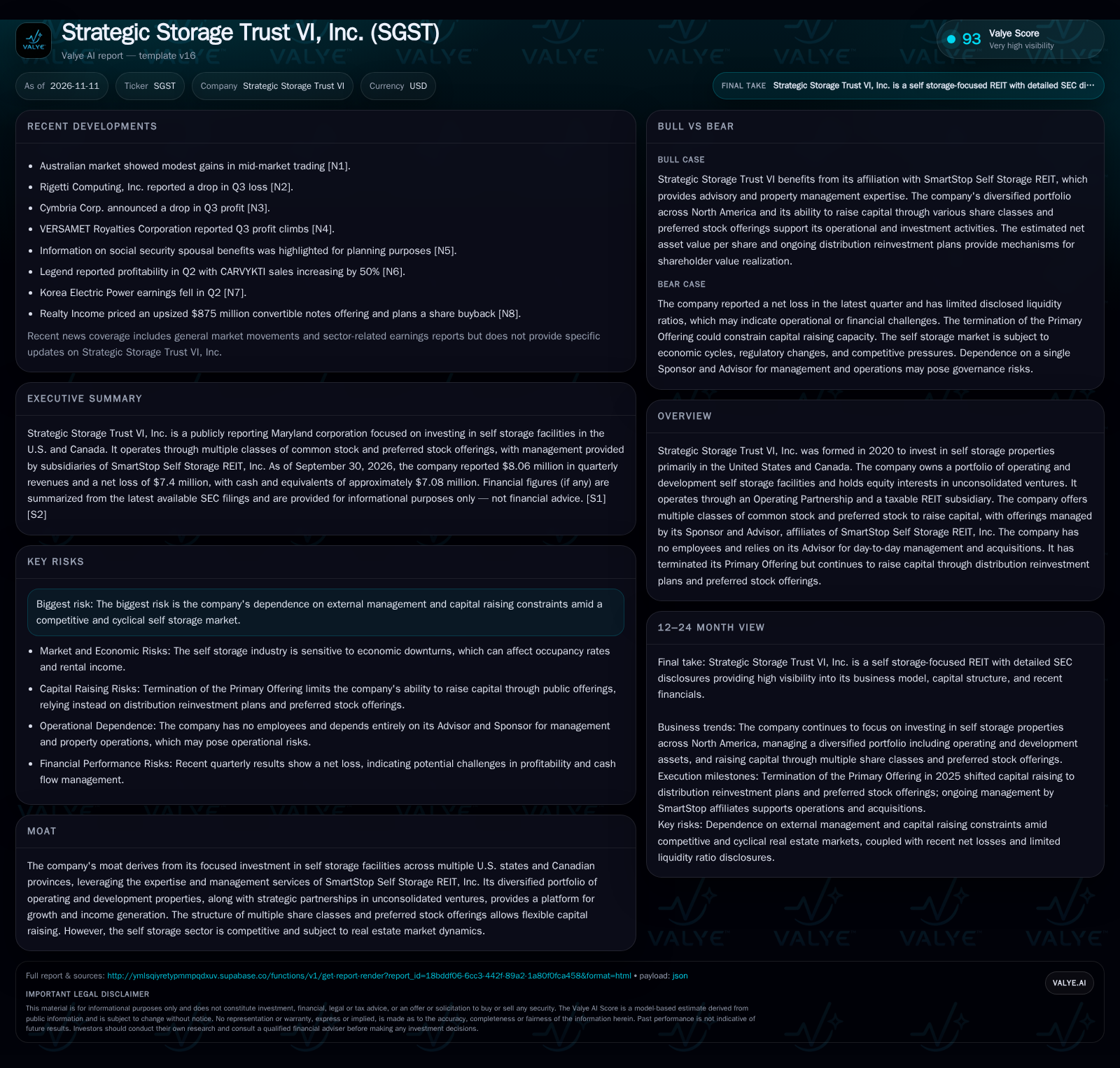
Strategic Storage Trust VI owns 24 operating self storage properties and two development sites across the U.S. and Canada, with additional joint ventures in Canada. After ending its primary equity offering, the company now relies on preferred stock and reinvestment plans for capital. The latest quarter showed $8.06M revenue but a $7.4M net loss, and cash stood at $7.08M. [S1] [S2]
Strategic Storage Trust VI, Inc. (SGST) sits at the intersection of property investment and capital-market innovation in the self storage sector. With a multi-state and cross-border portfolio, the company has grown its asset base through a mix of operating and development properties, alongside joint ventures. However, after closing its primary equity offering, SGST now leans on preferred stock and distribution reinvestment to fund its activities—just as persistent net losses and opaque liquidity measures call into question the durability of its expansion model, especially given its total reliance on third-party management from SmartStop Self Storage REIT affiliates.
Performance and Capital Structure: Growth Highlights and Emerging Pressures
Strategic Storage Trust VI owns 24 operating self storage properties spanning seven U.S. states and three Canadian provinces, with an additional two properties under development. The company also holds 50% equity stakes in five unconsolidated Canadian real estate ventures, indicating an appetite for both direct ownership and joint-venture models. As of September 30, 2026, SGST posted $8.06 million in quarterly revenue but incurred a net loss of $7.4 million, with cash on hand totaling $7.08 million. Notably, the termination of its primary equity offering in May 2025 has shifted capital-raising efforts to preferred stock and distribution reinvestment plans. [S1] [S2]
Economics of Self Storage: Operating Leverage, Capital Requirements, and Growth Costs
The core business model of SGST is rooted in acquiring, developing, and operating self storage facilities—a sector characterized by relatively high gross margins, but also significant upfront capital requirements for property acquisition, development, and improvement. Revenue streams are primarily driven by occupancy rates, rental pricing, and ancillary services such as insurance or moving supplies, though the report does not break down these components. Fixed costs—such as property taxes, insurance, and contracted management/advisory fees—create operating leverage, meaning incremental occupancy and pricing gains can disproportionately affect profitability.
The company’s recent net losses suggest current revenues are insufficient to absorb fixed costs and management fees, likely exacerbated by development-stage properties that have yet to contribute income. With the primary equity offering closed, SGST’s ability to fund further growth or cover operating shortfalls now depends on preferred stock offerings and its distribution reinvestment program. These channels may be less elastic and more expensive than public equity, potentially increasing the cost of capital and limiting large-scale expansion unless operating performance improves.
SGST’s reliance on its Advisor and Sponsor—affiliates of SmartStop—means management fees and incentive structures are likely tied to asset growth and performance, but the absence of direct employees could reduce overhead and streamline decision-making. However, this also concentrates operational risk and potentially weakens cost discipline, as external advisors may be less incentivized to drive down expenses than an internal team.
Competitive Positioning: Scale, Sponsor Links, and Market Influences
SGST’s access to property management, acquisition expertise, and operational infrastructure through its relationship with SmartStop Self Storage REIT provides a competitive advantage compared to smaller, stand-alone operators. This affiliation may enable better deal sourcing, operational best practices, and brand recognition, especially in fragmented regional markets. The company’s diversified geographic footprint, spanning multiple U.S. states and Canadian provinces, also insulates it from localized market shocks and enables portfolio balancing.
However, the self storage sector is marked by low barriers to entry, with local and regional operators frequently competing on price and service. Large national REITs command advantages in marketing, technology integration, and cost of capital, making it challenging for mid-sized entities like SGST to compete unless they can leverage their sponsor’s scale or carve out specialized niches. The company’s joint ventures in Canada suggest a willingness to share risk and tap local knowledge, but these structures can dilute returns and complicate governance.
The competitive environment is further shaped by the cyclical nature of real estate demand. Economic downturns can pressure occupancy and pricing, while periods of oversupply in certain markets may compress margins. Without proprietary technology, unique customer loyalty programs, or significant scale, SGST’s moat is largely dependent on sponsor relationships and diversified asset selection.
Value Creation Potential from Occupancy Improvements and Sponsor Synergies
A favorable scenario for SGST would see occupancy rates and rental pricing improve across its portfolio, especially as development properties stabilize and begin contributing cash flow. If integration with SmartStop’s national platform delivers cost efficiencies—such as centralized procurement, technology-enabled revenue management, or enhanced marketing reach—the company could achieve margin expansion even without rapid portfolio growth.
Success in raising capital through preferred stock and reinvestment plans would further support selective acquisitions or property upgrades, compounding cash flow growth. Over time, a shift to consistent profitability could validate the sponsor-driven model and attract additional capital, especially if the company can demonstrate a return to positive net income and growing cash distributions.
Confirmation of this scenario would include rising occupancy and rental rates (if disclosed), reduced net losses or a swing to net profit, and successful absorption of new developments into the operating portfolio. Evidence of cost discipline and improved operating margins, as well as continued access to preferred equity capital, would further support the upside case.
Maintaining Operations Under Capital Limitations and Margin Challenges
The most plausible near-term scenario is that SGST maintains its current asset base and operating structure, with modest improvements in revenue as new properties mature but continued pressure on margins due to fixed costs and external management fees. Capital raising will likely remain challenging, with preferred stock and reinvestment plans providing incremental but limited funding. This may restrict the pace of new acquisitions and require prioritization of internal asset optimization over expansion.
Profitability could remain elusive until occupancy and pricing improve materially or the company finds ways to reduce external advisory costs.
Evidence supporting this scenario would include stable or slowly improving revenue, continued net losses or breakeven results, and no significant increase in portfolio size. Reports of successful refinancing or cost containment would indicate incremental progress, while any large capital raise or shift in management structure could alter the trajectory.
Risks from Operational Stress and Funding Shortfalls
Dependence on SmartStop for management creates concentration risk; any disruption in this relationship or misalignment of incentives could exacerbate operational challenges. Additionally, if development projects are delayed or fail to lease up as projected, carrying costs would further erode margins. In a severe scenario, the company could be forced to sell assets at unattractive prices, suspend distributions, or seek costly emergency financing.
Evidence of downside risk would include declining revenue, widening net losses, inability to raise capital at reasonable terms, or asset sales below book value. Any indication of governance disputes with the sponsor or advisor, or deterioration in portfolio occupancy (if disclosed), would further validate this scenario.
Developments That May Alter Strategic Storage VI’s Outlook
Occupancy rates and average rental pricing (if disclosed): Rising figures would signal improving asset utilization and pricing power.
Operating margin trends: Widening margins would indicate successful cost control or revenue growth; narrowing margins would suggest ongoing fixed-cost pressure.
Net income progression: Movement toward profitability would test whether the current model can scale efficiently.
Preferred stock issuance and distribution reinvestment inflows: Sustained or growing capital inflows would confirm funding stability.
Expansion or contraction of the property portfolio: New acquisitions or development completions would validate ongoing growth capacity; asset sales or project delays could signal stress.
Changes in management fee structure or advisory agreements: Adjustments here would indicate efforts to align incentives or control costs.
Sponsor relationship developments: Any change in the affiliation with SmartStop could materially impact management quality and strategic direction.
Disclaimer: This is research-only, informational analysis and not investment advice. It may include AI-generated interpretation and general industry context. Always verify important details using primary sources.

Comments