
LENSAR, Inc.: Post-Merger Termination, Commercial Execution, and the Economics of Robotic Cataract Surgery
LENSAR’s ALLY System targets premium, out-of-pocket cataract surgery with advanced robotics, but faces heightened business risk after the collapse of its Alcon merger. The company’s ability to scale placements, manage cost structure, and drive adoption amid reimbursement barriers and competitive pressure will define its financial trajectory.
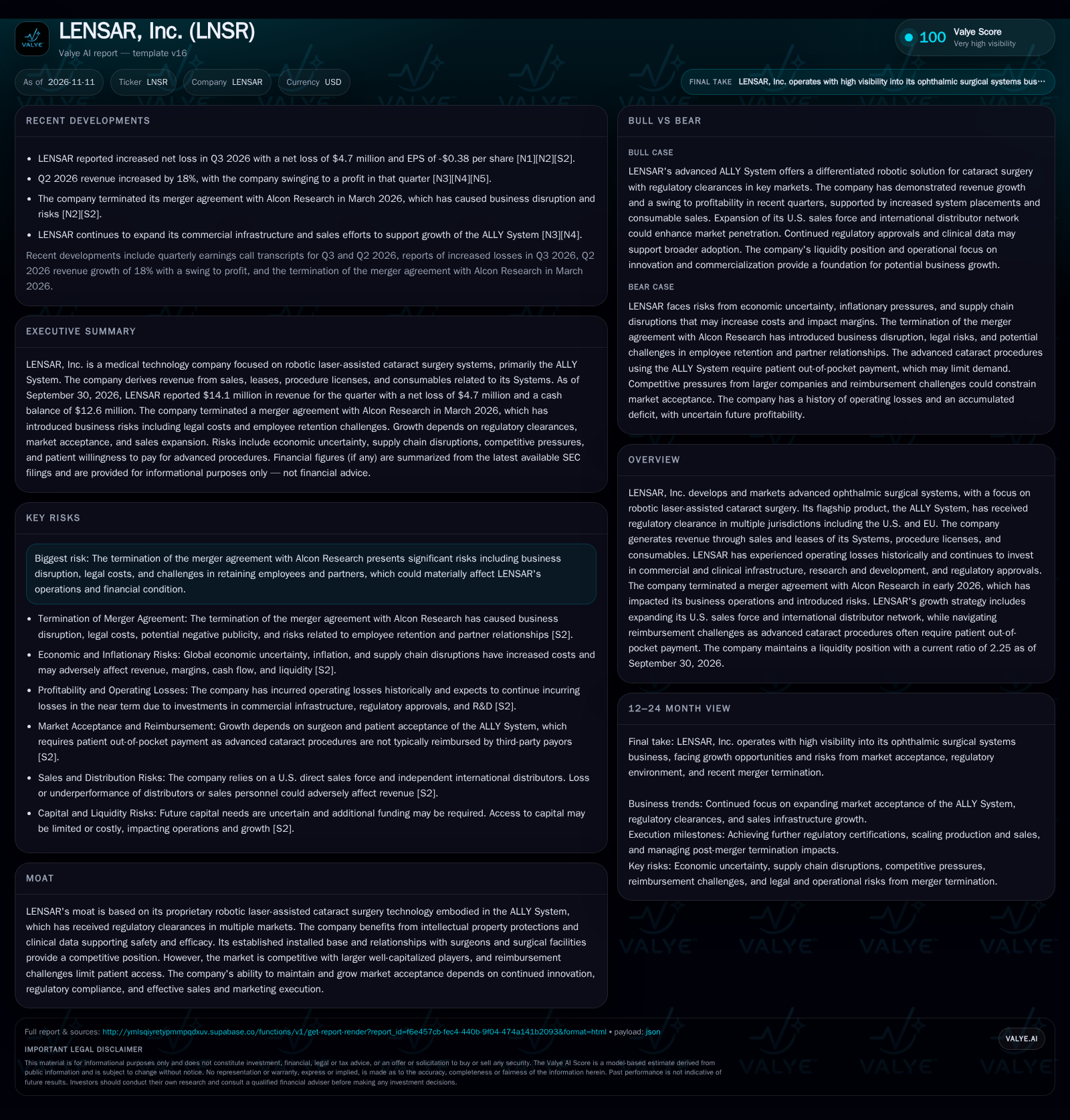
LENSAR specializes in robotic laser-assisted cataract surgery with the ALLY System, which is FDA-cleared and certified in multiple markets. The company is operating at a loss, with Q3 2026 revenue of $14.1 million and a net loss of $4.7 million, and recently terminated a merger with Alcon, introducing business disruption and legal risk. Future performance hinges on expanding system placements, increasing consumable usage, and overcoming patient-pay barriers in a competitive, innovation-driven market. [S2] [N1] [N2]
LENSAR, Inc. is navigating a pivotal period as it seeks to scale adoption of its advanced ALLY robotic cataract laser system in the premium segment of ophthalmic surgery. Following the abrupt termination of its merger with Alcon in March 2026, the company faces heightened legal and operational risks, while financial results reflect the ongoing challenge of reaching profitability. With a business model hinging on capital equipment sales, recurring consumables, and procedure licenses—all in a market where patients often pay out-of-pocket—LENSAR’s future now depends on its ability to drive broader acceptance, efficiently expand its commercial footprint, and withstand intensifying competition from larger medtech players. [S2] [N2]
Recent Results, Merger Fallout, and the State of the ALLY Platform
LENSAR posted $14.1 million in revenue and a net loss of $4.7 million for Q3 2026, continuing its history of operating losses and bringing its accumulated deficit to $142.4 million as of September 30, 2026. This follows a Q2 2026 where revenue grew 18% and the company briefly swung to profit, highlighting volatility in both topline growth and bottom-line performance. [S2] [N1] [N2] [N3]
The March 2026 termination of the Alcon Research merger introduced new business risks: disruption in operations, potential legal costs, challenges to employee retention, and negative publicity. These factors could affect execution in sales, product development, and partner relationships at a critical juncture. [S2] [N2]
The ALLY System, LENSAR’s flagship robotic laser platform for cataract surgery, remains the company’s primary growth engine. It is FDA-cleared and certified in the EU, India, Taiwan, South Korea, and other markets, providing a regulatory foundation for international expansion. [S2]
Revenue Streams, Cost Structure, and the Role of Recurring Consumables
LENSAR generates revenue through three main channels: (1) sale or lease of the ALLY System; (2) sales of disposable patient interface device (PID) kits required for each procedure; and (3) procedure licenses, which can be purchased individually or as part of a subscription package. This structure allows for a blend of upfront capital sales and recurring revenue from consumables and licenses. [S2]
The economics of the business hinge on system placements driving a growing installed base, which in turn fuels recurring consumable and license revenue. However, the high capital cost of the ALLY System and lack of broad reimbursement for advanced cataract procedures mean growth is tightly linked to the willingness and ability of patients to pay out-of-pocket, and to the commercial effectiveness of LENSAR’s direct and distributor sales teams.
Operating leverage could be significant if LENSAR can scale placements and increase procedure volumes per system. However, fixed costs related to R&D, regulatory compliance, and sales infrastructure are high, and the company’s history of operating losses suggests current scale is insufficient to cover these costs. The capital intensity of medtech commercialization, combined with the competitive need for ongoing product innovation, creates persistent funding needs and pressure to demonstrate accelerating adoption.
Technology, Distribution, and the Challenge from Larger Medtech Rivals
LENSAR’s competitive position is built on proprietary robotic laser technology, regulatory clearances, and a growing clinical base for the ALLY System. Intellectual property and integration with surgeon workflows are potential differentiators. However, the market for advanced cataract surgery devices is highly competitive, with large, well-capitalized incumbents offering alternative laser platforms and broad product portfolios.
The collapse of the Alcon merger may heighten competitive risks, as LENSAR now competes directly with Alcon and other major medtech firms without the benefit of a partner’s distribution scale or marketing muscle. The company relies on a direct U.S. sales force and independent international distributors; the performance, stability, and retention of these channels are pivotal but could be vulnerable to disruption or competitive poaching.
Substitution risk remains nontrivial: traditional phacoemulsification, lower-cost manual procedures, and alternative surgical technologies may all limit the pace of ALLY adoption, especially given the out-of-pocket nature of many premium procedures.
Surgeon Adoption and International Expansion Drive Operating Leverage
The most favorable pathway is one where LENSAR demonstrates accelerating ALLY placements, with each new system driving a predictable stream of consumable and license revenue as procedure counts rise. Expanded regulatory approvals and successful clinical outcomes could persuade more surgeons and surgical centers to adopt the platform—especially if LENSAR’s robotic workflow is perceived as meaningfully improving visual outcomes or procedural efficiency compared to alternatives.
International distributor expansion, especially in markets with growing demand for premium surgical options, could further amplify growth. Evidence for this scenario would include consecutive quarters of increasing system sales, rising consumables revenue, and growing average procedures per system, alongside stable or improving gross margins as scale improves.
Gradual Installed Base Growth Balanced by Patient-Pay and Cost Headwinds
The most plausible trajectory is a slow but steady expansion of the installed ALLY base, with recurring consumable revenue rising in line with modest increases in procedure volume. Out-of-pocket payment requirements and economic uncertainty will likely cap the pace of adoption, and competitive pricing or marketing by larger device companies may limit LENSAR’s ability to expand margins.
Operating losses could persist until system placements reach a critical mass, at which point higher utilization could deliver operating leverage. Confirmation would come from sequential growth in system placements, rising consumable attachment rates, and progress toward breakeven at the operating level. A reversal—such as declining placements or distributor churn—would challenge this scenario.
Merger Fallout, Competitive Pressure, and Stagnant Adoption Threaten Sustainability
A negative outcome could unfold if the Alcon merger fallout leads to employee attrition, sales channel instability, or legal and reputational distractions that disrupt commercial execution. In this scenario, system placements stall or decline, consumable usage plateaus, and the company is forced to spend more to defend or reestablish key relationships.
Heightened competitive actions—such as aggressive pricing, bundled offerings from larger device firms, or new technology launches—could further erode LENSAR’s market position. The inability to scale placements or offset fixed costs would extend operating losses, potentially requiring dilutive capital raises or restructuring. Evidence would include declining or flat revenue, increased legal and SG&A expenses, and negative distributor or customer commentary.
Benchmarks for LENSAR’s Next Phase: Commercial Momentum, Channel Stability, and Adoption Metrics
Quarterly system placements and installed base growth—if disclosed—would directly test whether LENSAR can scale its ALLY platform.
Trends in consumable (PID kit) and procedure license revenue, as a proxy for utilization and recurring revenue resilience.
Average procedure volume per system, which would clarify the intensity of usage and support for recurring revenue.
Gross margin movement, indicating whether scaling is delivering operating leverage or being offset by competitive pricing and input costs.
Sales force and distributor retention, particularly in the wake of the Alcon merger termination.
Legal expense trends and disclosure of any material litigation or settlement costs stemming from the merger fallout.
R&D spend and cadence of new feature launches or regulatory approvals, as evidence of continued innovation and product differentiation.
Any commentary or data on patient willingness to pay, procedure mix, or emerging reimbursement developments, which could change the addressable market or adoption curve.
Disclaimer: This is research-only, informational analysis and not investment advice. It may include AI-generated interpretation and general industry context. Always verify important details using primary sources.

Comments