
Capstone Companies: Can a Strategic Reset and HFS Ambition Overcome Structural Funding and Execution Hurdles?
Capstone Companies has exited legacy product lines and now sits at a strategic crossroads, relying on external funding and CEO sector expertise as it attempts to enter the health, fitness, and social activities market. With no revenue-generating business, a recent suspension of development activity, and persistent going-concern risk, the company’s future depends on its ability to secure both capital and a viable business model.
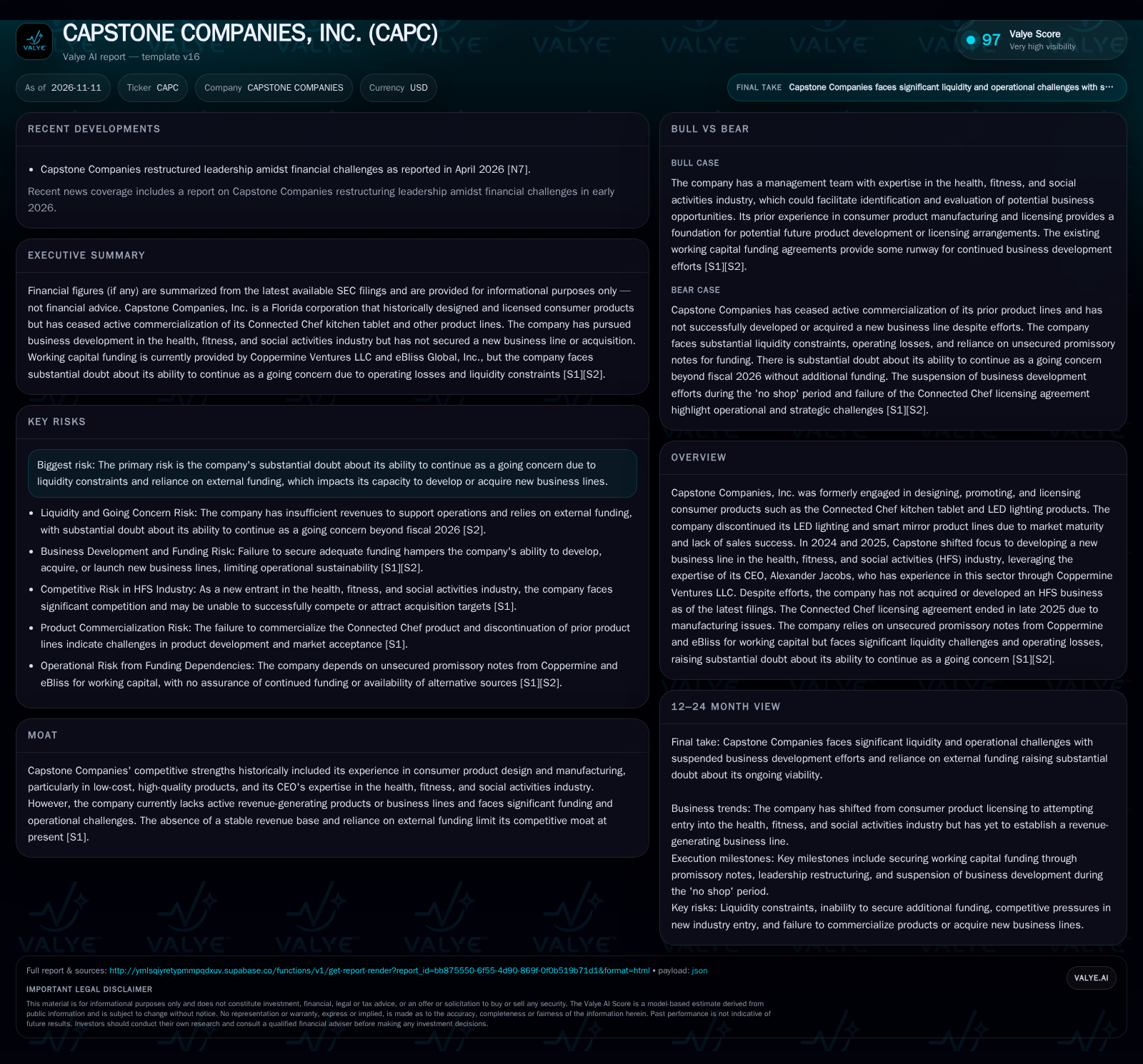
Capstone Companies has discontinued all legacy consumer products and failed to commercialize its Connected Chef tablet, leaving it without active revenue streams. Its pivot to the health, fitness, and social activities sector has stalled, with business development suspended during a 'no shop' period tied to a funding agreement. Heavy reliance on promissory notes and a severe liquidity crunch raise substantial doubt about the company’s ability to continue as a going concern absent a transformative deal or new capital injection. [S1] [S2]
Capstone Companies stands at a precarious inflection point. Having exited its legacy consumer electronics business and failed to generate revenue from the Connected Chef product, Capstone is now a shell with no active commercial operations. Management’s attempted pivot into the health, fitness, and social activities sector remains unrealized, with efforts frozen during a funding-related 'no shop' period. The company’s existence hinges on external working capital infusions and the prospect of a transformative acquisition or business launch.
Strategic Crossroads: Legacy Exit and Stalled HFS Entry Define Capstone’s Present State
As of late 2025, Capstone Companies has discontinued all legacy product lines, including LED lighting and smart mirror products, due to declining sales and lack of commercial success. The company’s latest attempt to generate revenue—licensing the Connected Chef kitchen tablet—collapsed in November 2025 when the contract manufacturer declined production, resulting in zero license revenue for the year. Capstone’s strategic pivot toward the health, fitness, and social activities (HFS) industry has not yielded any acquisition or operational business, and all development efforts have been suspended during a 90-day 'no shop' period linked to a March 2026 promissory note with eBliss Global. [S1] [S2]
Funding Reliance and the Challenge of Building a Profitable HFS Platform
Capstone’s business model is currently in abeyance: with no active products or services, the company is entirely dependent on external financing through unsecured promissory notes from Coppermine Ventures and eBliss Global, both accruing 7% simple annual interest. This funding covers basic operating expenses but does not support growth or acquisition activity. The company’s fixed costs are minimal, but negative operating leverage is acute—no revenue is available to offset even modest overhead. The economics of entering the HFS sector—whether via acquisition, development, or partnership—would typically require upfront capital for dealmaking, integration, and initial operational ramp, followed by variable costs tied to service delivery or product sales. In the HFS space, scale and repeat usage are critical for margin expansion; customer acquisition costs can be high, and retention is essential for recurring revenue models. Without a committed capital base or a proven product-market fit, Capstone’s margin structure and working capital needs will remain speculative. Any future business will need to demonstrate rapid scaling potential and a path to positive operating cash flow to overcome the current structural deficit.
Entrant Disadvantage: Navigating a Crowded HFS Market Without a Platform or Brand
Capstone faces a steep uphill battle in the HFS industry. The sector is characterized by entrenched incumbents (e.g., fitness clubs, digital wellness platforms, social activity apps) and a constant influx of specialized startups. Barriers to entry include established customer loyalty, high switching costs for recurring membership or subscription models, and the need for differentiated technology or service offerings. Capstone lacks both a proprietary platform and an existing user base, making customer acquisition expensive and uncertain. While the CEO’s experience in HFS (via Coppermine Ventures) could facilitate opportunity sourcing or deal evaluation, the company’s operational and financial constraints limit its ability to compete for attractive targets or to invest meaningfully in organic product development. Its historical strengths in low-cost consumer product manufacturing are not directly transferable to the relationship-driven and brand-centric economics of the HFS sector. Without a distinctive value proposition or access to capital for rapid scaling, Capstone’s competitive position is tenuous.
What Would a Turnaround Look Like? Pathways to Viable HFS Market Entry
A favorable scenario for Capstone would involve leveraging its CEO’s HFS sector connections to identify a distressed or overlooked acquisition target—such as a small chain of fitness studios, a niche wellness technology startup, or a social activity platform with latent user engagement. If Capstone could secure bridge funding or a strategic partner to finance the acquisition, it might be able to rebrand and relaunch the target, using operating synergies or cross-marketing to accelerate revenue generation. Early signs of viability would include a completed acquisition or partnership, evidence of a scalable business model with positive unit economics, and a funding package sufficient to support at least 12–18 months of ramp time. Confirmation would come from disclosed customer acquisition metrics, recurring revenue growth, and positive operating cash flow in subsequent quarters. Falsification would be the continued absence of a business launch, inability to raise new capital, or failure to close a deal by the end of the current funding runway.
Stalled in Neutral: Capstone’s Most Likely Outcome Without a Transformative Deal
The most plausible outcome, absent a major catalyst, is that Capstone remains in a holding pattern through the end of its current funding agreements. During the 'no shop' period, business development is paused, and after it lapses, the company resumes attempts to source deals or partnerships in the HFS space—still hampered by limited capital, lack of revenue, and a thin pipeline. Operating losses persist, and the company’s ability to meet basic obligations becomes increasingly dependent on new promissory notes or equity infusions, which may be dilutive or unattractive to current stakeholders. The base scenario is confirmed by continued operating losses, non-existent or minimal business development progress, and lack of disclosure regarding new funding or definitive agreements. An upside deviation would require news of a closed acquisition or a binding partnership that brings revenue and external capital.
Funding Cliff and Wind-Down Risk: When Inertia Meets Insolvency
If Capstone is unable to secure additional funding or fails to launch a revenue-generating business before the expiration of its current promissory notes, the likely outcome is a wind-down or bankruptcy proceeding. Warning signs would include default on existing notes, further deterioration of the cash position, and explicit auditor or management statements regarding imminent insolvency. The company could attempt to sell any remaining assets or intellectual property, but with no active business lines or valuable IP, recovery for stakeholders would likely be minimal. Confirmation of this scenario would come from 8-K filings announcing default, delisting notices, or public statements about liquidation or restructuring efforts.
Milestones and Disclosures That Will Determine Capstone’s Fate
Announcement of a definitive agreement (acquisition, partnership, or joint venture) in the HFS sector, with details on deal structure and expected financial contribution.
Disclosure of new funding commitments—either debt or equity—that materially extend the company’s operating runway beyond fiscal 2026.
Filing of 8-Ks or quarterly reports showing the launch of an active revenue-generating business line, with initial customer or user metrics if disclosed.
Updates on the expiration or renegotiation of the eBliss Global 'no shop' period and any resumption of business development activity.
Changes in the company’s leadership or board that could signal a shift in strategic direction or a restructuring of the business.
Explicit going concern disclosures in future SEC filings, and any auditor updates on the company’s financial viability.
If disclosed, customer acquisition cost, retention rates, or early margin data for any new HFS business line—these would help test the economic feasibility of the pivot.
Evidence of cost containment, cash burn rates, or operational restructuring to preserve remaining capital in the absence of new revenue.
Disclaimer: This is research-only, informational analysis and not investment advice. It may include AI-generated interpretation and general industry context. Always verify important details using primary sources.

Comments