
Acme United’s Post-Acquisition Momentum: Can Sales Growth and Strategic Expansion Deliver Durable Gains?
Acme United Corp’s 18% net sales jump in Q3 2026 and the recent My Medic acquisition highlight both momentum and execution risk. With strong current ratios and above-expectation earnings, the company faces the challenge of integrating its latest purchase while defending margins in an increasingly competitive landscape.
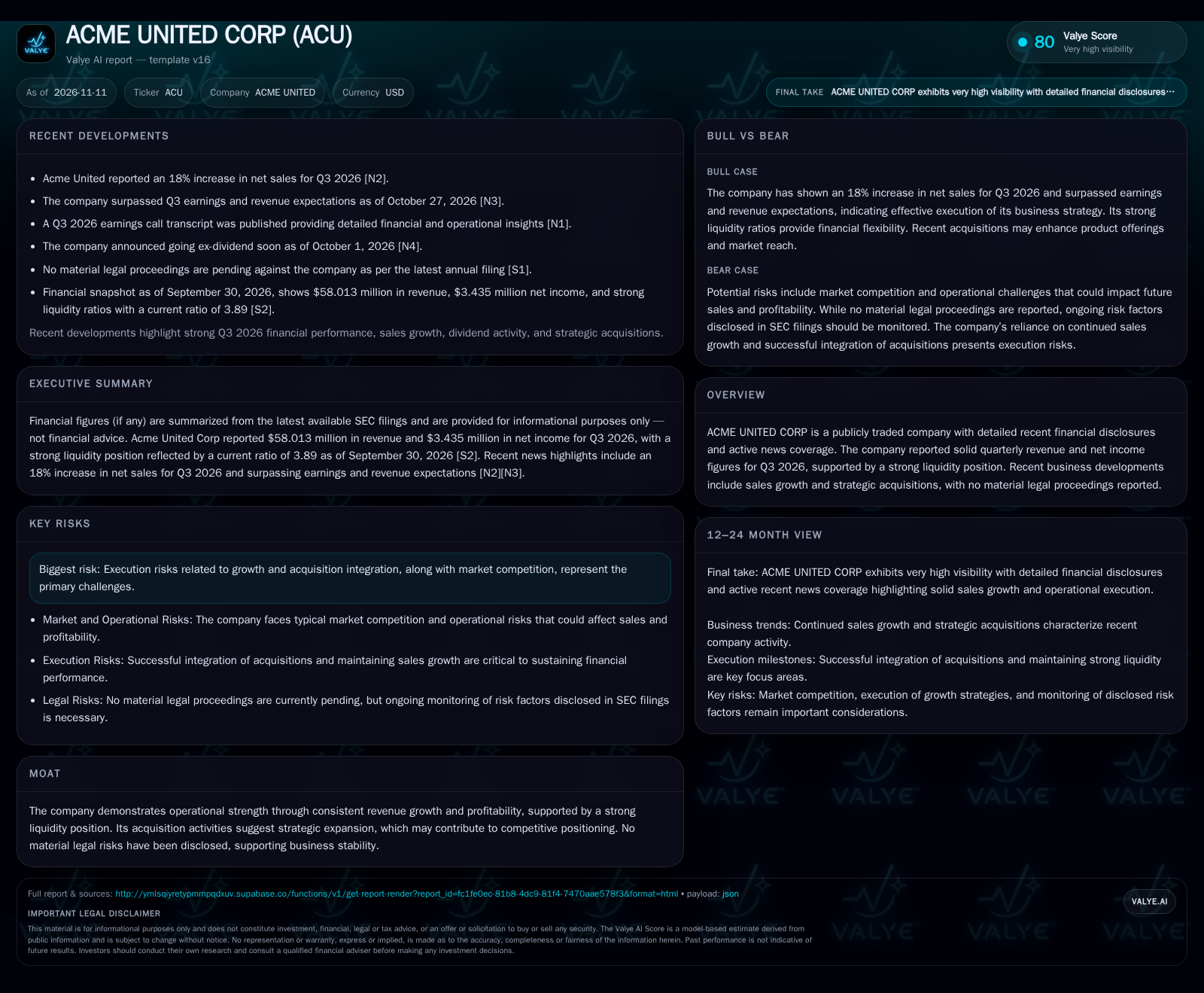
Acme United’s Q3 2026 results show an 18% sales increase and earnings outperformance, bolstered by a reported current ratio. The $18.5 million My Medic acquisition marks a push into the direct-to-consumer tactical medical market, potentially broadening the company’s revenue base. The central question is whether Acme can sustain growth and profitability as it integrates new assets and navigates industry competition.
Acme United Corp enters late 2026 with clear momentum, posting an 18% increase in Q3 net sales and surpassing both earnings and revenue expectations. The company’s acquisition of My Medic, a direct-to-consumer supplier of tactical medical products, signals a strategic expansion into higher-growth, potentially higher-margin categories. However, the integration of new assets and the need to defend profitability in a competitive and inflationary environment mean that Acme’s ability to sustain its current trajectory is not guaranteed. The next phase will test both its operational discipline and its capacity to turn headline revenue growth into durable shareholder value.
Recent Financial Performance and Strategic Moves Reshape Acme United’s Trajectory
Acme United delivered an 18% year-over-year increase in Q3 2026 net sales, rising to $58.013 million, while net income reached $3.435 million and diluted EPS was $0.80 [S2] [N2]. This marks a period of robust top-line momentum, with the company also exceeding analyst expectations for both revenue and earnings [N3]. The company reported cash and liquidity metrics for the period; these figures do not by themselves establish operating runway, investment capacity, financial flexibility, or financing capacity. [S2]
A pivotal recent development is the January 2026 acquisition of My Medic for $18.5 million, of which $14.4 million was paid in cash at closing and the remainder subject to revenue milestones and indemnification holdbacks [S2]. My Medic’s direct-to-consumer tactical and emergency response product line expands Acme’s portfolio and may help diversify revenue streams. No material legal proceedings are pending, and the company recently announced an ex-dividend event [N4] [S1].
The Mechanics of Growth: Revenue Drivers, Margin Levers, and Capital Allocation
Acme United’s business model is grounded in product sales across consumer, industrial, and healthcare verticals, with a growing emphasis on branded and specialized offerings. The 18% year-over-year sales increase for Q3 2026 likely reflects both organic growth and incremental revenue from the My Medic acquisition, although the precise contribution from each is not disclosed [S2].
Revenue expansion in this sector can be driven by volume (unit growth), pricing (ability to pass through inflation or create premium categories), and mix (shifting toward higher-margin or branded products). The My Medic portfolio, focused on tactical and emergency response products, typically commands higher average selling prices and may carry better gross margins than more commoditized segments. However, direct-to-consumer channels often entail increased marketing spend and fulfillment complexity, which could dilute operating leverage if not managed efficiently.
Acme’s capital deployment—evidenced by the $18.5 million My Medic deal—suggests a willingness to invest in product adjacencies. [S2]
A critical aspect of Acme United’s growth strategy hinges on its ability to optimize capital allocation between organic initiatives and acquisitions like My Medic. The balance between reinvesting in existing product lines and funding new ventures requires rigorous prioritization, especially given the potential capital intensity of scaling direct-to-consumer channels. Efficient use of working capital and disciplined investment in marketing and technology platforms will be essential to avoid diluting returns. Furthermore, the company’s margin levers depend not only on product mix but also on operational scalability; as the product portfolio diversifies, maintaining procurement efficiencies and cost controls becomes increasingly complex yet vital for sustaining profitability.
Defending Market Share in a Fragmented and Evolving Industry Landscape
Acme United operates in highly competitive segments where brand recognition, distribution reach, and product innovation are key differentiators. The tactical and emergency response market, into which Acme is expanding via My Medic, is fragmented but growing, attracting both specialized and diversified players.
Competitive threats include established branded competitors, low-cost importers, and e-commerce-native entrants. The shift toward direct-to-consumer sales may improve Acme’s customer intimacy and data access, but also exposes it to rapidly evolving consumer expectations and digital marketing arms races. The ability to leverage existing supply chain infrastructure and cross-sell across verticals could be a source of advantage, but integration missteps or misaligned channel strategies may erode gains.
Technology substitution—such as digital-first emergency response solutions or smart medical devices—could also reshape demand patterns, requiring ongoing product innovation and potentially new capabilities.
Unlocking Value Through Seamless Integration and Category Expansion
If Acme United successfully integrates My Medic, capturing synergies in procurement, distribution, and marketing, the company could accelerate both revenue and margin expansion. The direct-to-consumer channel may enable richer customer data, faster product iteration, and higher average order values, supporting premium pricing and brand loyalty.
Confirmation of this scenario would be visible in sustained double-digit sales growth, rising gross and operating margins, and evidence of cross-selling or new product launches leveraging the My Medic platform. Additional bolt-on acquisitions or organic innovation in adjacent categories could further amplify growth.
Falsification would be signaled by stalled sales growth, margin compression, or signs of customer/channel conflict as legacy and acquired businesses overlap or fail to deliver expected synergies.
Integration Brings Growth but Also Complexity: The Most Likely Outcome
The most plausible path is that Acme United sees continued mid-to-high single-digit revenue growth, with the My Medic acquisition contributing incrementally but requiring several quarters for full integration. Margins may fluctuate as the company invests in marketing, logistics, and systems to support the expanded product set.
A base scenario would be confirmed by stable or gradually improving operating margins, effective inventory management, and consistent cash generation. Disclosures around acquisition performance, customer retention, and new product adoption would bolster confidence.
Falsification would occur if integration costs consistently outpace synergies, or if organic growth slows due to competitive encroachment or execution missteps.
Execution Risks and Margin Erosion Could Derail Recent Gains
The adverse scenario centers on integration challenges with My Medic—such as cultural misalignment, supply chain disruption, or unexpected customer churn—leading to cost overruns and margin pressure. A failure to realize planned synergies, or an inability to defend pricing amid intensifying competition, could stall or reverse sales growth.
Confirmation would come from declining gross and operating margins, negative working capital trends, or repeated downward revisions to revenue and earnings guidance. Unexpected inventory write-downs or cash burn could also indicate deeper operational problems.
External shocks—such as supply chain disruptions, inflationary spikes, or regulatory changes—could exacerbate these risks, especially if Acme’s response is slow or miscalibrated.
Milestones and Metrics That Will Clarify Acme United’s Post-Acquisition Thesis
Quarterly disclosure of incremental revenue and profitability attributable to My Medic, if provided, would clarify the acquisition’s impact on overall company performance.
Gross and operating margin trends: Sustained improvement would suggest successful integration and pricing power; declines could signal execution issues or adverse mix shifts.
Direct-to-consumer channel metrics, such as customer acquisition cost, repeat purchase rates, and digital marketing ROI, would help gauge the viability of the new sales model.
Inventory turnover and working capital management: Efficient handling is critical as product and channel complexity increases post-acquisition.
Any updates to guidance or management commentary regarding acquisition synergies, integration milestones, or future M&A appetite.
Competitive developments, such as new product launches or pricing moves by peer companies in the tactical/emergency response and core segments.
External risk factors: Watch for changes in tariff regimes, supply chain disruptions, or significant swings in input costs that could impact profitability.
Disclaimer: This is research-only, informational analysis and not investment advice. It may include AI-generated interpretation and general industry context. Always verify important details using primary sources.

Comments