
Lake Shore Bancorp After Conversion: Growth, Competition, and the Next Phase in Community Banking
Lake Shore Bancorp’s mutual-to-stock conversion and record recent earnings mark a pivotal moment for the Western New York community bank. With new capital, a diversified loan book, and the end of regulatory restrictions, the company faces both opportunity and intensified competition as it seeks to balance local strength with the realities of a rapidly evolving financial landscape.
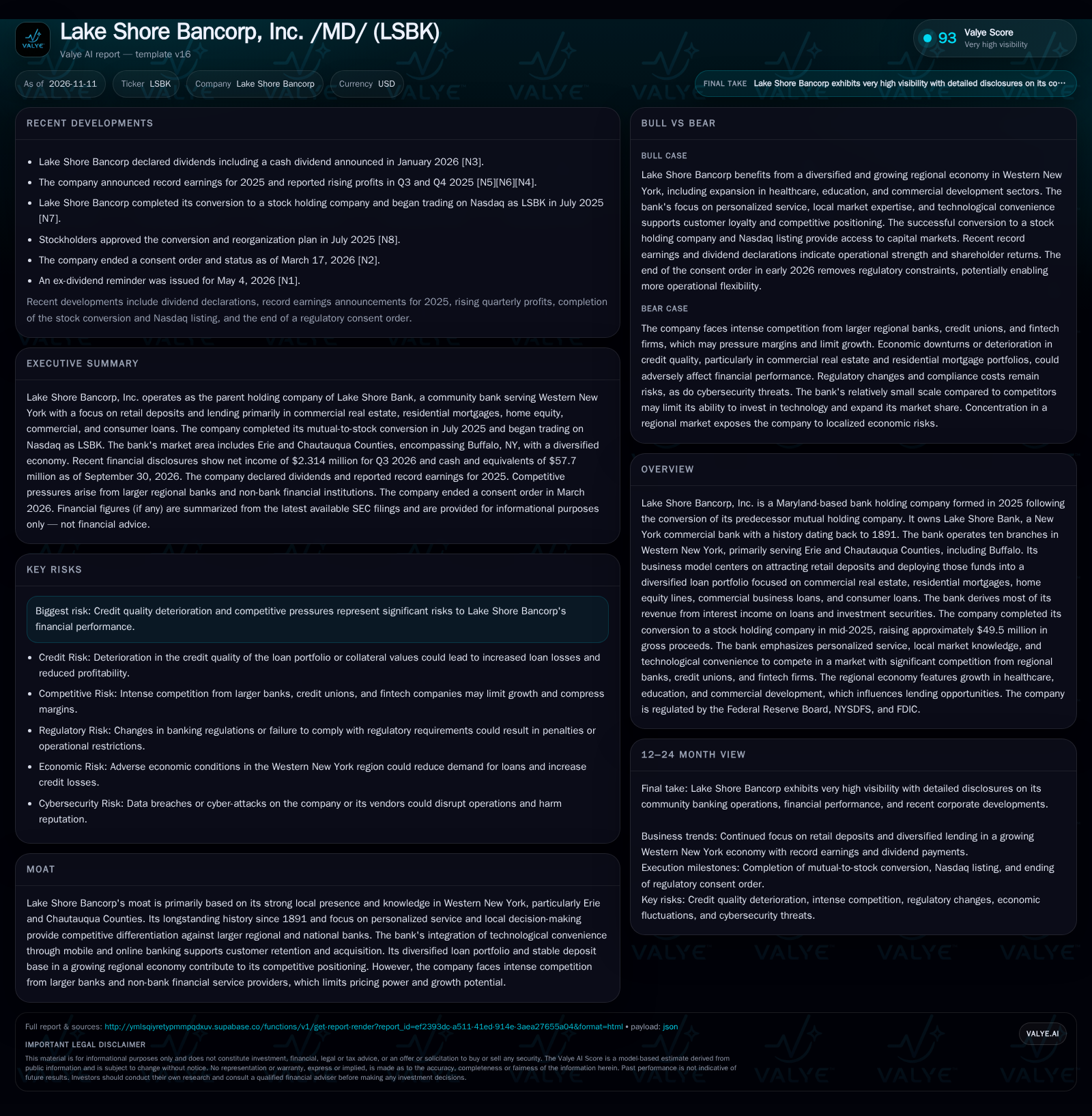
Lake Shore Bancorp, now publicly traded following its 2025 mutual-to-stock conversion, reported record profits and a reported liquidity position as of Q3 2026. The conclusion of a regulatory consent order has removed operational constraints, positioning the bank to leverage its local relationships and focus on commercial and residential lending. However, competition from larger banks and non-traditional lenders, plus regional economic dependence, remain central challenges for long-term growth and margin sustainability. [S1] [S2] [N2] [N5] [N6] [N4]
Lake Shore Bancorp’s transition from a mutual to a stock holding company, capped by its Nasdaq debut and $49.5 million capital raise, has redefined its growth potential and risk profile. The bank, with roots dating back to 1891, now operates in a highly competitive Western New York market, leveraging local expertise and a diversified loan book. Recent record earnings and the end of a regulatory consent order suggest a new phase of operational flexibility. Yet, as it invests proceeds and adapts to evolving customer expectations, its ability to sustain profitability and defend market share against larger and digital-first competitors will be the real test.
A Post-Conversion Snapshot: Capital, Earnings, and Regulatory Reset
Lake Shore Bancorp’s most material current developments are its 2025 mutual-to-stock conversion, which raised approximately $49.5 million in gross proceeds and initiated trading on Nasdaq under ticker LSBK, and its exit from a regulatory consent order as of March 2026. The bank reported net income of $2.314 million for Q3 2026, with cash and cash equivalents of $57.7 million at quarter-end. The loan portfolio stood at $557 million at 2025 year-end, reflecting ongoing lending activity across commercial real estate, residential mortgages, and consumer segments. These milestones matter because they have both recapitalized the balance sheet and removed regulatory constraints, creating a window for strategic growth, product expansion, or defensive repositioning in a competitive market. [S1] [S2] [N2] [N7]
How Lake Shore’s Community Bank Model Translates Deposits Into Profits
Lake Shore Bancorp’s business model rests on gathering retail deposits in Western New York and lending those funds primarily into commercial real estate, residential mortgages, home equity lines, and commercial loans. The spread between interest earned on loans and paid on deposits is the company’s main revenue driver, typical for community banks. Operating leverage is moderate: the fixed cost base includes branch operations and regulatory compliance, but variable costs scale with loan origination and servicing. After the capital raise, the bank’s ability to deploy new funds into higher-yielding loans or investment securities could further boost net interest income, provided credit quality is maintained.
Profitability hinges on three levers: loan growth (driven by local economic activity and customer relationships), net interest margin (affected by funding costs, loan mix, and competitive pricing), and credit losses. While the bank’s focus on personalized service and local decision-making could support stable deposit funding and customer loyalty, the small scale relative to larger banks may limit its ability to absorb technology investments or rapidly adjust to industry-wide margin compression. Capital needs are now less acute following the conversion, but future growth or technology upgrades could require further investment if internal capital generation lags opportunity.
Competing for Deposits and Loans: Local Strength Meets Industry Giants
Lake Shore Bancorp operates in a crowded field that includes regional and super-regional banks, credit unions, and online lenders. Its competitive edge lies in its deep local roots, personalized service, and knowledge of the Western New York market, particularly Erie and Chautauqua Counties. The bank’s longstanding presence and local decision-making are differentiators against larger institutions with more bureaucratic processes.
However, the counterforces are significant: larger banks can offer broader product suites, technology, and pricing advantages due to scale, while fintechs and online banks can compete on convenience and rate. The risk is that Lake Shore’s niche—community orientation and local knowledge—may be eroded if customer expectations shift further toward digital-first experiences or if price competition intensifies. Additionally, credit unions’ tax advantages and non-bank lenders’ regulatory flexibility put pressure on both deposit and loan pricing. The question is whether Lake Shore’s combination of local service and gradual technology adoption can continue to attract and retain profitable customers in this environment.
Unlocking Growth: Capital Deployment and Local Lending Tailwinds
If Lake Shore Bancorp can leverage its freshly raised capital to expand lending in Western New York’s growing sectors—such as healthcare, education, and commercial real estate—while maintaining strong credit standards, it could accelerate earnings growth and market share. The removal of the consent order gives management greater flexibility to launch new products, pursue selective branch expansion, or invest in technology that enhances customer experience and operational efficiency.
The upside scenario also relies on continued regional economic development, which would boost both loan demand and deposit growth. Evidence confirming this track would include above-peer loan origination growth, stable or improving net interest margins, and credit losses remaining at or below historical averages. If the bank demonstrates successful digital adoption (e.g., growing mobile and online usage, improved efficiency ratios), it would further support the sustainability of margin expansion and customer retention.
Sustaining Community Bank Economics in a Competitive, Low-Growth Market
The most plausible outcome is that Lake Shore Bancorp continues to operate as a stable, moderately growing community bank. Loan growth is likely to track local GDP trends, with net interest margins gradually pressured by competition and deposit costs. The bank’s emphasis on local relationships and service may help it retain core customers, but market share gains will be incremental given the presence of larger and technologically advanced rivals.
Profitability should remain positive as long as credit quality in the loan book is preserved and expenses are managed prudently. The bank’s capital position post-conversion provides a buffer, but without significant differentiation in digital offerings or product breadth, outperformance versus peers is unlikely. Evidence supporting this scenario would be stable loan growth, modest margin contraction, and credit metrics in line with regional banks. A potential falsification would be a sharp acceleration in customer attrition or margin compression beyond peer averages.
Margin Squeeze and Credit Deterioration: When Local Advantage Isn’t Enough
The downside scenario is driven by a combination of intensifying competition, regional economic weakness, or a significant credit event. If local economic conditions deteriorate—particularly in commercial real estate or residential housing—the bank could face rising loan losses and pressure on capital. At the same time, aggressive pricing from larger banks, credit unions, or fintechs could compress deposit and loan spreads, eroding profitability.
Further, if Lake Shore struggles to keep up with digital banking trends, it may see accelerated customer attrition, especially among younger or tech-savvy segments. Evidence that this scenario is unfolding would include rising non-performing loans, outsized credit loss provisions, declining deposit balances, or a materially higher efficiency ratio due to fixed-cost rigidity. A renewed regulatory issue or cybersecurity incident would further compound downside risks.
Milestones That Will Shape Lake Shore Bancorp’s Competitive Trajectory
Loan origination and repayment trends by segment—commercial real estate, residential mortgage, and business lending—if disclosed, would show whether the bank is capturing local growth opportunities or losing ground to competitors.
Net interest margin evolution in the face of rising deposit costs and competitive loan pricing would help test the sustainability of the bank’s core earnings power.
Credit quality metrics, including non-performing loan ratios and net charge-offs, are essential to monitor for early signs of regional economic stress or underwriting missteps.
Deposit growth and mix (core vs. time deposits) would indicate the bank’s ability to retain customer relationships and manage funding costs.
Adoption rates for digital and mobile banking platforms, if disclosed, would reveal whether technology investments are translating into improved customer retention and operational efficiency.
Efficiency ratio trends would provide insight into management’s ability to control expenses and realize operating leverage post-conversion.
Any new regulatory developments or compliance disclosures could affect operational flexibility and risk profile.
Disclaimer: This is research-only, informational analysis and not investment advice. It may include AI-generated interpretation and general industry context. Always verify important details using primary sources.

Comments