
Humacyte’s Bid for Commercialization: Clinical Progress, Operational Cutbacks, and the Nasdaq Compliance Clock
Amid narrowing losses and clinical milestones for its engineered human tissue platform, Humacyte faces the dual pressures of regulatory progress and the risk of Nasdaq delisting. The company’s cost-cutting and focus on dialysis access commercial launch define a pivotal period ahead.
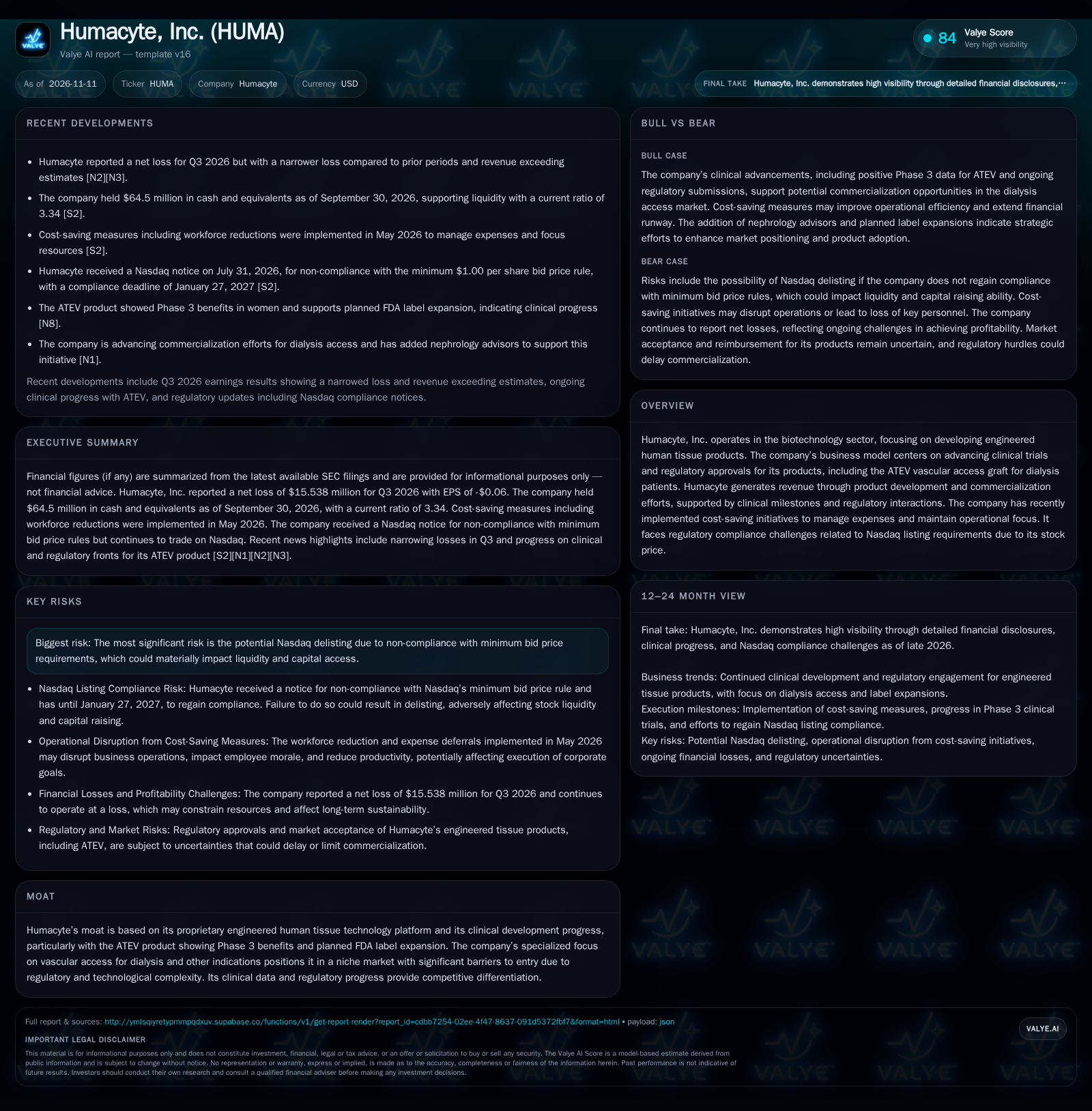
Humacyte is advancing its ATEV engineered tissue product for dialysis access, reporting positive Phase 3 data and pursuing FDA label expansion. Despite narrowing losses and a reported cash position as of Q3 2026, the company faces a Nasdaq delisting threat if its share price does not recover. Recent cost-saving actions and new clinical advisors highlight a focus on resource optimization and market entry, but execution and regulatory outcomes remain critical levers for value creation or downside.
Humacyte, Inc. stands at a crucial juncture in late 2026, balancing tangible clinical progress for its ATEV vascular graft product with acute operational and capital market risks. The company’s narrowing losses and positive Phase 3 data signal potential for near-term commercialization in dialysis access. However, recent cost-saving measures and a looming Nasdaq delisting deadline underscore the challenges of scaling a novel biotech platform under financial and regulatory stress. The next several quarters will test whether Humacyte’s differentiated technology and clinical momentum can convert into durable market adoption and financial stability.
Recent Achievements and Risks Define Humacyte’s Late-2026 Landscape
Humacyte’s Q3 2026 earnings revealed a net loss of $15.538 million, a narrowing deficit compared to earlier periods, with revenue surpassing analyst expectations [S2] [N2] [N3]. The company reported cash and liquidity metrics for the period; these figures do not by themselves establish operating runway, investment capacity, financial flexibility, or financing capacity. [S2] In May 2026, Humacyte enacted significant cost-saving measures—including a workforce reduction of roughly 45 employees and a hiring freeze—aimed at preserving cash while maintaining strategic focus [S2]. On the regulatory front, Humacyte received a Nasdaq notice in July 2026 for non-compliance with the $1.00 minimum bid price rule, with a compliance deadline set for January 2027 [S2]. Clinically, the ATEV product showed Phase 3 benefits in women, supporting a planned FDA label expansion and bolstering the company’s commercial aspirations [N8]. These facts collectively set the stage for a period of heightened operational discipline and execution risk, with both upside and downside levers in play.
How Humacyte’s Engineered Tissue Model Could Scale—If Adoption Follows
Humacyte’s core business model is built around the development, regulatory approval, and commercialization of engineered human tissue products, with ATEV as the leading asset targeting vascular access for dialysis patients. Commercial economics in this sector typically depend on successful clinical outcomes, regulatory approvals, and the ability to secure reimbursement at premium price points relative to synthetic grafts or autologous options. If ATEV is approved and adopted, revenue would likely ramp through a combination of direct sales to hospitals and clinics, with possible distributor partnerships to accelerate reach.
The fixed-cost base in biotech is substantial, given R&D, regulatory, and manufacturing investments, but variable costs post-approval are typically lower, enabling strong potential operating leverage with scale. However, the need to fund ongoing clinical development and invest in commercial infrastructure (e.g., salesforce, medical education, post-market studies) can keep losses elevated in the early commercialization phase. The May 2026 cost-cutting actions indicate a deliberate attempt to reduce burn and stretch the cash runway, but also signal that Humacyte is not yet generating self-sustaining cash flows and remains dependent on either external financing or rapid commercial traction.
Securing favorable reimbursement and demonstrating clinical and economic superiority to incumbent products will be critical for pricing power and margin realization. If adoption is slower than anticipated, or if payer resistance emerges, the path to profitability could be delayed, requiring further dilution or operational retrenchment.
Barriers, Differentiation, and the Challenge of Entrenched Alternatives
Humacyte’s primary differentiation lies in its proprietary engineered human tissue platform, with the ATEV product demonstrating Phase 3 efficacy in women and supporting FDA label expansion efforts [N8]. In the vascular access market for dialysis, the main competitors are established synthetic graft manufacturers and autologous fistula procedures. The biotech’s barriers to entry include the complexity of tissue engineering, regulatory hurdles, and the need for robust clinical data—factors that can deter new entrants.
However, incumbent products are deeply embedded in clinical practice, with established supply chains and reimbursement pathways. For Humacyte to capture meaningful share, it must not only demonstrate superior clinical outcomes (e.g., fewer infections, longer patency) but also convince nephrologists and vascular surgeons to change entrenched habits. The recent addition of nephrology advisors suggests a focus on clinical advocacy and education [N1], which could help bridge the adoption gap.
Potential substitutes—such as advances in synthetic grafts, new biologic approaches, or disruptive device technologies—could erode the long-term moat unless Humacyte continues to innovate and expand its label indications. Regulatory and payer acceptance remain gating factors for broader adoption.
If Clinical Wins and Regulatory Momentum Translate to Rapid Adoption
The most favorable scenario for Humacyte would see the ATEV product secure FDA label expansion and obtain robust reimbursement coverage, catalyzed by the recent Phase 3 data showing benefits in women [N8]. Early clinical champions, supported by the company’s nephrology advisors, could drive rapid uptake in dialysis centers, especially if real-world outcomes mirror trial results. As volumes scale, the company could leverage its manufacturing base, driving gross margin expansion and potentially achieving positive operating leverage within several years.
Confirmation of this scenario would come from the following: FDA approval for the expanded label, inclusion of ATEV in major clinical guidelines, rapid sequential revenue growth from new accounts, and positive reimbursement decisions from large payers. Additional signals would include announcements of hospital or group purchasing contracts, and early real-world data supporting reduced complication rates compared to traditional grafts.
This upside chain could enable Humacyte to access new capital on favorable terms, regain Nasdaq compliance through organic share price appreciation, and reinvest in pipeline expansion without resorting to dilutive financings.
Commercial Progress Tempered by Execution Risks and Gradual Uptake
A more probable scenario is that Humacyte achieves regulatory milestones and launches ATEV for dialysis access, but encounters the typical slow adoption curve seen with novel medical devices. Hospitals and clinicians may trial the product in select patient cohorts, leading to incremental rather than breakout revenue growth in the first 12-24 months. Cost-saving measures help extend the cash runway, but the company remains unprofitable as it scales commercial operations and continues post-market studies.
Supporting evidence for this scenario would include modest but sequential revenue growth, additional clinical publications or label expansions, and progress in payer negotiations—without clear evidence of broad, rapid market penetration. The company may secure extensions to its Nasdaq compliance period or pursue a reverse split to maintain its listing, while continuing to explore partnership or licensing opportunities to reduce cash burn.
Falsification would come from either a clear inflection in revenue or, conversely, a failure to convert clinical progress into meaningful sales traction, necessitating further restructuring or capital raises.
Delayed Adoption, Capital Constraints, and Delisting Threats
In a negative scenario, Humacyte’s ATEV product faces delays in regulatory approval or fails to secure broad reimbursement, leading to weak initial sales and persistent operating losses. The combination of cost-saving measures and workforce reductions may impair execution, slow R&D progress, or erode organizational morale, further hampering commercialization. If the share price remains below the Nasdaq threshold and compliance is not regained by January 2027, delisting could occur, reducing liquidity and making capital raising significantly more difficult.
Confirmation of this downside chain would include regulatory setbacks, flat or declining sequential revenues, loss of key personnel, and an inability to execute commercial agreements or raise new funds on acceptable terms. The company might be forced to pursue asset sales, downsize further, or seek alternative listing venues with less stringent requirements, potentially destroying shareholder value.
Falsifying this scenario would require clear evidence of accelerated adoption, new funding at attractive terms, or a rapid recovery in share price driven by market enthusiasm for clinical or commercial wins.
Milestones and Data That Will Determine Humacyte’s Next Chapter
The outcome and timing of FDA decisions on ATEV label expansion for dialysis access.
Quarterly revenue growth rates and the number of new accounts or hospital customers adopting ATEV, if disclosed.
Updates on payer reimbursement coverage and inclusion in clinical guidelines or value-based purchasing arrangements.
Progress in regaining Nasdaq compliance, including any announced share consolidation or reverse split actions.
Employee turnover, morale, and R&D productivity metrics following the May 2026 workforce reduction, if disclosed.
Any new capital raises, partnership announcements, or nondilutive financing events.
Clinical outcomes and real-world evidence reports comparing ATEV to incumbent grafts in infection rates, patency, and cost-effectiveness.
Expansion or contraction of the nephrology advisory board and its impact on advocacy and adoption.
Disclaimer: This is research-only, informational analysis and not investment advice. It may include AI-generated interpretation and general industry context. Always verify important details using primary sources.

Comments