
Stran & Company: Programmatic Revenue Drives Stability, But Margin Volatility and Industry Concentration Remain Central Risks
Stran & Company, Inc. is evolving from transactional sales to a programmatic, contract-driven model in promotional products and outsourced marketing. Recent revenue growth and liquidity ratios reflect operational progress, yet earnings volatility and industry concentration expose the company to margin pressures and cyclical demand.
Stran & Company has demonstrated consistent revenue growth and margin expansion in recent quarters, with a growing share of revenue from long-term program clients. Its heavy reliance on the promotional products industry and a concentrated customer base introduce risk if market conditions shift.
Stran & Company, Inc. is transitioning its business model towards recurring, programmatic contracts in the promotional products and outsourced marketing space. Recent quarters have shown revenue and margin gains, notably with program clients now comprising the majority of revenue. However, the company’s Q2 2026 earnings dip despite top-line growth, and its high industry concentration, highlight persistent margin and demand risks.
Momentum and Margin Pressures: Recent Financial Performance in Focus
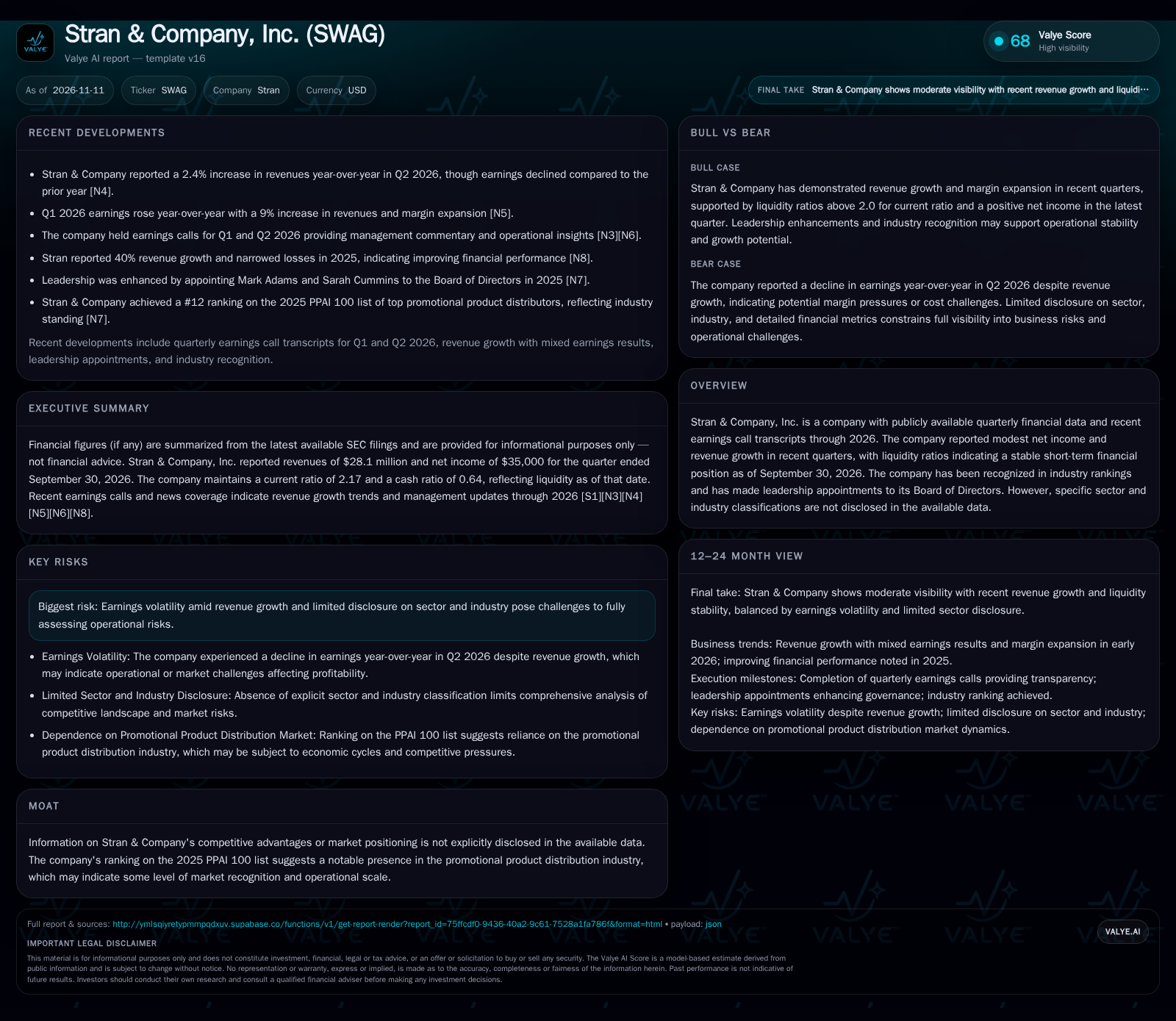
Stran & Company reported $28.1 million in revenue and $35,000 in net income for Q3 2026, with cash and equivalents of $7.38 million and short-term investments of $5.2 million as of September 30, 2026. The company reported cash and liquidity metrics for the period; these figures do not by themselves establish operating runway, investment capacity, financial flexibility, or financing capacity. [S1]
Revenue growth has been steady: Q1 2026 saw a 9% increase with margin expansion, while Q2 2026 delivered a 2.4% revenue uptick but a year-over-year earnings decline [N4] [N5]. The company’s revenue mix is increasingly weighted toward program clients, who accounted for 84-85% of revenue in 2026, up from 78-80% in 2025 [S1].
Stran’s #12 ranking on the 2025 PPAI 100 and recent board appointments reflect industry standing and leadership refresh [N7]. However, the Q2 earnings dip signals ongoing margin volatility, even as revenue growth persists.
The interplay between revenue growth and margin volatility underscores the complexity of Stran’s operational environment. While programmatic contracts provide a more predictable revenue base, the lag between contract acquisition and full margin realization can create short-term earnings fluctuations. Additionally, external factors such as raw material costs, logistics disruptions, and labor market dynamics can disproportionately affect quarterly profitability. Understanding these temporal mismatches and external cost pressures is critical to evaluating Stran’s near-term financial stability and the sustainability of its margin improvements.
Recurring Program Revenue: Economics and Leverage in Stran’s Model
Stran’s core business is the sale of branded promotional products, primarily through third-party manufacturing and decoration partners. The company also offers value-added services—such as warehousing, fulfillment, e-commerce solutions, loyalty programs, and event management—layered atop its physical goods sales [S1].
A key economic shift is the transition from transactional orders to programmatic contracts, where clients have ongoing branding needs and often leverage Stran’s technology and warehousing. Program clients generate recurring revenue streams and allow for greater revenue visibility. With program clients comprising 84-85% of recent revenue, the business is becoming less dependent on unpredictable one-off orders [S1].
The cost structure includes significant variable costs (product procurement, logistics, fulfillment), with potential for modest operating leverage if programmatic volumes scale. Gross margins are likely pressured by intense competition and cost pass-through limitations, but margin expansion in Q1 2026 suggests some success in pricing or mix management [N5].
From a leverage perspective, the scalability of Stran’s programmatic model depends on the balance between fixed and variable costs within its supply chain and service infrastructure. If fixed costs related to technology platforms, warehousing, and fulfillment centers are substantial, incremental volume growth from program clients could yield meaningful operating leverage. Conversely, if the model remains heavily reliant on variable costs tied to third-party manufacturing and logistics, margin expansion may be limited to pricing improvements or service mix shifts. The degree of cost pass-through to clients and contractual pricing flexibility will therefore be pivotal in determining margin trajectory.
Industry Concentration and Competitive Dynamics in Promotional Products
Stran operates in the outsourced marketing and promotional products space, a highly fragmented industry with low barriers to entry and intense price competition. Its #12 ranking in the 2025 PPAI 100 signals operational scale but does not guarantee durable competitive advantage [N7].
The shift toward programmatic, contract-based relationships could increase customer stickiness, as clients rely on Stran’s integrated e-commerce, fulfillment, and loyalty platforms. However, with fewer than 350 program clients out of 2,000+ active customers, revenue concentration risk remains if large clients reduce spend or switch providers [S1].
Competitive threats include commoditized pricing from smaller distributors, direct sourcing by large enterprises, and digital-native platforms that could bypass traditional intermediaries. Technology-enabled services—such as customizable e-commerce portals and integrated loyalty programs—may offer some differentiation, but these features are increasingly standard in the industry.
Switching frictions for program clients may exist via integration, warehousing, and custom e-commerce, but are not so high as to preclude competitive churn if service quality or pricing falters.
Long-Term Contracts and Platform Integration Drive Margin Gains
If Stran successfully expands its base of program clients—particularly by converting transactional customers to multi-year, integrated service contracts—the company could achieve higher revenue visibility, reduced churn, and improved gross margins. Enhanced technology integration and cross-selling of value-added services (such as loyalty programs and event management) would deepen customer relationships and justify premium pricing.
Confirmation of this scenario would involve sustained growth in program-client share (well above 85%), rising average contract values, and consecutive quarters of both revenue and gross margin expansion. Evidence of multi-year customer renewals or expanded service footprints would further validate this upside.
Falsification would occur if program-client growth stalls, margins remain flat or contract, or customer concentration leads to episodic revenue declines as large clients churn or reduce spend.
Incremental Programmatic Growth Offsets Margin Headwinds
The most plausible outcome is a continued gradual increase in program-client share, with overall revenues growing at a modest rate. Margins may remain volatile, reflecting industry price competition and cost inflation, but operational efficiencies and selective pricing power in value-added services could partially offset these pressures.
This scenario would be confirmed by ongoing, albeit moderate, revenue growth, stable or slightly improving liquidity, and intermittent margin expansion. The company may maintain a mid-tier industry ranking without clear evidence of durable pricing power or outsized market share gains.
Falsification would be indicated by a reversal in program-client mix, sustained margin compression, or a notable deterioration in liquidity, possibly due to cost spikes or working capital mismanagement.
Margin Compression and Customer Churn Erode Profitability
Should cost inflation accelerate or competition intensify, Stran could face margin compression that outpaces any incremental revenue gains. The risk is magnified if large program clients reduce spend or switch providers, given the concentrated revenue base.
In this scenario, earnings would decline or turn negative despite stable or rising revenues, as seen in Q2 2026. Liquidity could become pressured if cash flows weaken and working capital needs rise. The company may lose industry standing if competitors undercut pricing or offer superior digital solutions.
Evidence would include consecutive quarters of declining net income, shrinking cash balances, and a reversal in program-client revenue share. Large customer losses or increased bad debt expense would further confirm downside risk.
Milestones That Will Shape Stran’s Programmatic Growth Thesis
Quarterly changes in program-client share of total revenue, especially sustained movement above 85%, would clarify the success of the programmatic model.
Gross margin trends on a quarterly basis—expansion would signal pricing power or mix improvement, while contraction would indicate cost or competitive pressures.
Average revenue per program client, if disclosed, as a test of contract depth and cross-selling effectiveness.
Churn rates or retention metrics for program clients, if disclosed, to assess the stickiness of long-term relationships.
Cash flow from operations and changes in working capital requirements, to determine whether growth is self-funding or eroding liquidity.
Any customer concentration disclosures—loss or downsizing by a top client would materially impact results.
Expansion or attrition in value-added services (e.g., number of clients using e-commerce, loyalty, or warehousing solutions), as a signal of platform adoption and differentiation.
Further board or management changes that may impact strategic direction or execution focus.
Disclaimer: This is research-only, informational analysis and not investment advice. It may include AI-generated interpretation and general industry context. Always verify important details using primary sources.

Comments