
Biomea Fusion: Can Clinical Progress and Strategic Refocus Overcome Capital and Development Risk in Metabolic Disease?
Biomea Fusion’s pivot to metabolic disorders, early BMF-650 weight loss data, and shrinking losses highlight progress. Yet, persistent capital needs, product development risk, and lack of revenue underscore the binary nature of the opportunity.
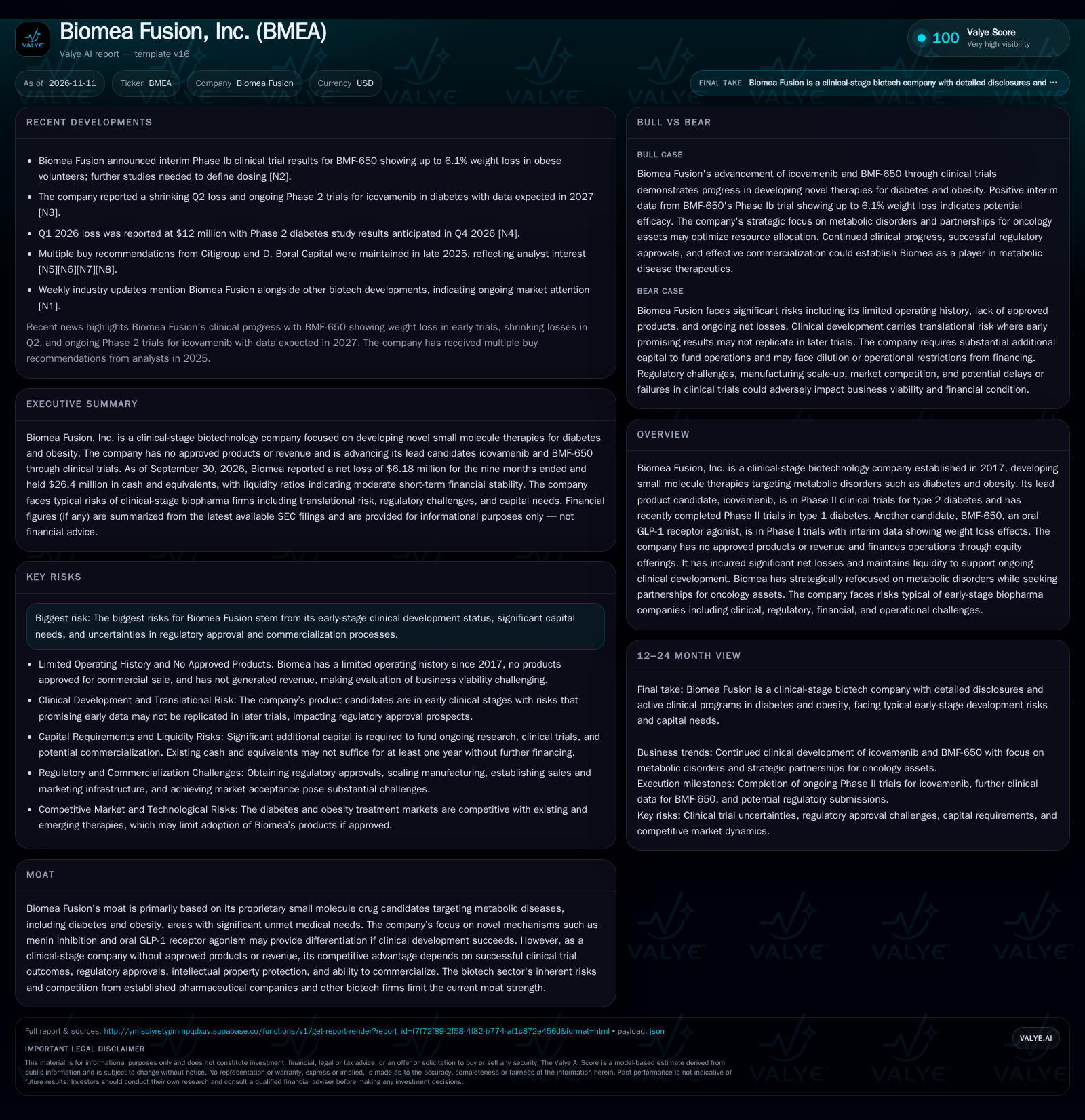
Biomea Fusion, a clinical-stage biotech, is advancing small molecule therapies for diabetes and obesity. Interim results for BMF-650 showed up to 6.1% weight loss in early trials, and the company has shifted strategic focus toward metabolic disorders. The next phase 2 data and financing steps are pivotal to the company’s future trajectory. [S2] [N2] [N4]
The core question is whether Biomea’s scientific and strategic progress can translate into regulatory success and commercial viability before capital constraints become critical.
Recent Clinical and Financial Milestones Signal Both Progress and Ongoing Strain
Biomea Fusion reported interim topline results from a Phase Ib trial of BMF-650, showing up to 6.1% weight loss in obese volunteers. This result positions BMF-650 as a potential entrant in the high-growth GLP-1 receptor agonist class, though the company notes that longer studies are needed to characterize dosing and durability of effect. [N2]
Financially, Biomea reported a net loss of $6.18 million for the nine months ended September 30, 2026, with a Q1 loss of $12 million earlier in the year. Notably, losses have shrunk on a quarterly basis, reflecting some cost containment or trial progress, but the company still carries an accumulated deficit of $476 million. [S2] [N4]
As of September 30, 2026, Biomea held $26.4 million in cash and equivalents, with a current ratio of 2.17 and a cash ratio of 2.16. The company reported cash and liquidity metrics for the period; these figures do not by themselves establish operating runway, investment capacity, financial flexibility, or financing capacity. [S2]
Strategically, the company shifted in January 2025 to prioritize metabolic disorders, particularly diabetes and obesity, and is seeking partners for its oncology assets. This focus aims to align resources with the most commercially promising and differentiated opportunities.
How Biomea’s Model Could Create Value—If Clinical Success Is Achieved
Biomea’s business model is predicated on developing and, if successful, commercializing small molecule therapies targeting large patient populations in diabetes and obesity. The economics of this approach hinge on high fixed costs (R&D, clinical trials, regulatory activities) and low variable costs per unit post-approval, especially if oral administration enables broad primary care adoption.
If BMF-650 or icovamenib achieves approval, pricing power would likely depend on differentiation versus existing GLP-1 receptor agonists (efficacy, safety, oral dosing, side effect profile). Volume potential is significant: the global diabetes and obesity markets are multibillion-dollar opportunities, but payer dynamics and competitive pricing could compress margins unless clear superiority or niche positioning is established.
Biomea’s capital requirements remain substantial and ongoing. The company has historically funded operations via equity offerings, with dilution risk evident if further large-scale financings are required before pivotal data. There is no evidence in the current report of non-dilutive funding or significant partnership revenue.
Operating leverage would only materialize if a candidate is approved and commercialized, as fixed R&D costs give way to higher-margin product revenue. Until then, the company’s economics remain negative, with quarterly cash burn and the need to stage clinical development prudently.
Navigating a Crowded Field: Differentiation and Barriers in Diabetes and Obesity
Biomea competes in one of the most competitive and innovation-driven segments in biopharma. The diabetes and obesity markets are dominated by established pharmaceutical companies with approved GLP-1 receptor agonists and other metabolic therapies. Any new entrant must demonstrate clear advantages in efficacy, safety, delivery, or patient convenience.
The interim BMF-650 data suggest potential for meaningful weight loss, but the bar for market entry is high given recent advances in GLP-1 class drugs. Intellectual property around novel mechanisms (such as menin inhibition) and oral administration could offer differentiation, but these advantages only become commercially relevant if late-stage trials confirm benefit and safety.
Switching costs are generally low for payers and prescribers unless a therapy offers a step-change improvement or addresses an unmet need (e.g., oral alternatives for patients intolerant to injectables). Biomea’s ability to partner or license assets to larger players could be a lever for value if clinical proof-of-concept is achieved.
The company also faces the risk that larger incumbents could rapidly iterate or acquire new modalities, compressing the window for competitive advantage. Regulatory, manufacturing, and commercialization capabilities will be critical if Biomea seeks to launch independently.
What Success Looks Like: Translating Early Data Into Regulatory and Commercial Momentum
The most optimistic outcome for Biomea would see current BMF-650 and icovamenib clinical programs deliver robust, durable efficacy and safety in larger, longer-term Phase 2 and 3 trials. If subsequent studies confirm the interim 6.1% weight loss or show superior metabolic control in diabetes, the company could secure regulatory approval and attract significant strategic interest.
A successful late-stage readout could enable Biomea to raise capital on favorable terms, license assets to a major pharma partner, or even position for an acquisition. Evidence that would confirm this trajectory includes statistically significant efficacy in pivotal trials, a clean safety profile, and early partnership or licensing deals—particularly with upfront payments or co-development agreements.
Rapid enrollment, positive regulatory feedback, and growing analyst support (as reflected in multiple 2025 buy recommendations) would further validate the upside scenario. Commercially, payer acceptance and guideline inclusion would be critical milestones.
Most Likely Trajectory: Incremental Clinical Progress Amid Funding and Execution Hurdles
The most plausible near-term path is one of continued but incremental clinical progress, punctuated by capital raises and operational discipline. Biomea is likely to advance BMF-650 and icovamenib through ongoing trials, with topline Phase 2 data for diabetes anticipated in Q4 2026. [N4]
The company will probably need to secure additional financing—likely through equity offerings—to maintain operations and fund further development. Dilution risk is a near-certainty unless non-dilutive partnership funding is secured.
Clinical data may show some efficacy but with nuances around dosing, durability, or safety that require further optimization. Regulatory timelines could slip, and the company’s ability to manage cash burn and trial execution will be tested.
Confirmation of this scenario would come from sequential, non-pivotal data releases, moderate capital raises, and ongoing trial updates without major breakthroughs or setbacks. Falsification would come from either dramatic clinical success (accelerating partnerships/acquisition) or major negative trial outcomes or financing failures.
Where It Breaks: Clinical Setbacks or Funding Gaps Trigger Strategic Reset or Wind-Down
The primary risk for Biomea remains binary: failure to deliver compelling efficacy or safety in mid-to-late-stage trials would undermine the investment case and limit access to additional capital. Any signal of serious adverse events, lack of efficacy, or inability to dose adequately could force the company to halt programs or seek strategic alternatives.
A secondary risk is an inability to secure sufficient funding before pivotal data is available. With current liquidity insufficient for at least one year, market appetite for additional equity offerings may be limited if clinical progress stalls or macro conditions worsen.
In this scenario, Biomea could be forced to out-license assets at distressed valuations, cut staff, or wind down operations. Negative clinical updates, regulatory setbacks, or dilutive financings at low valuations would confirm the downside case.
Milestones That Will Define Biomea’s Trajectory in Metabolic Disease
Timing and outcome of Phase 2 data for BMF-650 and icovamenib in diabetes and obesity—statistical significance, effect size, and safety profile.
Updates on dosing optimization and durability of weight loss or metabolic control in ongoing and future clinical trials.
Disclosure of new financing events, including the terms and dilutive impact of equity offerings or the securing of non-dilutive capital (if disclosed).
Progress in partnership discussions or licensing deals for metabolic or oncology assets, with emphasis on upfront payments or co-development structures.
Regulatory feedback—such as Fast Track or Breakthrough Therapy designation—that could accelerate pivotal trial timelines.
Cash burn rate and updated liquidity projections, particularly in light of clinical trial pacing and operational spending.
Any material adverse events or regulatory holds that could delay or terminate clinical programs.
Changes in competitive landscape, such as new data from rival GLP-1 or metabolic therapies that could raise the efficacy or safety bar for approval and adoption.
Disclaimer: This is research-only, informational analysis and not investment advice. It may include AI-generated interpretation and general industry context. Always verify important details using primary sources.

Comments