
LightPath Technologies: Acquisition-Driven Expansion Meets Margin and Integration Hurdles
LightPath Technologies nearly doubled its revenue in fiscal 2026 through aggressive acquisitions and expanded defense and industrial sales, but profitability remains elusive amid sharply higher costs and integration complexity. The company’s strategic pivot to western manufacturing and deepened product investment could reshape its competitive standing, yet the path to sustainable earnings requires disciplined execution and proof of synergy realization.
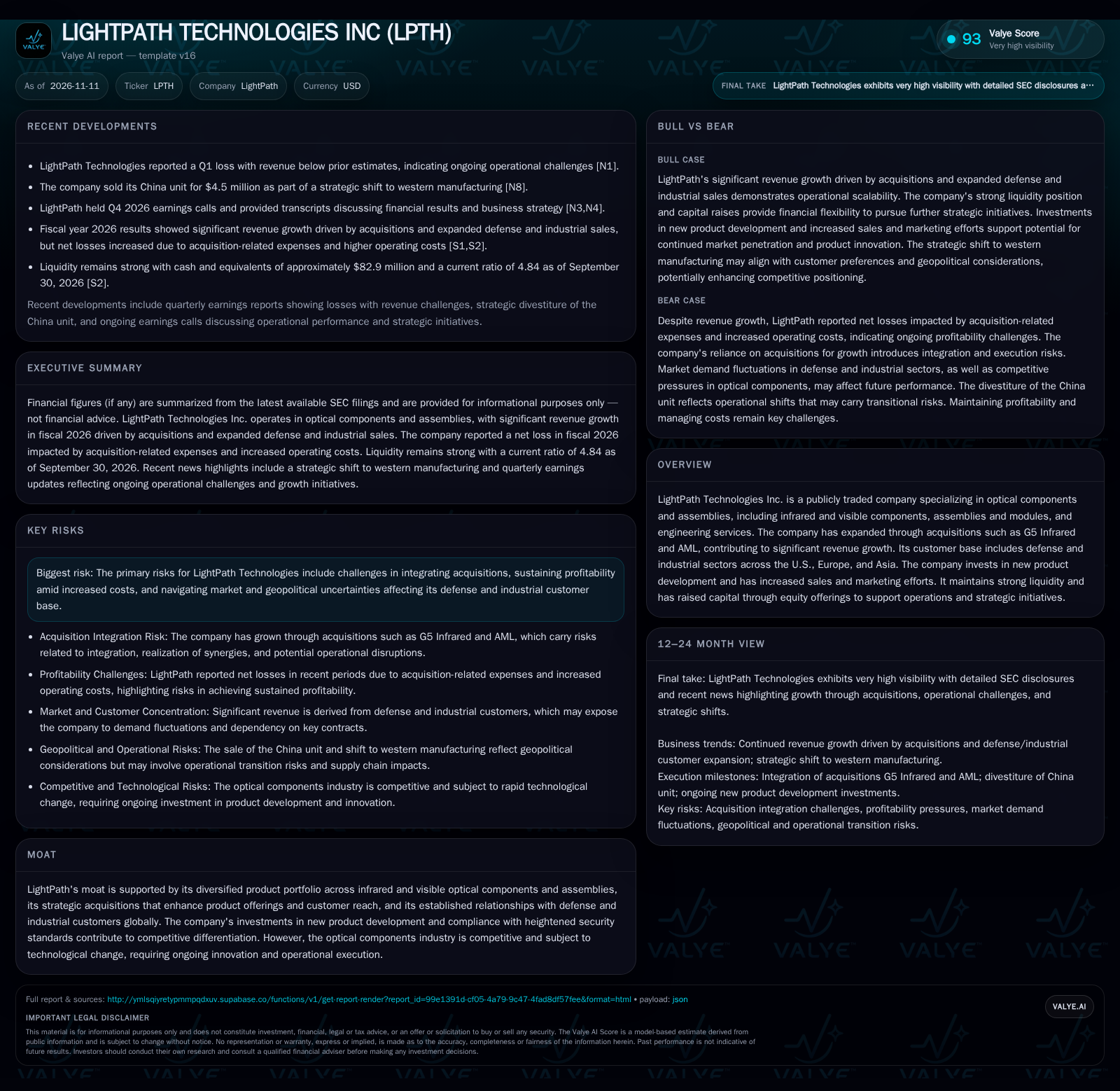
LightPath Technologies delivered 93% revenue growth in fiscal 2026, fueled by the G5 Infrared acquisition and increased sales to defense and industrial customers. Gross margins expanded to 36%, but net losses widened due to acquisition-related and operational costs. The company reported $82.9 million in cash and a current ratio of 4.84 post-equity offerings. Its shift to western manufacturing and continued product investment target long-term competitive gains, but integration risk and the need to translate scale into profitability remain the central challenges. [S1] [S2] [N8]
LightPath Technologies has transformed its scale and product mix over the past year, with fiscal 2026 revenue climbing 93% on the back of strategic acquisitions and heightened demand from defense and industrial customers. The G5 Infrared deal in particular reshaped the revenue base, especially in high-growth assemblies and modules. However, the company’s sharply increased operating costs and acquisition-related expenses mean losses have widened, not narrowed, despite improved gross margins. With a strategic divestiture of its China unit and a pivot to western manufacturing, LightPath is betting on operational realignment and product innovation to drive future gains. The critical question now is whether the company can convert scale into sustainable profitability and effectively integrate its new assets.
Acquisitions, Revenue Surge, and the Profitability Gap
LightPath Technologies reported fiscal 2026 revenue of $71.7 million, a dramatic 93% increase from the prior year, fueled by acquisitions—most notably G5 Infrared—and robust demand from defense and industrial customers across the U.S., Europe, and Asia. Revenues from assemblies and modules, a category boosted by G5 Infrared, soared 281% to $31.9 million, while infrared and visible components also saw double-digit growth. Gross profit surged 155% to $25.8 million, with gross margin improving from 27% to 36%, indicating some operating leverage from higher volumes and product mix. [S1]
Despite these gains, LightPath posted a net loss of $20.5 million for the year, up from $14.9 million in fiscal 2025, as operating expenses—including acquisition and integration costs—rose sharply. The company reported $82.9 million in cash and a current ratio of 4.84 as of September 30, 2026, following two equity offerings. [S2] The company also sold its China unit for $4.5 million, marking a strategic pivot to western manufacturing that may have broad implications for cost structure, supply chain risk, and customer alignment. [N8]
How LightPath’s Expansion Alters Its Economic Model
LightPath’s business model centers on the design and manufacture of optical components, assemblies, and engineering services, with a customer base spanning defense, industrial, and security sectors. Historically, the company’s economics were constrained by modest scale and relatively thin gross margins—characteristic of optical hardware suppliers facing price competition and high fixed R&D costs. The 2026 surge in revenue and gross margin suggests that scale from acquisitions is starting to yield operating leverage, particularly in higher-value assemblies and modules where integration and customization allow for premium pricing.
However, the economics remain challenging. The sharp increase in Selling, General, and Administrative expenses (up 56% to $24.7 million) and new product development costs (up 24% to $3.8 million) reflect both the cost of integrating acquisitions and the need to invest for future growth. The result: operating losses persist, and the company’s ability to turn higher sales into positive net income is unproven. The capital-intensive nature of optical manufacturing, especially with a shift to western production, may raise unit costs in the near term, though it could also support premium pricing if customers value domestic supply and security compliance. The company reported cash and liquidity metrics for the period; these figures do not by themselves establish operating runway, investment capacity, financial flexibility, or financing capacity. [S1] [S2]
Competitive Landscape: Positioning Amid Integration and Technology Pressures
LightPath operates in an intensely competitive market for optical components and assemblies, where barriers to entry are moderate but sustaining advantage requires continuous innovation, quality, and customer trust—particularly for defense and industrial end markets. The company’s expanded portfolio, bolstered by acquisitions like G5 Infrared and AML, increases its breadth of offerings and geographic reach, potentially positioning it as a more complete solution provider.
However, these advantages must be weighed against significant integration risk and the challenge of achieving true product and process synergies. Larger competitors in the optical and photonics sector often wield greater scale, R&D budgets, and established supply relationships. The sale of the China unit and focus on western manufacturing may differentiate LightPath for customers requiring secure, domestic supply chains, especially in defense. Still, this shift could also expose the company to higher labor and input costs, and to the risk that near-term operational disruption outweighs strategic benefits.
Technology substitution—such as advances in solid-state sensors or alternative photonics architectures—remains a long-term threat. LightPath’s ability to invest in next-generation products and maintain relevance as industry standards evolve will be a key test of its competitive durability.
If Integration Delivers, Margin Expansion Could Follow
The most favorable scenario for LightPath is one in which the company successfully integrates its recent acquisitions, realizes operational and cost synergies, and leverages its expanded portfolio to secure larger, higher-margin contracts—particularly in defense and critical infrastructure. In this case, gross margins could continue to expand toward industry norms for advanced optical assemblies, and SG&A growth would level off as integration costs subside. The shift to western manufacturing could bolster customer trust and enable premium pricing, especially if geopolitical tensions persist and domestic sourcing is prioritized by key accounts.
Confirmation of this scenario would come from sustained revenue growth in assemblies and modules, sequential improvement in gross and operating margins, and a narrowing net loss or eventual positive net income. Evidence of expanded multi-year contracts, new customer wins in defense and industrial verticals, and clear disclosure of realized cost synergies would further support the thesis.
Scale Brings Growth, but Profitability Proves Slow to Emerge
The most plausible trajectory is that LightPath continues to grow revenue at an above-market rate, driven by the full-year impact of acquisitions and organic expansion among defense and industrial customers. However, integration frictions, ongoing elevated SG&A, and the cost of maintaining dual manufacturing footprints likely keep the company in a loss-making position for several more quarters.
Gross margin may remain stable or improve modestly as the product mix tilts toward higher-value assemblies, but net profitability will lag until the company demonstrates cost discipline and operational efficiency at scale. The capital raised in 2025–2026 provides a temporary cushion, but future equity dilution or the need for additional funding could become concerns if losses persist beyond the integration window. Progress would be evidenced by stable or improving margins, lower relative SG&A, and a trend toward cash flow neutrality.
Integration Stumbles and Cost Pressures Undermine the Growth Thesis
The adverse scenario centers on LightPath’s inability to integrate its acquisitions efficiently, leading to operational inefficiencies, customer attrition, or loss of key personnel. If the shift to western manufacturing results in sustained cost inflation without commensurate pricing power, gross margins could erode. Continued reliance on equity offerings to fund losses would dilute shareholders and signal structural profitability issues.
Additional risks include unexpected declines in defense or industrial demand, technological obsolescence, or the emergence of lower-cost competitors. Confirmation of this scenario would be seen in margin compression, stagnant or declining revenue despite acquisition spend, and ongoing or worsening net losses. Delays or setbacks in new product launches, or negative customer feedback regarding integration execution, would be further warning signs.
Milestones That Will Determine LightPath’s Ability to Convert Scale into Profitable Growth
Gross margin trend by product group: Sustained or improving margins, particularly in assemblies and modules, would indicate successful integration and pricing discipline.
SG&A as a percentage of revenue: A decline would suggest absorption of acquisition costs and improved operating leverage.
Net income and operating cash flow progression: Movement toward breakeven or positive territory is critical for validating the business model.
Revenue mix evolution: Tracking the share of revenue from higher-value assemblies versus lower-margin component sales will clarify the company’s ability to move up the value chain.
Integration milestones: Disclosure of realized synergies, cost savings, or customer retention rates post-acquisition would help test the integration thesis.
New product development pipeline: Evidence of successful launches or major new contracts resulting from recent R&D investment would support the innovation narrative.
Impact of the China unit divestiture: Monitoring any near-term supply chain disruptions or margin impacts from the shift to western manufacturing.
Customer concentration and contract renewal rates (if disclosed): High dependency on a few large customers or contract losses would heighten risk.
Disclaimer: This is research-only, informational analysis and not investment advice. It may include AI-generated interpretation and general industry context. Always verify important details using primary sources.

Comments