
Grayscale Hyperliquid Staking ETF: Profitability Despite Opaque Mechanics and Disclosure Gaps
The Grayscale Hyperliquid Staking ETF posts notable net income but leaves investors with limited visibility into its strategy, risk exposures, and operational underpinnings. The fund’s opaque disclosure raises questions about the durability and sources of its earnings, especially in the context of potential exposure to volatile or regulated asset classes.
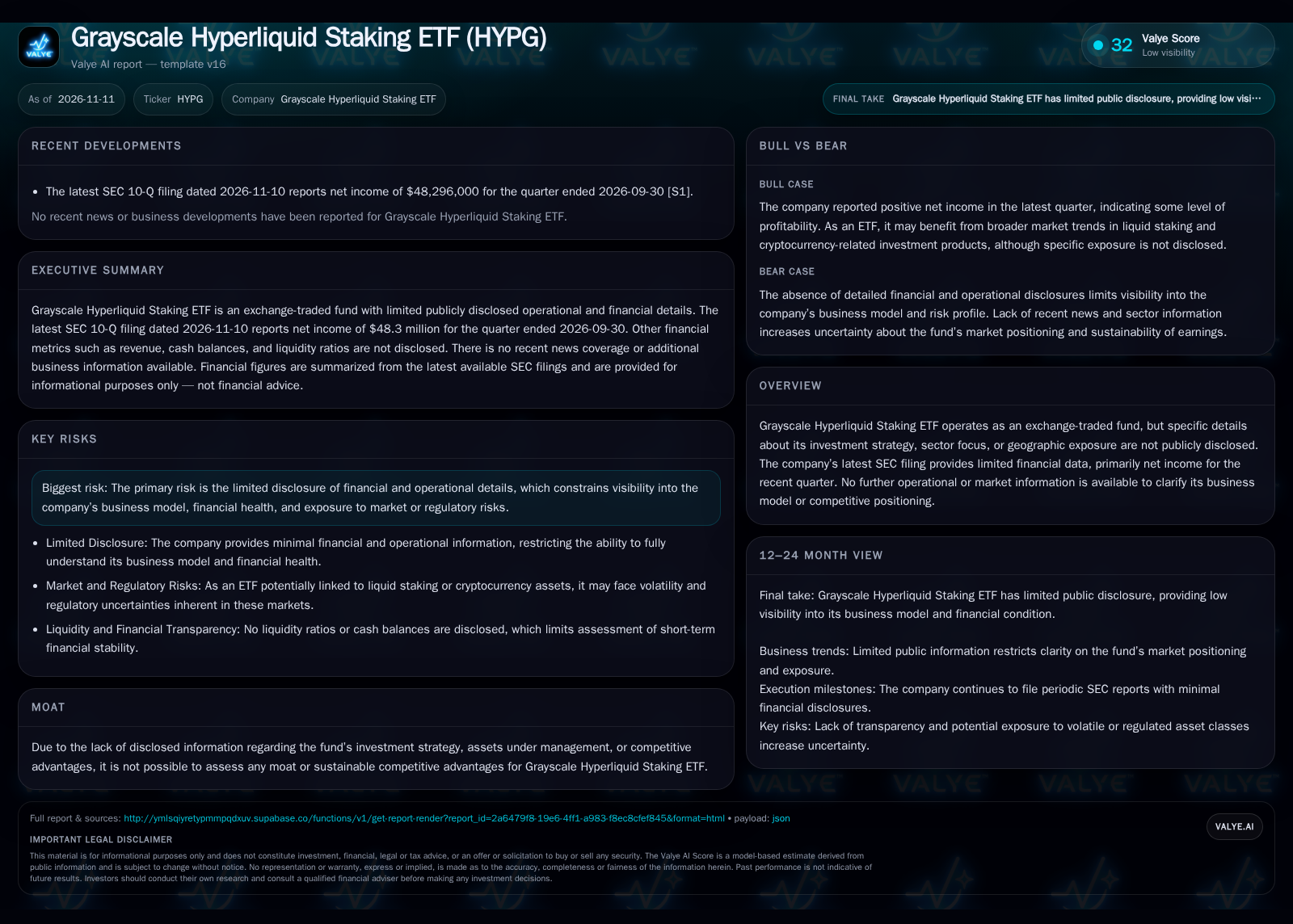
Grayscale Hyperliquid Staking ETF reported $48.3 million in net income for the recent quarter, but provides no detail on revenue, cash, or investment strategy. The fund’s earnings demonstrate profitability, yet the lack of transparency around its business model, asset exposure, and risk management leaves material uncertainty around the sustainability of results and resilience to market or regulatory shocks. Investors must weigh the demonstrated earnings against significant information gaps and the potential for volatility in crypto-linked markets. [S1]
Grayscale Hyperliquid Staking ETF stands out for reporting a sizable $48.3 million in net income for the latest quarter, but beyond this headline figure, the fund remains a black box. Investors are left to speculate about the underlying mechanics, asset exposures, and risk management practices supporting these profits. In an environment where transparency is increasingly vital—particularly for products potentially linked to volatile digital assets—the lack of disclosure makes it difficult to distinguish between sustainable earnings and fleeting windfalls. This opacity poses a challenge for both risk assessment and long-term confidence.
Net Income Figures That Highlight Transparency Issues
The most material current fact is that Grayscale Hyperliquid Staking ETF reported net income of $48,296,000 for the quarter ending September 30, 2026, as disclosed in its latest SEC 10-Q filing [S1]. No details were provided regarding revenue, cash balances, liquidity ratios, or the sources of income. There is also no disclosure of the fund’s investment strategy, asset allocation, or sector/geographic focus. These omissions mean that while the fund is demonstrably profitable for the quarter, the sustainability and drivers of this profit remain unknown. In the absence of additional disclosures, investors face significant uncertainty regarding the ETF’s risk profile, business model, and resilience to market or regulatory shocks.
Earnings Potential and Disclosure Shortfalls in HYPG’s Model
In the ETF industry, funds typically generate revenue through management fees charged as a percentage of assets under management (AUM), performance fees (rare for passive vehicles), and sometimes securities lending or other ancillary activities. For a fund branded as 'Hyperliquid Staking,' plausible mechanisms include earning staking yields by participating in proof-of-stake blockchain protocols and collecting management fees from investors seeking crypto exposure. If the ETF is structured as a pass-through vehicle, most staking rewards or appreciation would accrue to shareholders, with the fund operator retaining only the fee margin.
The reported net income suggests the ETF is operating profitably, but without revenue or AUM disclosure, it is impossible to determine whether this reflects recurring management fees on a large asset base, nonrecurring gains (such as token appreciation), or accounting effects. The economics could be highly variable: staking rewards fluctuate with blockchain protocol yields, and crypto asset values are notoriously volatile. High fixed costs are unlikely for an ETF structure, but variable expenses could rise with increased regulatory compliance or technological infrastructure requirements. The absence of cash and liquidity disclosures also prevents assessment of working capital needs or the ability to withstand redemption shocks during periods of market stress.
Positioning Challenges in a Complex and Competitive Market
The ETF sector, especially for digital assets and staking strategies, is highly competitive and rapidly evolving. Major asset managers, crypto-native firms, and fintech upstarts all vie to offer differentiated products, with competition centered on fees, liquidity, transparency, and access to novel yield streams. If Grayscale Hyperliquid Staking ETF indeed provides exposure to liquid staking, it would face competition from both traditional ETFs and specialized digital-asset vehicles, including direct staking platforms and other crypto-linked funds.
Potential advantages could include scale, brand recognition (if related to Grayscale’s established franchise), or unique access to staking protocols. However, the lack of disclosure about strategy, underlying assets, or fee structure makes it impossible to assess whether the ETF enjoys true differentiation or is exposed to commoditized, high-churn segments. Opaqueness itself is a disadvantage in a sector where regulatory scrutiny and investor demand for transparency are rising. Substitutes abound: investors may opt for more transparent ETFs, direct crypto holdings, or staking via exchanges and DeFi platforms if they perceive lower risk or better economics elsewhere.
Market Drivers and Operational Strengths That Could Boost Returns
A favorable scenario would see the ETF capitalizing on rapid growth in institutional and retail demand for liquid staking exposure, with sustained inflows boosting AUM and generating stable management fees. If the fund has secured access to high-yield staking protocols or negotiated favorable custody and trading terms, it could deliver attractive net returns, supporting both profitability and asset growth.
Upside confirmation would require disclosure of rising AUM, robust net inflows, and consistent fee revenue, ideally alongside transparent reporting of staking yields and expense ratios. Evidence of investor stickiness, such as low redemption rates during volatile periods, would further support the thesis that the ETF offers a compelling value proposition. Regulatory clarity around staking products would also help, reducing headline risk and enabling the fund to scale without major compliance overhangs. The scenario would be falsified if future filings show declining net income, shrinking AUM, or one-off gains masking weak underlying economics.
Disclosure Limits and Result Volatility Undermine Long-Term Growth
The most plausible near-term outcome is that the ETF continues to post periodic profits, but with significant variability and limited visibility. Profits may be driven by episodic gains from asset price appreciation or staking rewards rather than steady, fee-driven income. Investor inflows and outflows could be volatile, particularly if market sentiment toward crypto assets turns or if regulatory scrutiny intensifies.
Base-case confirmation would come from continued—but volatile—net income reporting, without accompanying detail on revenue, assets, or strategy. Persistent opacity would reinforce uncertainty and likely limit the ETF’s appeal to sophisticated allocators or institutional clients. The scenario would be challenged if the fund begins to disclose its AUM, fee structure, or underlying holdings, allowing for more rigorous assessment and potentially greater investor confidence.
Risks from Opacity and Market Turbulence Threaten Performance
A negative scenario could unfold if the ETF is heavily exposed to volatile or illiquid crypto assets, and suffers sharp declines in NAV due to adverse market moves or protocol-specific risks (such as staking slashing events or smart contract failures). If the fund’s earnings are driven by one-off gains or unsustainable sources, subsequent quarters could show sharp profit reversals or even losses. A lack of cash or liquidity transparency heightens the risk of redemption stress, particularly if large investors seek to exit amid market turmoil.
Downside confirmation would include disclosure of declining net income, losses, or negative NAV movements, as well as any regulatory actions or restrictions affecting staking or crypto-linked ETFs. Persistent lack of disclosure would exacerbate investor uncertainty, potentially leading to outflows or reputational damage. The downside case would be partially mitigated if the ETF demonstrates robust risk management, transparent reporting, or resilience during crypto market drawdowns.
Factors That Could Illuminate Grayscale Hyperliquid Staking ETF’s True Risk and Reward
Quarterly disclosure of assets under management (AUM) would help gauge scale and revenue potential, if reported.
Breakdown of revenue sources—management fees, staking rewards, capital gains—would clarify the sustainability of net income.
Detailed reporting on asset allocation, sector, and protocol exposures would reveal the true risk profile.
Disclosure of redemption activity and net inflows/outflows would indicate investor confidence and fund resilience.
Information on fee structure and expense ratios would enable peer benchmarking and margin analysis.
Regulatory developments or compliance disclosures specific to staking and crypto ETFs would help assess headline risk.
A useful metric would be the fund’s NAV volatility relative to benchmarks or peer products, if disclosed.
Disclaimer: This is research-only, informational analysis and not investment advice. It may include AI-generated interpretation and general industry context. Always verify important details using primary sources.

Comments