
Beyond Meat’s Reinvention: Navigating Category Contraction and the Broader Plant Protein Bet
Beyond Meat is in the midst of a high-stakes strategic overhaul, pivoting from its core plant-based meat business to encompass a wider array of plant protein products. While this transformation is driven by persistent contraction in its legacy category, execution risks and consumer acceptance challenges loom large, making the next 18 months a critical period for validation.
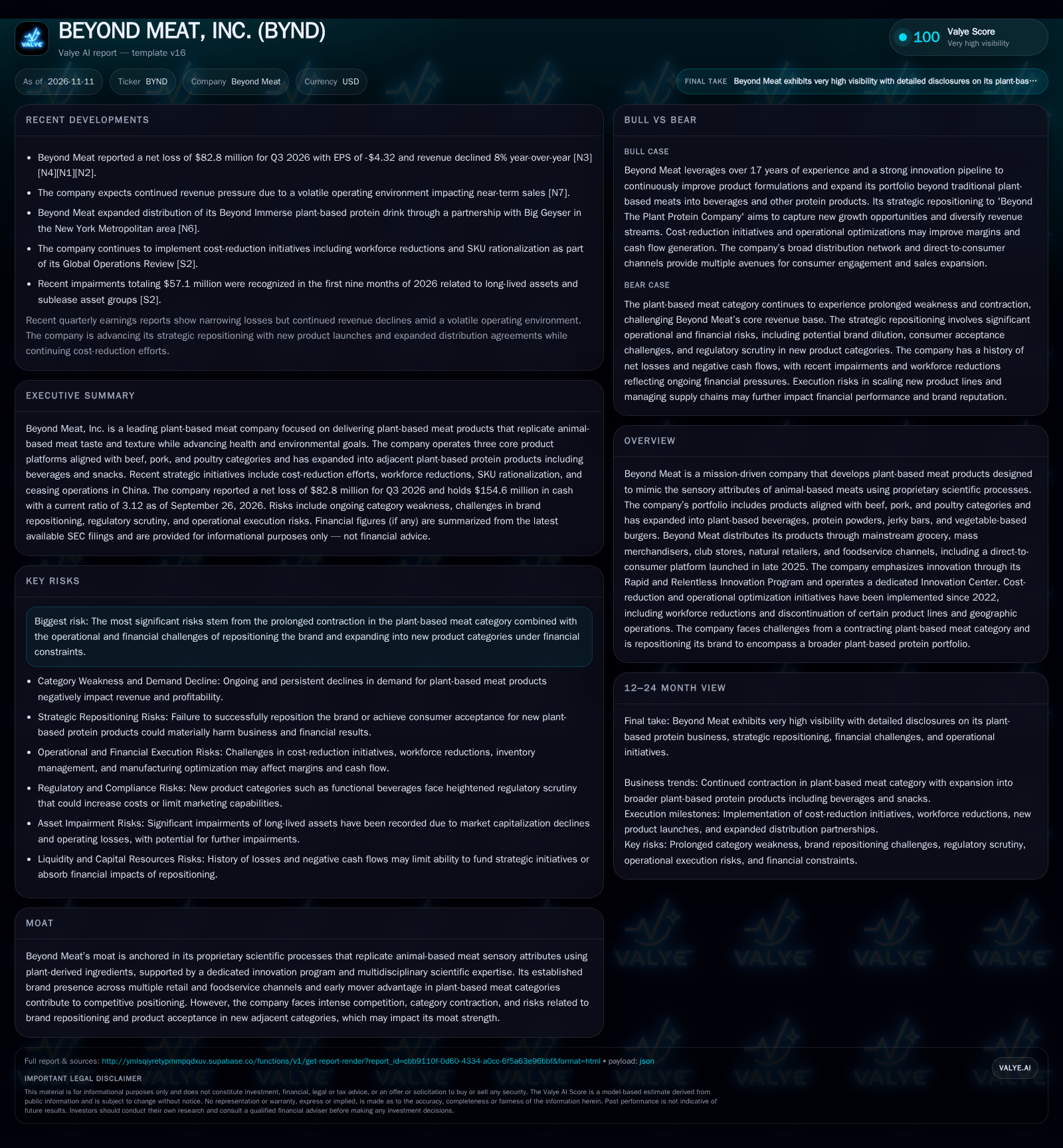
Beyond Meat faces deepening losses and ongoing plant-based meat category contraction. Its response is a sweeping repositioning: expanding into plant-based beverages, protein powders, and snacks, while executing major cost reductions and SKU rationalization. This transformation could diversify revenues and address demand weakness, but brings significant risks around execution, brand coherence, and regulatory scrutiny. Near-term revenue and profitability remain under pressure as the company tests whether it can redefine its value proposition and regain momentum. [S2] [N7]
Beyond Meat’s mission to replace animal protein with plant-based alternatives once positioned it as a disruptor in the food industry. Today, however, the company finds itself at a crossroads: its core plant-based meat segment is shrinking, operating losses are mounting, and major asset impairments reflect the toll of this contraction. In response, Beyond Meat has embarked on a bold strategy to rebrand and expand into a broader spectrum of plant-based protein products, including beverages and snacks. This pivot is both a necessary adaptation to market realities and a risky leap into less-proven territory, with success hinging on consumer adoption, operational discipline, and the ability to create a cohesive, differentiated brand in a crowded field.
Strategic Overhaul and Financial Strain: The Current State of Beyond Meat
Beyond Meat reported a net loss of $82.8 million for Q3 2026, underscoring persistent financial challenges as the company contends with a shrinking plant-based meat category. The company recognized $57.1 million in asset impairments in the first nine months of 2026, following over $49 million in charges the prior year, reflecting both declining market capitalization and the impact of operating losses. In response, Beyond Meat is executing deep cost reductions, including workforce cuts and SKU rationalization, and discontinuing operations in China by the end of 2025. Most notably, the company has announced a strategic repositioning to become 'Beyond The Plant Protein Company,' with new product launches in beverages, protein powders, and snacks, and a key distribution agreement with Big Geyser to expand retail and foodservice reach. Despite holding $154.6 million in cash and equivalents as of September 2026 and a current ratio of 3.12, the company’s disclosures emphasize the need for careful liquidity management due to its history of negative cash flows. [S2] [S1] [N7]
How the Numbers Could Work: Product Mix, Margins, and Operating Leverage in Transition
Beyond Meat’s historical business model relied on premium pricing for plant-based meat analogues, but category contraction and margin compression have challenged this formula. The company’s shift to a broader plant protein portfolio introduces new revenue streams—beverages, powders, and snacks—each with distinct economics. Beverages and protein powders often carry lower per-unit margins than premium meat analogues but may offer higher volume potential and faster inventory turns if distribution scales. However, these categories are also highly competitive, with established CPG players and private label brands exerting pricing pressure.
Cost structure is in flux: fixed costs have been reduced via workforce cuts and SKU rationalization, but asset impairments highlight the drag of underutilized manufacturing capacity and write-downs on legacy investments. If Beyond Meat can drive adoption of its new products while leveraging existing supply chain and distribution relationships, there is potential for improved operating leverage. On the other hand, the need for marketing investment to build awareness in new categories, regulatory compliance for functional beverages, and the risk of inventory obsolescence could offset gains. The capital-light expansion into powders and snacks may help limit further fixed-cost escalation, but successful execution is required to transition from negative cash flow to a sustainable margin profile. [S2] [S1]
Defending Differentiation in a Crowded Plant Protein Market
Beyond Meat’s early mover advantage in plant-based meats delivered strong brand recognition, but this edge is now eroding as the core category contracts and competitors proliferate across adjacent plant protein segments. In beverages and protein powders, the company faces entrenched consumer brands, private label offerings, and new entrants leveraging functional ingredients or clean-label positioning. The risk of brand dilution is real: expanding too broadly may undermine the company’s identity as a meat alternative leader, especially if new products lack clear differentiation or fail to connect with Beyond Meat’s mission-driven consumer base.
The company’s proprietary scientific processes and focus on ingredient simplification may help defend against pure commodity pricing, but switching costs for consumers remain low in the beverage and snack aisles. Distribution partnerships such as the Big Geyser deal could provide shelf presence and trial opportunities, yet sustained success will likely hinge on product quality, taste, perceived health benefits, and credible marketing. Regulatory scrutiny—particularly for functional claims in beverages—adds another layer of risk, as compliance failures could slow adoption or trigger reputational setbacks. [S2] [S1]
If the Brand Resonates Beyond Meat: Pathways to Revenue Diversification and Margin Recovery
In a favorable scenario, Beyond Meat’s repositioning succeeds in establishing its new product lines—Beyond Immerse, Beyond Starmatter, Beyond Starcut, and Beyond Veggie—as credible, desirable options in the broader plant protein market. Retail and foodservice distribution partnerships drive strong trial and repeat purchase, while the company leverages its innovation center to rapidly iterate on formulations and address early consumer feedback. Marketing campaigns effectively communicate the health and sustainability benefits of the new portfolio, mitigating concerns of brand dilution and building a cohesive umbrella identity.
Operating leverage improves as new products scale and legacy fixed costs are absorbed across a broader revenue base. Cost-reduction efforts and SKU rationalization lead to margin stabilization, with positive cash flow emerging as new categories gain traction. Confirmation of this scenario would be visible in sequential revenue growth from new product lines, improving gross margins, and evidence of repeat purchase behavior—especially if Beyond Meat can demonstrate market share gains in the plant-based beverage or snack categories. [S2] [S1]
Incremental Progress and Persistent Headwinds: What a Plausible Middle Ground Looks Like
The most probable outcome for Beyond Meat over the next 12-24 months is a slow, uneven transition. While new product launches and expanded distribution provide some incremental revenue, the legacy plant-based meat segment remains weak, and overall sales growth is subdued. Cost reductions help contain losses, but marketing and regulatory expenses for new categories offset some savings. Brand identity is in flux, with some consumer confusion around the company’s broader plant protein positioning.
Financially, Beyond Meat continues to report operating losses, though at a gradually moderating rate as impairments and restructuring costs abate. Liquidity is managed carefully, but negative cash flow persists unless one or more new product lines achieves breakout momentum. Confirmation of this scenario would be flat or modestly declining core meat-alternative revenues, limited but stabilizing contributions from new categories, and continued but narrowing net losses. [S2] [N7]
Brand Dilution and Execution Missteps: How the Transformation Could Falter
If Beyond Meat’s repositioning fails to resonate—due to weak consumer acceptance, ineffective marketing, or regulatory hurdles in new segments—the company could face a worsening financial spiral. New product lines may struggle to gain distribution or repeat sales, while legacy meat alternatives continue to decline. Brand dilution becomes acute, eroding whatever pricing power or loyalty remains from the core consumer base. Operational missteps, such as inventory write-downs, further impair margins, and ongoing negative cash flow depletes the company’s cash reserves.
This scenario would manifest in sequential revenue declines across both legacy and new categories, continued asset impairments, and the need for additional restructuring or capital raises. If Beyond Meat is unable to demonstrate traction in at least one new product segment, the risk of a strategic sale, further downsizing, or even insolvency could rise. [S2]
Milestones That Will Determine If Beyond Meat’s Transformation Gains Traction
Sequential revenue growth (or decline) attributable to new product lines such as Beyond Immerse, Beyond Starmatter, and Beyond Starcut—if disclosed—would help test adoption beyond legacy plant-based meat.
Gross margin trends and whether cost-reduction initiatives translate into sustainable margin improvement, particularly as the product mix shifts.
Evidence of repeat purchase rates or consumer retention for newly launched beverages, snacks, and powders—a useful metric if disclosed.
Market share gains in the plant-based beverage and protein powder categories, especially relative to private label and established CPG competitors.
Regulatory developments or compliance incidents related to functional beverage claims, which could materially affect marketing and distribution.
Cash flow from operations and any changes in the company’s cash balance or current ratio that signal improved or worsening liquidity.
Updates on distribution expansion and velocity from key partners (e.g., Big Geyser), including retail or foodservice penetration.
Further asset impairments, restructuring charges, or workforce reductions that could indicate ongoing operational distress.
Disclaimer: This is research-only, informational analysis and not investment advice. It may include AI-generated interpretation and general industry context. Always verify important details using primary sources.

Comments