
Airgain’s Systems Strategy: Evaluating Adoption and Financial Outcomes of Integrated Wireless Solutions
As Airgain advances from a component supplier to a systems-level wireless solutions provider, the company’s prospects hinge on certifying new platforms, forging carrier partnerships, and establishing recurring software revenues. The key question is whether its integrated approach can scale to offset competitive and financial headwinds.
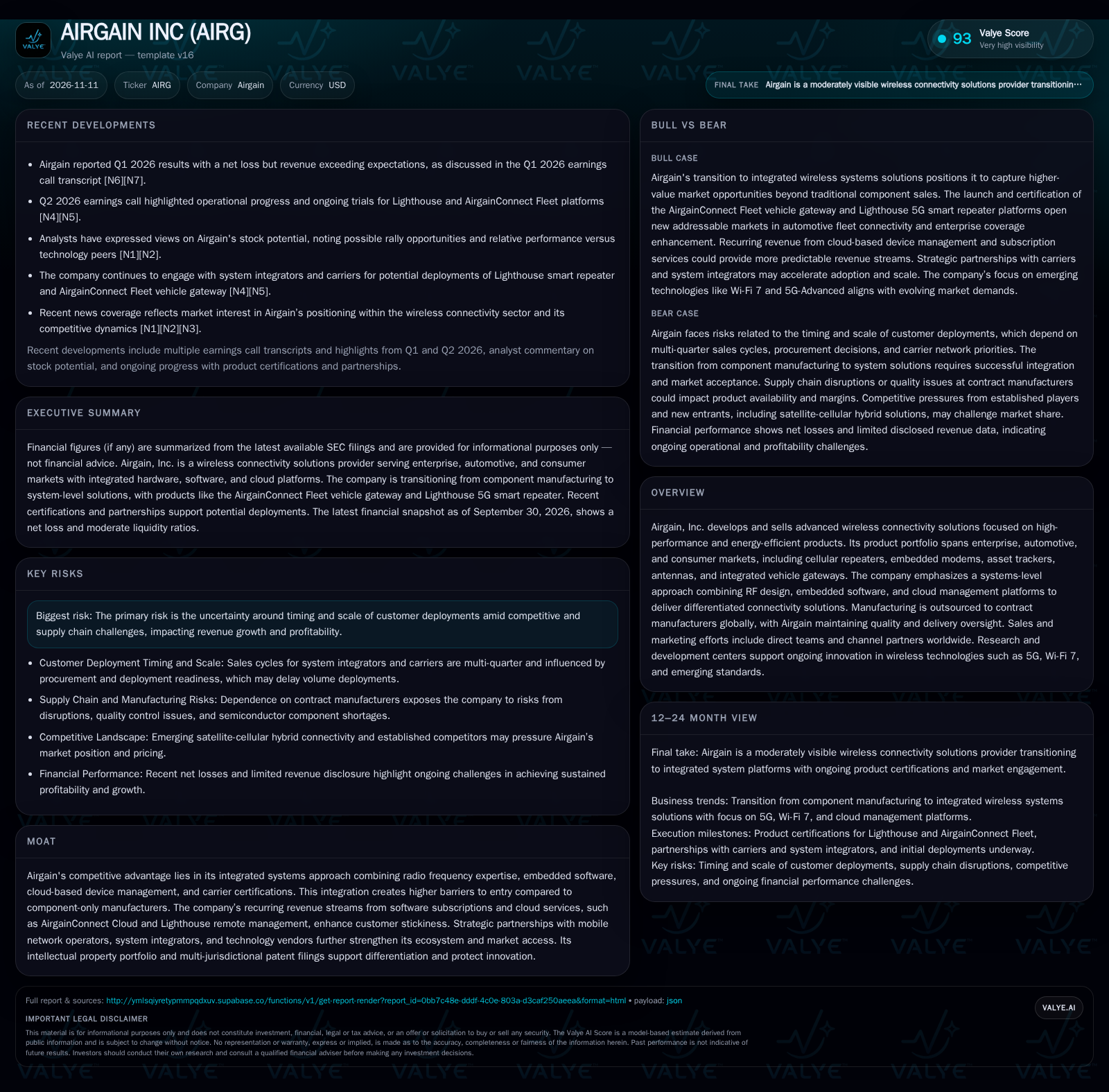
Airgain is shifting from primarily supplying wireless components to offering integrated hardware-software-cloud systems, targeting enterprise, automotive, and consumer markets. The September 2026 quarter showed a net loss and moderate balance-sheet health, while recent product certifications and partnerships provide new deployment opportunities. The company’s ability to drive adoption of its Lighthouse and AirgainConnect platforms, secure recurring revenues, and manage competition and supply chain risks will determine its economic trajectory over the next 12-24 months. [S1] [S2]
Airgain, Inc. stands at a strategic inflection point as it moves beyond its legacy of wireless components toward integrated systems that combine RF hardware, embedded software, and cloud management. Recent certifications for its flagship Lighthouse smart repeater and AirgainConnect Fleet vehicle gateway signal technical validation and potential market entry, but the company’s Q3 2026 net loss and reported liquidity position highlight the commercial and financial hurdles ahead. The next phase will test whether Airgain’s systems-centric model can deliver scalable, recurring revenue streams and achieve adoption among enterprise, automotive, and carrier customers, or whether competitive, operational, and market-cycle headwinds will constrain its ambitions. [S1] [S2]
Certifications, Partnerships, and Financial Position Define Airgain’s Current Standing
Airgain’s transition to an integrated solutions provider is supported by a handful of recent milestones: the FCC certification of the Lighthouse 5G smart repeater in September 2025, a partnership with a U.S. system integrator by December 2025, and ongoing trials with a Tier-1 mobile network operator. The AirgainConnect Fleet system has secured commercial certifications from T-Mobile, AT&T, Verizon, and relevant regulatory bodies, including approvals for prioritized first responder connectivity. These achievements provide technical and regulatory validation, enabling Airgain to target enterprise and automotive deployments at scale. [S1]
Financially, as of September 30, 2026, Airgain reported $7.71 million in cash and equivalents, current assets of $28.16 million against current liabilities of $13.39 million, and a current ratio of 2.1. However, the company posted a net loss of $0.583 million for the quarter, with EPS of -$0.04, signaling ongoing profitability challenges despite moderate short-term liquidity. [S2]
Recent analyst attention and market commentary reflect increased scrutiny on Airgain’s stock potential and its positioning relative to technology peers, largely hinging on the commercial success of its new systems platforms and ability to convert technical progress into revenue growth. [N1] [N2]
Airgain’s Shift from Components to Platforms Aims to Enhance Value Capture
Airgain’s legacy business centered on high-volume, lower-margin wireless components—antennas and modules—for OEMs and device manufacturers. The economics of this model are defined by price-sensitive sales, limited recurring revenue, and modest differentiation, making it susceptible to margin compression and volume swings.
The ongoing pivot is toward integrated systems: hardware devices (like the Lighthouse repeater and AirgainConnect Fleet vehicle gateway) embedded with proprietary software and managed via cloud platforms (AirgainConnect Cloud, Lighthouse remote management). This approach aims to create bundled offerings with higher average selling prices, greater functional differentiation, and opportunities for recurring subscription or device management fees. If successful, this could improve gross margins and revenue predictability by layering software and service revenue atop hardware sales.
Airgain’s outsource manufacturing model keeps fixed costs relatively low, but the systems transition brings higher R&D investment (47 engineering employees as of end-2025) and potentially longer sales cycles, as enterprise and carrier customers require integration, customization, and certification. The company’s ability to achieve operating leverage depends on scaling deployments and driving software attach rates, which would amortize R&D and platform investments over a broader installed base.
The company reported cash and liquidity metrics for the period; these figures do not by themselves establish operating runway, investment capacity, financial flexibility, or financing capacity.
Comparing Airgain’s Integrated Strategy with Key Connectivity Competitors
Airgain’s move into integrated hardware-software-cloud systems positions it against a diverse field of competitors. In enterprise and carrier markets, it faces established wireless infrastructure vendors, network equipment providers, and component specialists, many of whom have deeper customer relationships and greater R&D scale. In automotive, the AirgainConnect Fleet system competes with incumbent telematics and in-vehicle connectivity solution providers.
A potential source of differentiation is Airgain’s carrier-grade certifications and its ability to offer a bundled experience—from RF design through device management—potentially reducing integration complexity for customers. The addition of remote management, firmware-over-the-air updates, and advanced features like carrier aggregation and echo cancellation may add value for network operators and system integrators seeking turnkey solutions.
However, the market is also seeing the rise of satellite-cellular hybrid connectivity and new entrants leveraging open standards, which could reduce switching costs and undercut proprietary systems. Airgain’s competitive sustainability will depend on the stickiness of its software platforms, the degree of integration required for customer deployments, and the pace at which it can establish recurring relationships with carriers and large fleet operators.
Margin Growth Potential Hinges on Recurring Revenue and Large-Scale Deployments
The bull case for Airgain hinges on successful conversion of recent product certifications and trials into commercial-scale deployments, particularly with Tier-1 carriers and major fleet operators. If the Lighthouse smart repeater and AirgainConnect Fleet platforms are adopted at scale, Airgain could see a step-change in revenue, accompanied by higher gross margins from software and cloud management subscriptions layered atop hardware sales.
Evidence that would confirm this scenario includes: signed multi-year contracts with major carriers or system integrators, disclosed growth in recurring software or subscription revenue, and a visible increase in deployment volumes. Improved EPS and a return to operating profitability would further validate the transition.
Falsification would come from persistent delays in commercial deployments, lack of disclosed recurring revenue growth, or continued single-digit million-dollar quarterly losses despite technical progress.
Most Probable Scenario Involves Steady Adoption, Mixed Margins, and Financial Challenges
The most plausible outcome is a multi-quarter ramp in systems deployments, with initial wins in targeted enterprise or automotive segments, but a slower-than-hoped transition to material recurring revenues. Margin improvement may be incremental as hardware sales still dominate, and software attach rates build over time rather than in a single inflection.
Customer adoption cycles—especially among large carriers and fleet operators—may remain lengthy, with deployments gated by integration, certification, and budget cycles.
Confirmation would come from steady growth in deployment volumes, gradual improvement in gross margin, and periodic announcements of new customer partnerships. Falsification would be indicated by stalled revenue growth, rising losses, or evidence that customers are choosing alternative or open-standard solutions over Airgain’s proprietary platforms.
Risks Include Deployment Delays, Heightened Competition, and Increased Cash Burn
A negative scenario could unfold if customer deployments are repeatedly delayed due to budget constraints, integration hurdles, or shifting carrier priorities.
Intensifying competition—whether from established network vendors, low-cost component suppliers, or disruptive satellite-cellular entrants—could compress pricing and limit Airgain’s ability to win contracts, especially if customers perceive switching costs to be low or if open-standard solutions become preferred.
Evidence for this scenario would include declining or stagnant deployment volumes, worsening gross margins, negative free cash flow, or disclosures of working-capital or liquidity stress. Falsification would occur if Airgain demonstrates resilient margins, new contract wins, or successfully raises capital to extend its runway.
Key Milestones Will Shape Airgain’s Progress Toward a Systems-Based Revenue Model
Disclosed growth in recurring software or subscription revenue from AirgainConnect Cloud and Lighthouse management platforms would help test whether the company is successfully shifting to a higher-margin, predictable revenue model.
Signed multi-year or high-volume deployment contracts with Tier-1 carriers, major system integrators, or large fleet operators would validate commercial acceptance of Airgain’s integrated platforms.
Gross margin trends, especially as a percentage of revenue, will indicate whether the systems pivot is delivering improved economics over the legacy component business.
Quarterly deployment volumes for Lighthouse and AirgainConnect platforms (if disclosed) would signal market traction and adoption rates.
Operating cash flow and net loss trajectory—particularly whether net losses narrow or widen as deployments scale—will be key to assessing sustainability.
Any disclosures of supply chain disruptions, inventory write-downs, or contract manufacturer challenges could signal operational risks that may impact delivery and margins.
Updates on competitive responses—such as new offerings from large network vendors, or evidence of customers choosing satellite-cellular or open-standard alternatives—would help gauge market risk.
Disclaimer: This is research-only, informational analysis and not investment advice. It may include AI-generated interpretation and general industry context. Always verify important details using primary sources.

Comments