
Ambow Education: AI-Driven Hybrid Learning, Regulatory Crossroads, and the Sustainability Test
Ambow Education is deepening its digital and hybrid education portfolio with new AI-powered HybriU tools and university partnerships, while facing a pivotal test of regulatory compliance and operating leverage as U.S. higher ed rules tighten.
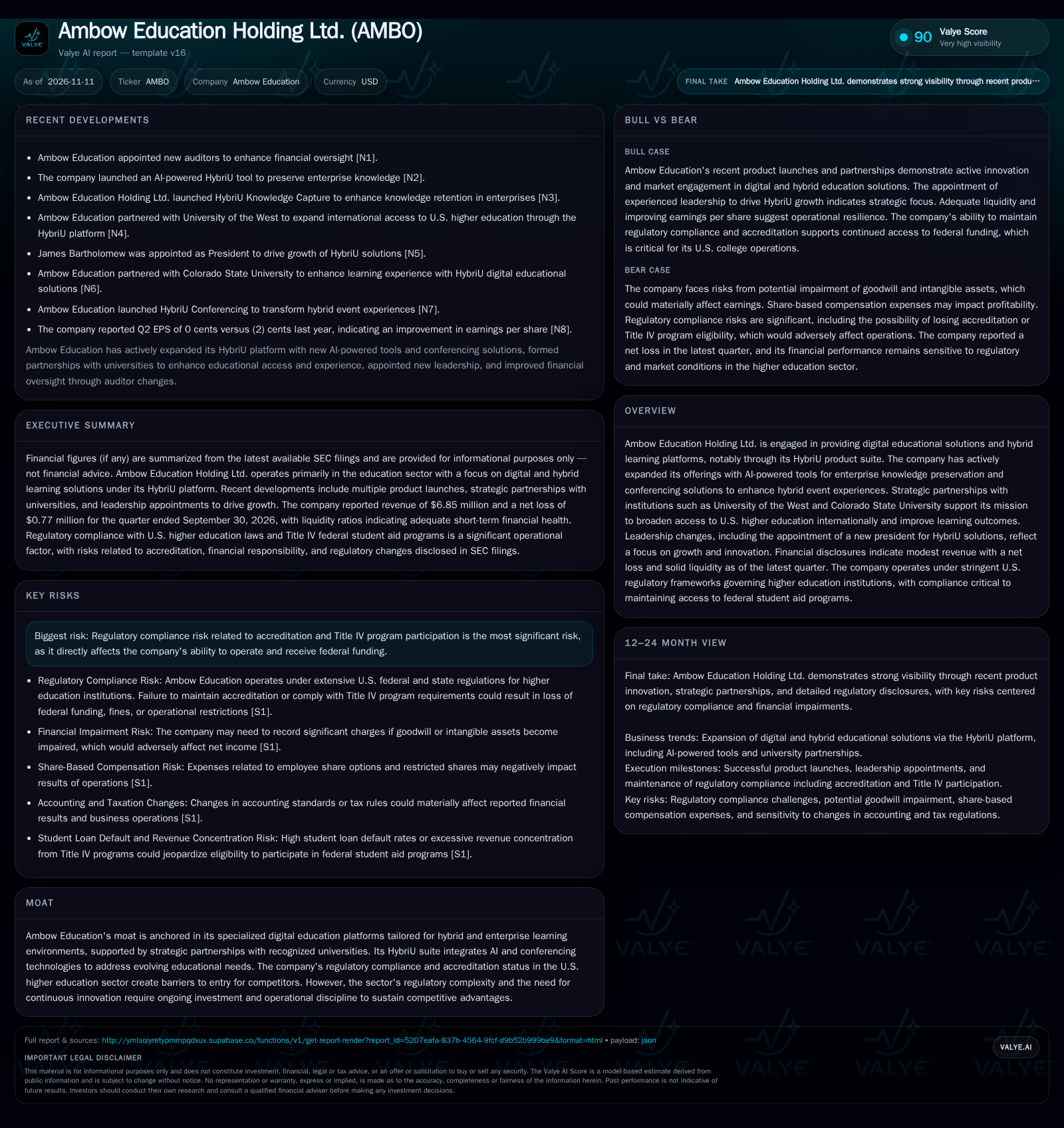
Ambow Education is pursuing growth through digital innovation and U.S. university partnerships, highlighted by recent HybriU product launches and new leadership. The next phase depends on scaling its hybrid platform and demonstrating resilience in a tightly regulated education market. [S2] [N2] [N4] [N5]
Ambow Education is betting its future on hybrid and digital education, rolling out new AI-powered HybriU tools and forging partnerships with U.S. universities to broaden its reach. The company’s latest quarter saw modest revenue and improved earnings, but the real test is whether Ambow can translate product innovation and regulatory compliance into sustainable scale. With federal funding eligibility and tight oversight looming large, Ambow’s ability to grow its digital platform and maintain accreditation will determine whether it can move beyond survival to durable profitability.
AI-Powered HybriU Launches and University Partnerships Shape Ambow’s Present
Ambow Education’s strategic direction in 2026 is defined by a series of product and partnership moves. The company has launched several AI-driven solutions under the HybriU brand—including Knowledge Capture and Conferencing tools—targeted at both enterprise knowledge retention and hybrid event experiences. These offerings are designed to address the evolving demands of digital and hybrid learning environments. Recent partnerships with University of the West and Colorado State University reinforce Ambow’s intent to expand international access to U.S. higher education and enhance learning outcomes via its digital platform. Financially, Ambow reported Q2 revenue of $6.85 million, a net loss of $0.77 million, and an EPS improvement to 0 cents from (2) cents the previous year. The company reported a current ratio of 1.98 for the period. Leadership changes—including the appointment of James Bartholomew as President for HybriU—and new auditors indicate renewed focus on growth and oversight. [S2] [N1] [N2] [N3] [N4] [N5] [N6] [N7]
How Ambow Could Monetize Hybrid Learning: Pricing, Volume, and Fixed Cost Leverage
Ambow’s business model is anchored in digital solutions for education—primarily through its HybriU platform, which combines AI-powered tools, conferencing, and knowledge management with a focus on the enterprise and higher education markets. The company likely generates revenue through a mix of SaaS-style licensing for its digital tools, service fees for hybrid event support, and potentially tuition or service-based revenue from college operations. While the report does not specify contract structures, digital education typically favors subscription models, which can provide recurring revenue and higher gross margins if adoption scales.
The underlying economics of hybrid platforms hinge on achieving sufficient user volume to spread fixed technology and content development costs. Margins in digital education can be attractive due to low incremental delivery costs, provided that customer acquisition and retention are efficient. For Ambow, scaling HybriU adoption among universities and enterprises is essential to leverage these fixed costs. However, the company’s modest revenue base and ongoing net loss suggest that current scale is insufficient to fully realize operating leverage.
Capital needs appear manageable in the near term, given reported liquidity, but sustained investment in R&D, compliance, and sales may be necessary to compete in a crowded digital education market. The need to maintain accreditation and Title IV eligibility also creates compliance-driven cost overheads that do not scale down with revenue.
Hybrid Education’s Crowded Arena: Where Ambow Stands
Ambow operates in a highly competitive landscape, facing digital-native education technology firms, global SaaS providers, and traditional universities expanding their own hybrid offerings. Its key differentiators are the integration of AI-powered tools within the HybriU suite and its ability to form partnerships with accredited U.S. institutions. These partnerships may facilitate market access and confer a measure of credibility, particularly for international students seeking U.S. degrees.
However, barriers to entry in digital education are relatively low for software-driven solutions, so sustained advantage depends on product innovation, seamless integration, and regulatory compliance. Where Ambow may enjoy a defensible position is in its U.S. college operations—assuming continued accreditation and Title IV eligibility—since regulatory approval processes and compliance can deter less-established competitors. Yet, these same regulatory hurdles are double-edged, introducing persistent risk and overhead.
Customer switching costs in education technology are generally modest unless a platform becomes deeply embedded in institutional workflows, data, and accreditation processes. If Ambow can drive deeper integration of its HybriU platform into partner institutions’ core operations, it may be able to raise switching frictions and improve retention. The question is whether current product breadth and institutional relationships are sufficient to achieve this stickiness.
Scaling HybriU Adoption: The Path to Profitable Growth
The bull case for Ambow hinges on its ability to convert recent product launches and university partnerships into material adoption of the HybriU platform. If the company succeeds in embedding its AI-powered tools into the workflows of U.S. and international educational institutions, it could achieve a critical mass of recurring digital revenue. This would drive operating leverage by spreading fixed development and compliance costs over a larger revenue base, potentially turning net losses into sustainable profits.
Confirmation of this scenario would come from evidence such as growing institutional client counts, multi-year digital licensing agreements, or disclosed metrics showing rising HybriU user adoption and retention. Additional university partnerships or successful case studies demonstrating improved learning outcomes could further validate demand. Margin expansion in subsequent quarters, with net income moving consistently into positive territory, would also support the upside thesis.
This scenario would be falsified if, despite product launches, there is no meaningful growth in digital revenue, client adoption, or margin improvement—suggesting the platform’s value proposition is not resonating or scaling.
Incremental Digital Gains Amid Regulatory Vigilance
The most plausible near-term trajectory for Ambow is incremental growth in digital solution revenue, supported by ongoing partnerships and gradual HybriU adoption, while the company continues to operate under tight regulatory scrutiny. In this scenario, Ambow’s financials remain modest: revenue grows slowly, losses narrow but persist, and liquidity is maintained but not substantially improved.
Success in maintaining institutional accreditation and compliance with Title IV requirements allows Ambow to continue participating in federal student aid programs, preserving a core source of funding. However, the company’s scale remains below what is needed for substantial margin expansion, and regulatory compliance costs continue to weigh on results.
This scenario would be confirmed by steady but unspectacular revenue growth, stable or slightly improving liquidity ratios, and continued disclosures of new partnerships or product enhancements, but without a step-change in profitability or market share. Signs that would falsify this scenario include an abrupt loss of accreditation, a material regulatory penalty, or a reversal in digital revenue trends.
Regulatory Setbacks or Stagnant Adoption Could Derail the Model
The bear case is driven by a scenario in which Ambow fails to maintain necessary accreditations or compliance with Title IV federal student aid rules, leading to a loss of eligibility for federal funding. This would severely constrain the company’s U.S. college operations, potentially triggering material revenue declines, reputational damage, and financial distress.
Alternatively, if the HybriU platform fails to gain traction—either due to insufficient differentiation, ineffective sales execution, or a crowded market—Ambow could remain trapped at subscale, with ongoing net losses and mounting pressure on liquidity. Impairment of goodwill or intangible assets could further exacerbate losses, while share-based compensation may continue to erode profitability.
Evidence for this scenario would include regulatory warnings or sanctions, a drop in the composite financial responsibility score below Title IV minimums, increased student loan default rates, or a sharp fall in digital solution revenue. An inability to renew key university partnerships or a wave of client churn would also signal deteriorating prospects.
What Will Decide Ambow’s Digital Education Trajectory in 2027 and Beyond
Trends in digital revenue growth and the proportion attributable to HybriU product adoption—if disclosed—would help test whether the platform is scaling.
Number and depth of new university or enterprise partnerships, especially those involving multi-year digital platform commitments.
Accreditation status updates and any regulatory communications impacting Title IV eligibility or federal funding access.
Changes in student loan default rates and the composition of revenue from federal aid programs, as indicators of regulatory risk exposure.
Net margin progression and evidence of operating leverage as digital revenue grows.
Liquidity development—cash and equivalents trends and any new financing arrangements—given ongoing net losses.
Impairment charges or disclosures related to goodwill and intangible assets, which could signal financial stress or strategic pivots.
Management commentary or disclosed KPIs on HybriU user engagement, retention, and client satisfaction, if provided.
Disclaimer: This is research-only, informational analysis and not investment advice. It may include AI-generated interpretation and general industry context. Always verify important details using primary sources.

Comments