
ClearOne’s Post-Asset Sale Crossroads: Merger, Delisting Risk, and the Endgame for Legacy Obligations
After divesting its core operating assets and ceasing product sales, ClearOne is left as a transitional shell with ongoing warranty liabilities, minimal liquidity, and the prospect of a reverse merger with Cortigent. With a Nasdaq delisting hearing imminent, the company’s future—and that of its shareholders—hinges on the successful execution of strategic alternatives and the navigation of legacy risks.
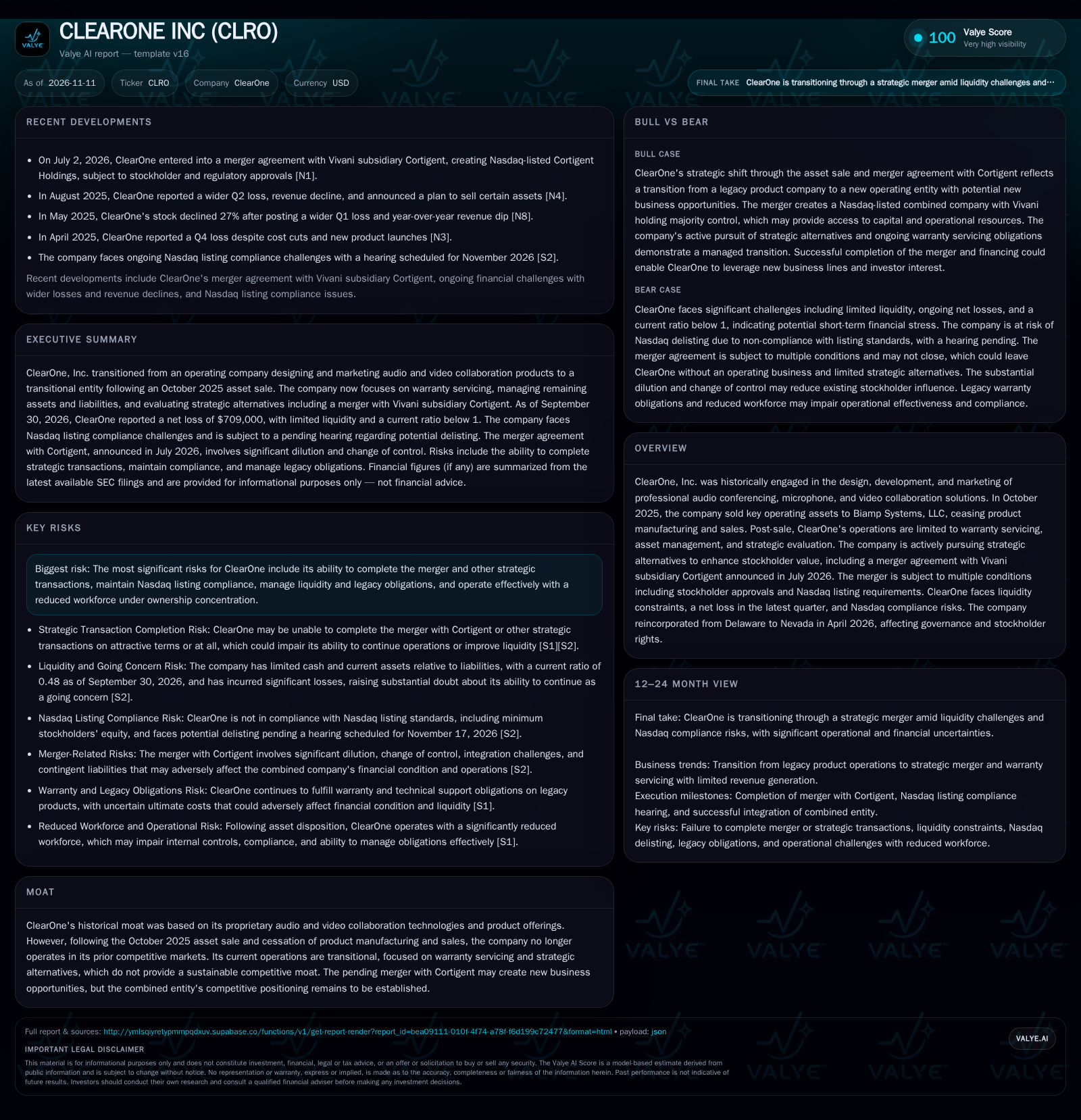
ClearOne, once an audio/video collaboration hardware and software provider, has ceased product sales after selling key assets in October 2025. The company now exists in a transitional state, servicing warranties and seeking strategic transactions, most notably a merger with Cortigent that would result in a change of control and substantial dilution. Its financial position is precarious, with a current ratio of 0.48 and a Nasdaq delisting hearing scheduled for November 2026. The next phase will be defined by the outcome of the merger, the ability to address liabilities, and the resolution of public listing status. [S1] [S2] [N1]
ClearOne’s transformation from a specialized audio and video collaboration company into a transitional shell is nearly complete. After selling its core assets in October 2025, the company’s operational footprint now consists of little more than warranty servicing and the management of residual assets and liabilities. With a Nasdaq delisting hearing imminent and a merger with Cortigent pending, ClearOne’s future is tethered to its ability to execute a complex transaction that will fundamentally alter its ownership, governance, and potential business direction. For legacy shareholders, the stakes are high: dilution, loss of control, and the uncertainty of what—if anything—remains after this transition.
ClearOne’s Transitional State: Asset Sale, Merger Prospects, and Looming Delisting
The most consequential recent development for ClearOne was the sale of its intellectual property, product inventory, and certain non-exclusive rights to Biamp Systems for $3 million in October 2025, which ended its status as an operating manufacturer and vendor of audio and video collaboration products. Since then, ClearOne’s activities have been reduced to warranty support, asset and liability management, and the search for strategic alternatives. [S1]
Financially, the company’s position is dire: as of September 30, 2026, ClearOne held just $18,000 in cash against $1.27 million in current liabilities, with a current ratio of 0.48 and a net loss of $709,000 for the quarter. [S2] This imbalance underscores the company’s inability to self-fund ongoing obligations for long.
ClearOne faces an imminent Nasdaq delisting hearing for failing to meet minimum equity requirements, raising the risk of losing its public listing. [S2] The company’s primary strategic option is a merger with Vivani’s Cortigent subsidiary, which, if completed, would result in a new publicly traded entity controlled by Vivani and substantial dilution for existing shareholders. [N1] [S2]
From Operating Company to Shell: Economics of a Transitional Entity
ClearOne no longer generates material revenue from product sales, having exited its legacy business lines. Its only remaining sources of cash flow are immaterial, likely limited to the $3 million received from the asset sale, interest income (if any), and possibly minimal service fees related to warranty support. [S1]
The cost structure is now dominated by fixed obligations—warranty and technical support costs, public company compliance, legal and advisory fees related to strategic transactions, and administrative overhead—while lacking any recurring revenue base. With a drastically reduced workforce, certain variable costs have declined, but the company’s fixed public company costs and legal liabilities continue to erode its limited capital base.
ClearOne’s capital needs are therefore not growth-driven but survival-driven: the paramount requirement is external funding to bridge the gap until a successful transaction (such as the Cortigent merger) or asset monetization occurs. The absence of operating leverage and the lack of scale in continuing activities mean there is little path to profitability or organic cash-flow improvement under the current structure.
No Longer in the Arena: ClearOne’s Vanished Moat and the Realities of a Shell
Historically, ClearOne competed in the professional audio and video collaboration markets, leveraging proprietary technology and channel relationships. That competitive position has been extinguished by the October 2025 asset sale; the company no longer manufactures, sells, or develops products. [S1]
In its current form, ClearOne is not a competitor in any operating market. It functions as a shell or transition vehicle, with its value proposition now tied to the efficient management of remaining assets, fulfillment of warranty obligations, and the completion of a strategic transaction.
The only relevant ‘competition’ now is for the attention of potential acquirers, merger partners, or investors interested in a public listing vehicle. The company’s diminished resources, risk of delisting, and lack of recurring operations make it a less attractive platform for most strategic buyers or reverse-merger candidates, except those—like Cortigent—seeking a fast track to public markets.
Merger Completion and Value Extraction: What a Successful Transaction Could Unlock
The best-case scenario for ClearOne is the timely completion of its merger with Cortigent. If this transaction closes, ClearOne’s public shell structure could provide Cortigent with an immediate Nasdaq listing, and the combined entity might benefit from new capital infusions, a refreshed business strategy, and the operational leadership of Vivani’s team. [N1] [S2]
For legacy shareholders, the upside is limited by substantial dilution and loss of control, but some residual value could be realized if the post-merger entity trades successfully or if there are contingent payouts. Confirmation of this upside case would require: (1) finalization of all shareholder and regulatory approvals, (2) successful financing to support the new business, (3) maintenance of Nasdaq listing, and (4) clear disclosure of any contingent value rights or mechanisms for legacy shareholders to participate in future upside.
This scenario would be falsified if the merger fails, if Nasdaq delists the company before closing, or if post-merger trading is illiquid or subject to further capital stress.
Protracted Transition: Warranty Runoff and Asset Management as the Default Outcome
Absent a successful merger or alternative transaction, ClearOne is likely to remain in a protracted state of wind-down. The company would continue servicing warranty claims on legacy products, attempt to monetize any remaining assets, and manage down liabilities while facing ongoing public company costs.
Shareholders would see little to no recovery, and the company could ultimately lose its public listing status if delisting proceeds.
This scenario is confirmed if the merger is delayed or collapses, no alternative transactions materialize, and ClearOne continues to report mounting net losses and diminishing asset balances in future filings.
Delisting, Insolvency, and the End of the Shell: How Failure Could Play Out
The most adverse outcome is a combination of Nasdaq delisting, failed merger negotiations, and an inability to meet ongoing obligations—culminating in insolvency or a court-supervised wind-down. With a current ratio of 0.48 and only $18,000 in cash as of September 2026, ClearOne is operating on borrowed time. [S2]
If the Nasdaq delisting hearing results in removal from the exchange, ClearOne’s shares could become illiquid and ineligible for many institutional holders. If the merger with Cortigent falls through and no other capital is secured, the company may be forced to cease operations, liquidate remaining assets, and settle claims with creditors, likely leaving equity holders with little or no recovery.
Confirmation of this scenario would come from public announcements of delisting, bankruptcy filings, or disclosures of failed strategic negotiations in subsequent SEC filings.
Tracking the Endgame: What Will Determine ClearOne’s Outcome
Resolution of the Nasdaq delisting hearing and any subsequent appeals or compliance plans.
SEC filings and press releases disclosing the status, timing, and terms of the Cortigent merger, including any required financing or regulatory approvals.
Disclosure of any contingent value rights, earn-outs, or other mechanisms for legacy shareholder participation in the post-merger entity, if applicable.
Updates on the magnitude and timing of remaining warranty and technical support liabilities—and the company’s ability to fulfill them with existing resources.
Changes in the company’s current asset and liability balances, especially any sources of non-dilutive funding or asset monetization.
Announcements of additional strategic alternatives, asset sales, or liquidation plans if the merger does not proceed.
Evidence of further reductions in workforce, operating expenses, or public company compliance costs, if disclosed.
Disclaimer: This is research-only, informational analysis and not investment advice. It may include AI-generated interpretation and general industry context. Always verify important details using primary sources.

Comments