
Datacentrex: Scrypt Mining Scale, Marketplace Monetization, and the Search for Durable Margins
Datacentrex, Inc. has emerged as a scaled Scrypt ASIC mining operator following its Dogehash Technologies acquisition and a substantial capital raise, but faces fundamental questions about the sustainability of its margin model, exposure to digital asset volatility, and the durability of its operational advantages.
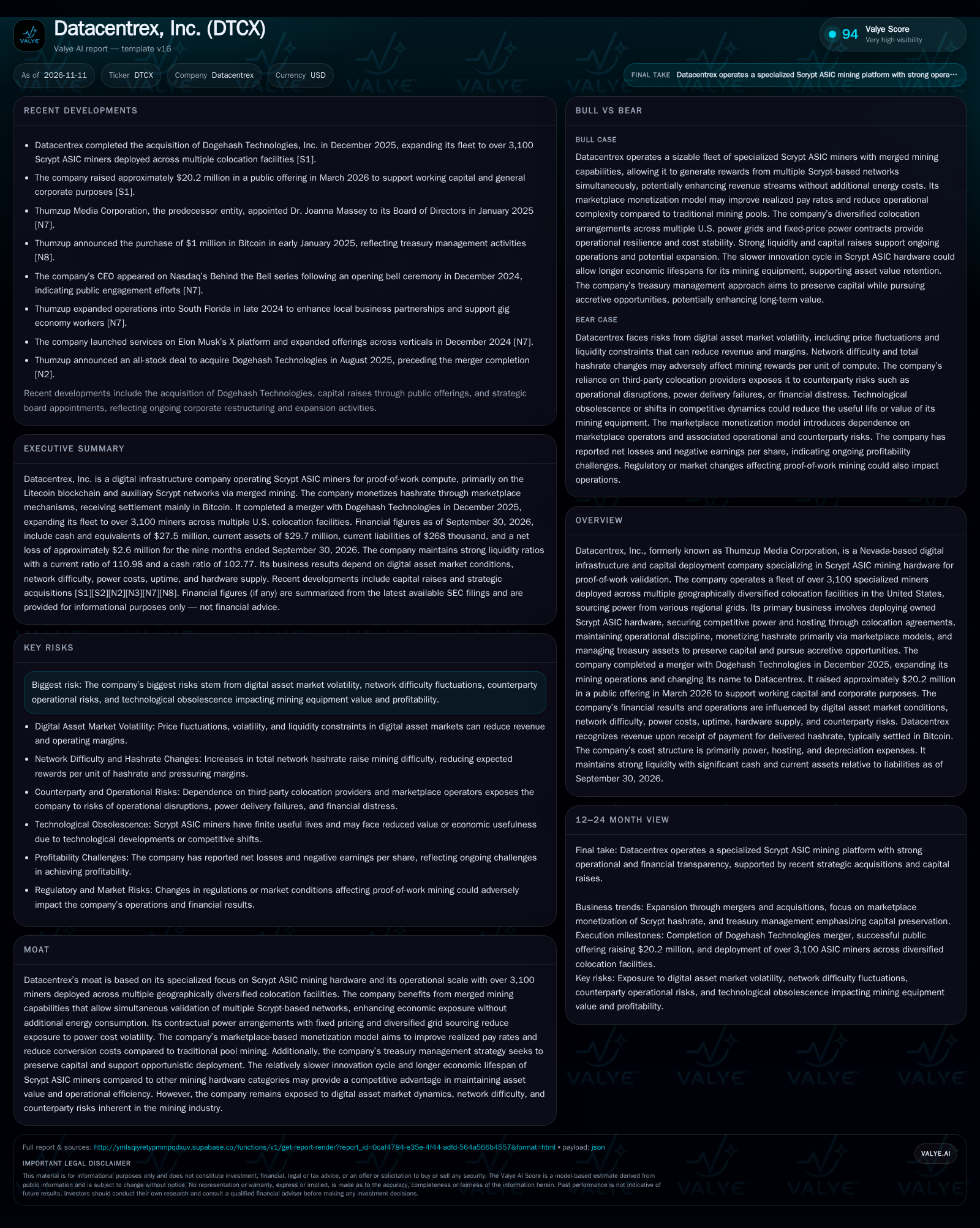
Datacentrex now operates over 3,100 Scrypt ASIC miners across diversified U.S. colocation sites, with recent expansion fueled by the Dogehash Technologies merger and a $20.2 million public offering. Its business model—monetizing hashrate via marketplace settlement, primarily in Bitcoin—aims to optimize conversion and capital efficiency. The company’s long-term edge will depend on disciplined cost control, hardware longevity, and its ability to manage exogenous risks inherent in proof-of-work mining.
Datacentrex, Inc.'s transformation into a scaled Scrypt ASIC mining platform—amplified by its acquisition of Dogehash Technologies and a substantial capital infusion—positions it as a notable player in the proof-of-work compute sector. With over 3,100 miners deployed and a business model focused on marketplace monetization and Bitcoin-denominated settlement, Datacentrex seeks both operational resilience and capital efficiency. Yet, its path to durable profitability is challenged by digital asset market volatility, network difficulty escalation, and the ever-present risk of hardware obsolescence.
Recent Scale and Capital Moves Define Datacentrex’s Strategic Position
Datacentrex’s operational footprint has expanded significantly following the December 2025 acquisition of Dogehash Technologies, growing its Scrypt ASIC miner fleet to over 3,100 units distributed across multiple U.S. colocation facilities [S1]. This expansion leverages the merged mining capability of Scrypt ASICs, allowing Datacentrex to extract value from both the Litecoin blockchain and auxiliary Scrypt networks such as Dogecoin, without incremental energy expenditure.
The company’s capital structure was further strengthened by a $20.2 million public offering in March 2026, which, combined with ongoing cash flows, contributed to a cash and equivalents balance of $27.5 million and a current ratio of 110.98 as of September 30, 2026 [S2]. The company reported cash and liquidity metrics for the period; these figures do not by themselves establish operating runway, investment capacity, financial flexibility, or financing capacity.
Despite these strengths, Datacentrex reported a net loss of $2.6 million for the first nine months of 2026, and continues to face negative earnings per share (-$0.06 basic and diluted) [S2]. This loss profile underscores the persistent pressure on margins and the challenge of achieving sustainable profitability in the face of fluctuating digital asset markets and rising network difficulty.
Marketplace Monetization and the Economics of Scrypt Mining
Datacentrex’s revenue model is built on delivering hashrate from its owned Scrypt ASIC fleet to buyers via hashrate marketplaces, with settlement typically received in Bitcoin rather than in protocol-native tokens [S1]. This approach may reduce conversion costs and mitigate some volatility arising from less liquid Scrypt-based assets, but it introduces dependency on the liquidity and reliability of hashrate marketplaces.
The company’s primary variable costs are power and hosting expenses, both contractually fixed under colocation agreements, and the depreciation of mining hardware [S1]. This structure provides cost predictability, but gross margins remain directly exposed to the market value of mined digital assets and the difficulty levels of underlying blockchains. Asset utilization (i.e., miner uptime and efficiency) and the longevity of Scrypt ASIC hardware are critical to sustaining positive unit economics, as hardware obsolescence can rapidly erode returns if network difficulty rises or block rewards diminish.
Capital requirements in this sector are front-loaded—hardware acquisition and facility deployment—followed by ongoing power and maintenance costs. Datacentrex’s recent capital raise provides runway for these needs, but the company’s ability to reinvest at attractive returns will depend on future digital asset market conditions, anticipated hardware replacement cycles, and the competitive landscape.
How Differentiated Is Datacentrex’s Edge in a Crowded Mining Landscape?
Datacentrex’s scale—over 3,100 Scrypt ASIC miners—and its diversified U.S. colocation footprint position it as a mid-sized operator in the Scrypt mining segment [S1]. The merged mining capability (Litecoin and auxiliary Scrypt networks) allows enhanced asset yield without additional power draw, which is an advantage over single-chain miners. Fixed-price power contracts and multi-grid sourcing (ERCOT, MISO, Georgia Power) provide some insulation from regional power price spikes, supporting operational resilience.
However, barriers to entry in Scrypt mining are moderate; competitors can acquire similar hardware and negotiate comparable hosting arrangements. The longer innovation cycle for Scrypt ASICs may slow hardware obsolescence versus Bitcoin SHA-256 mining, but this advantage is not structural. Moreover, Datacentrex’s reliance on third-party colocation and external hashrate marketplaces introduces counterparty and operational risks—if these partners experience disruptions or market conditions deteriorate, Datacentrex’s economics could suffer.
The company’s treasury management approach—balancing capital preservation with opportunistic digital asset deployment—may offer some flexibility, but does not confer a durable moat. Ultimately, competitive advantage in this sector is transient, hinging on cost discipline, hardware efficiency, and the ability to withstand digital asset market cycles.
Scenario: Margin Expansion Through Favorable Network Dynamics and Cost Discipline
A constructive scenario for Datacentrex would see sustained or rising prices for Scrypt-based digital assets (notably Litecoin and Dogecoin), combined with stable or modestly increasing network difficulty. In this environment, the company’s fixed power contracts and geographically diversified hosting could enable it to capture expanding gross margins, particularly if competitors face higher operating costs or hardware supply constraints.
Marketplace monetization could further enhance realized pay rates if Datacentrex is able to consistently achieve favorable pricing on its delivered hashrate, and if Bitcoin settlement continues to offer superior liquidity and conversion economics. If hardware lifespans meet or exceed expectations, depreciation costs per unit of compute would fall, improving operating leverage.
Confirmation of this scenario would require evidence of: (1) rising or stable mining revenues per deployed ASIC; (2) declining or stable unit costs, especially power and hosting; (3) positive or improving net income margins; and (4) minimal downtime or operational disruptions across the fleet.
Scrypt Mining’s Enduring Volatility: Most Likely Outcomes for Datacentrex
The most plausible medium-term scenario is one of continued margin pressure amid fluctuating digital asset prices and rising network difficulty. Datacentrex is likely to experience periods of profitability interspersed with net losses, as the economics of Scrypt mining remain cyclical and closely tied to external market forces.
Over time, hardware depreciation and potential obsolescence may begin to weigh on margins, especially if digital asset prices stagnate or decline.
Indicators for this scenario would include: (1) stable but low-to-moderate gross margins; (2) ongoing net losses or break-even results; (3) limited reinvestment in new hardware unless market conditions improve; and (4) continued reliance on capital markets or asset sales to fund operations if cash flows are insufficient.
Margin Compression and Asset Impairment in a Bearish Crypto Cycle
A negative scenario could unfold if Scrypt-based asset prices fall sharply or network difficulty rises faster than anticipated, compressing mining rewards per unit of compute. In such an environment, even fixed-cost power contracts may not offset the decline in revenue, leading to negative gross margins.
Operational disruptions at colocation facilities or failures by marketplace partners could further exacerbate losses, while hardware obsolescence risk would rise if a new generation of Scrypt ASICs rapidly outpaces existing fleet efficiency. Regulatory changes targeting proof-of-work mining—such as restrictions on energy use or digital asset settlement—could also undermine the business model.
Evidence supporting this scenario would be: (1) declining mining revenues per deployed ASIC; (2) negative gross and operating margins; (3) asset impairments or accelerated depreciation charges; (4) increased downtime or hardware failures; and (5) shrinking cash balances without offsetting capital inflows.
Testing Datacentrex’s Margin Model and Strategic Resilience: What Will Matter Most
Mining revenue per deployed ASIC, reported quarterly, would help assess unit economics and the impact of network difficulty and digital asset price swings—if disclosed.
Gross margin trends and their sensitivity to digital asset price volatility and network hashrate shifts.
Average power cost per kWh and hosting expense per miner, as disclosed, to test the durability of fixed-cost advantages.
Miner uptime and operational efficiency metrics, which would indicate the effectiveness of maintenance and colocation partnerships—if disclosed.
Capex and hardware replacement spending versus depreciation, providing insight into asset longevity and reinvestment needs.
Treasury management outcomes, including realized gains/losses on digital asset holdings and the timing of conversions to cash.
Counterparty performance, such as incidents of colocation or marketplace disruptions, and their financial impact—if reported.
Regulatory developments or market signals affecting proof-of-work mining, especially in primary operating jurisdictions.
Disclaimer: This is research-only, informational analysis and not investment advice. It may include AI-generated interpretation and general industry context. Always verify important details using primary sources.

Comments