
Corbus Pharmaceuticals: Advancing Oncology and Obesity Candidates Through Critical Clinical Inflection Points
Corbus Pharmaceuticals is approaching pivotal moments in its clinical pipeline, with lead assets in oncology (CRB-701) and obesity (CRB-913) progressing through mid- and late-stage trials. The company's financial position supports near-term development, but long-term value hinges on successful clinical outcomes, regulatory advances, and the competitive landscape in high-stakes therapeutic categories.
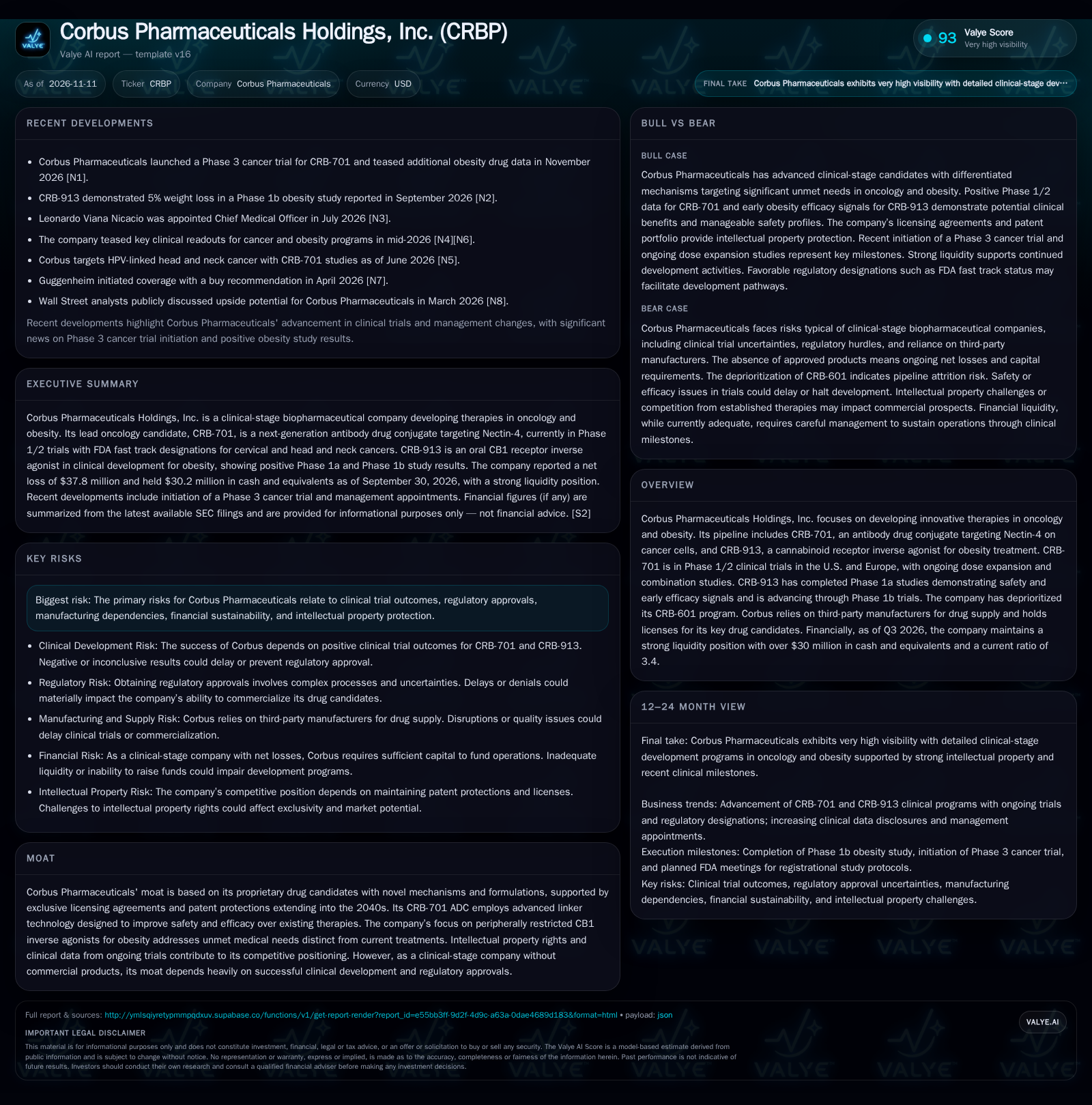
Corbus Pharmaceuticals is a clinical-stage biotech with lead candidates in oncology and obesity. Recent milestones include the launch of a Phase 3 trial for CRB-701 and positive early efficacy for CRB-913. While the company holds over $30 million in cash and has a current ratio of 3.4, ongoing net losses and reliance on external financing remain key considerations. The next 12-24 months will be defined by clinical readouts and the company's ability to carve out a differentiated position in crowded therapeutic markets. [S1] [S2] [N1] [N2]
Corbus Pharmaceuticals stands at a pivotal juncture as its two lead assets—CRB-701 in oncology and CRB-913 in obesity—move deeper into clinical development. The company's recent launch of a Phase 3 trial for its antibody-drug conjugate and encouraging early results from its obesity candidate signal potential for value creation, but also sharpen the consequences of clinical and regulatory risk. With a cash position sufficient for near-term operations but not long-term commercialization, Corbus must navigate a competitive landscape and the inherent volatility of drug development. The next phase will test whether its differentiated mechanisms can translate into real-world impact and sustainable business value.
Recent Clinical Milestones and Financial Position Define Near-Term Trajectory
Corbus Pharmaceuticals' lead oncology candidate, CRB-701, has advanced to a Phase 3 trial following a Phase 1/2 program that demonstrated early signs of efficacy and safety across multiple solid tumor types. The asset has received FDA fast track designations for relapsed or refractory metastatic cervical cancer and recurrent/metastatic head and neck squamous cell carcinoma, supporting an accelerated development path. [S1] [N1]
In obesity, the company’s CRB-913 has posted a 5% weight loss in a Phase 1b study and is progressing through a 240-subject, 12-week dose-finding trial. [S1] [N2]
As of September 30, 2026, Corbus reported $30.2 million in cash and equivalents, with a current ratio of 3.4 and a net loss of $37.8 million for the latest quarter. The company reported cash and liquidity metrics for the period; these figures do not by themselves establish operating runway, investment capacity, financial flexibility, or financing capacity. [S2]
The company relies on third-party contract manufacturing organizations for supply and has deprioritized its CRB-601 oncology program, narrowing its immediate focus to the two lead assets. [S1]
How Corbus Could Generate Value: Commercial Models, Cost Structure, and Capital Needs
Corbus remains a pre-revenue, clinical-stage biotech; its business model will only become fully operational if and when its candidates achieve regulatory approval. For CRB-701, commercial success would likely hinge on premium pricing typical of oncology biologics, with potential for multi-year, high-value contracts if efficacy, safety, and differentiation from incumbent ADCs or checkpoint inhibitor regimens are established. Volume would be initially limited to advanced-stage cancer populations but could expand if label extensions or combination use are supported by data.
CRB-913, if successful, would enter a competitive obesity market increasingly dominated by GLP-1 agonists. Its potential for oral dosing and improved tolerability could enable broad primary-care adoption, but payer coverage, real-world adherence, and head-to-head efficacy versus established therapies would shape uptake and pricing power.
Fixed costs are currently dominated by R&D and clinical operations, with variable costs rising if late-stage trials expand or commercial manufacturing is initiated. The company’s reliance on third-party manufacturers helps avoid heavy capital outlays for plant and equipment but may limit margin expansion or introduce supply risks. Operating leverage would only materialize with significant scaling post-approval, and the path to profitability is likely to require substantial additional funding—through equity, partnerships, or non-dilutive sources—before any revenue arrives. [S2]
Differentiation and Headwinds: Corbus’ Place in Oncology and Obesity Therapeutic Arenas
CRB-701’s positioning as a next-generation Nectin-4-targeting ADC leverages site-specific conjugation and novel linker technology, aiming to improve safety and pharmacokinetics over first-generation competitors such as PADCEV®. If the early safety and efficacy signals are borne out in larger trials, Corbus could carve out a meaningful share in hard-to-treat, Nectin-4-expressing tumors—particularly in indications with high unmet need or limited competition. However, the oncology ADC space is crowded, with large pharmaceutical incumbents, rapid follow-on innovation, and frequent combination trials raising the bar for both differentiation and payor acceptance.
In obesity, CRB-913’s mechanism (peripherally restricted CB1 inverse agonism) targets a distinct pathway compared to GLP-1 or dual agonists, theoretically sidestepping the GI and neuropsychiatric adverse effects that limit some existing therapies. However, efficacy, durability of weight loss, and demonstration of metabolic or cardiovascular benefit will be critical for competitive positioning. The field is rapidly evolving, with multiple oral and injectable agents in late-stage development, and payor scrutiny remains high.
Intellectual property protections and exclusive licensing arrangements provide some insulation, but sustained advantage will depend on clinical data, regulatory timing, and commercial execution rather than patents alone.
Transformational Value If Clinical Data and Regulatory Momentum Align
A favorable scenario sees CRB-701’s Phase 3 trial generating statistically significant improvement in objective response rates and survival over standard-of-care, with a safety profile that supports broad use or combination regimens. Fast track designation could enable accelerated approval, opening the door to early commercialization in select tumor types. Partnering or licensing deals with larger pharma could follow, providing non-dilutive capital and commercial infrastructure.
For CRB-913, robust Phase 1b and subsequent Phase 2/3 data confirming meaningful, durable weight loss and superior tolerability would position the drug as a differentiated alternative to GLP-1s, particularly for patients unable to tolerate those agents. Rapid enrollment and clear benefit-risk signals could attract strategic interest or facilitate a premium pricing strategy.
Evidence confirming this scenario would include: positive topline Phase 3 oncology data, regulatory filings or approvals, substantial partnership announcements, and successful completion of larger obesity trials with weight loss and safety outcomes matching or exceeding initial results. [N1] [N2] [N4] [N6]
Clinical Progress with Incremental De-Risking, But Commercial Questions Remain
The most plausible path involves continued advancement of CRB-701 and CRB-913 through their respective clinical stages, with a mix of positive and equivocal data. The company achieves key enrollment and data readout milestones, but may face challenges in demonstrating clear superiority or differentiation over existing therapies, particularly in obesity where placebo-adjusted efficacy and real-world adherence are scrutinized.
The company may secure regulatory designations or conditional approvals in niche indications, but broad commercial adoption is likely to lag without compelling head-to-head results or demonstrated payer acceptance.
Evidence supporting this scenario would include timely completion of ongoing trials, continued but moderate clinical updates, additional financing events, and steady but unspectacular analyst coverage or partnership discussions. If disclosed, early commercial planning or real-world access agreements would help test the thesis.
Clinical Setbacks, Funding Pressure, and Erosion of Strategic Options
Adverse outcomes could arise if CRB-701 fails to demonstrate efficacy or encounters unforeseen safety issues in larger trials, resulting in study halts, regulatory setbacks, or withdrawal of fast track status. In obesity, if CRB-913’s weight loss effects are not durable, clinically meaningful, or are overshadowed by safety signals, the program could stall or be deprioritized—mirroring the fate of CRB-601.
Pipeline attrition, increased competition, or intellectual property challenges could further erode residual value.
Evidence confirming this case would include negative or inconclusive trial results, FDA clinical holds, delayed or failed fundraising efforts, and management signaling program pivots or staff reductions.
Milestones and Metrics That Will Determine Corbus’ Next Chapter
Topline data from the Phase 3 CRB-701 study, including objective response rate, progression-free survival, and safety outcomes in target tumor types.
Interim and final results from the 12-week, 240-subject Phase 1b CANYON-1 study for CRB-913, with particular focus on placebo-adjusted weight loss and adverse event rates.
Regulatory updates regarding fast track, breakthrough, or accelerated approval pathways for both lead assets.
Evidence of new partnership or licensing deals with large pharmaceutical companies, or non-dilutive capital raises tied to clinical milestones.
If disclosed, enrollment pace and protocol amendments in ongoing clinical trials, as indicators of trial execution and feasibility.
Cash burn rate and updated guidance on runway relative to planned clinical milestones and operational expenses.
Intellectual property developments, especially patent challenges or new filings covering composition, manufacturing, or clinical use.
Disclaimer: This is research-only, informational analysis and not investment advice. It may include AI-generated interpretation and general industry context. Always verify important details using primary sources.

Comments