
Palisade Bio: Targeted IBD Innovation Faces the Clinical and Commercial Crucible
Palisade Bio advances a novel, locally-activated oral PDE4 inhibitor into mid-stage trials for IBD, leveraging reported liquidity position and a differentiated mechanism. Success now hinges on clinical validation, regulatory navigation, and standing out in a crowded, risk-laden field.
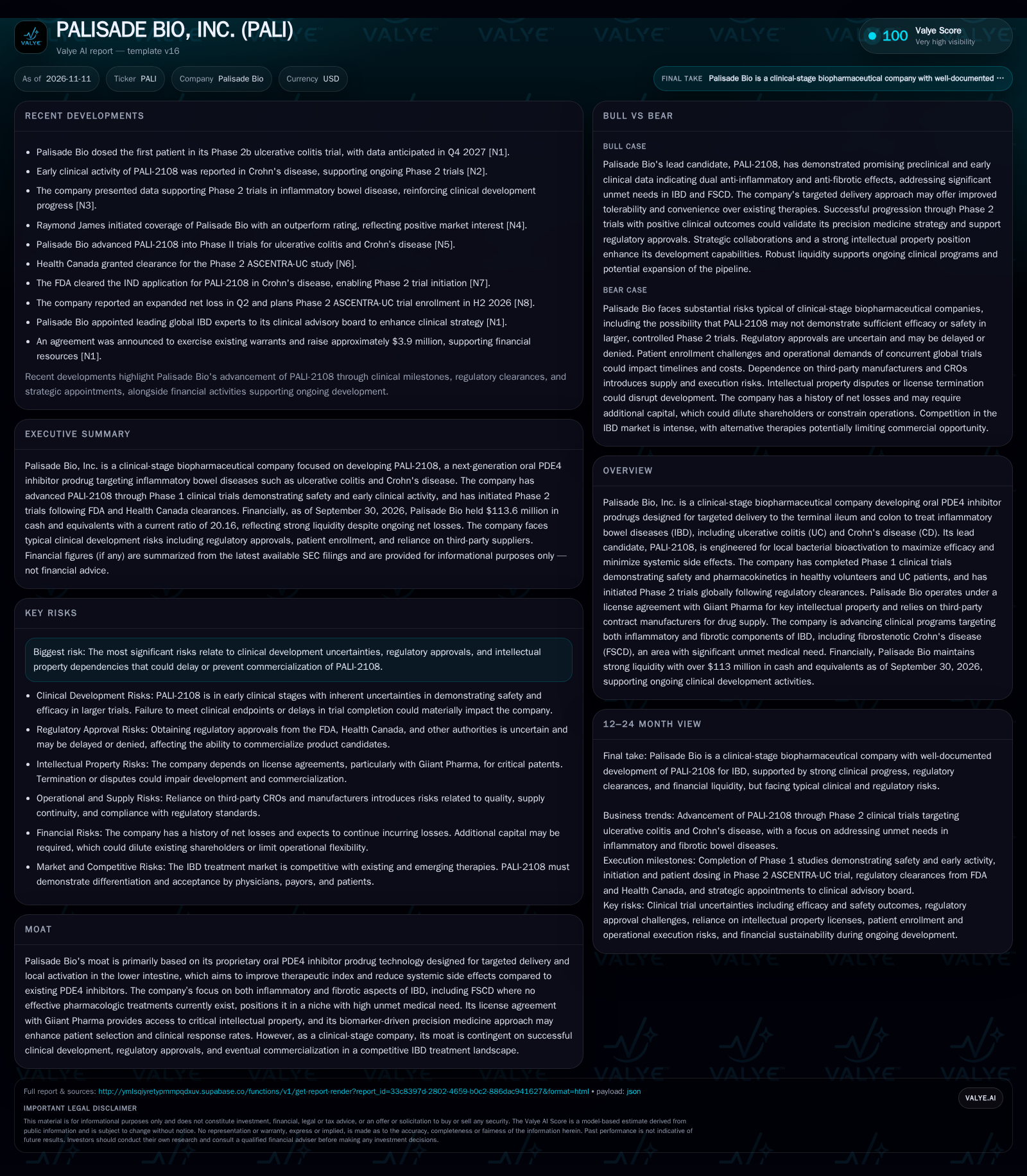
Palisade Bio is moving its oral PDE4 inhibitor, PALI-2108, into global Phase 2 studies for ulcerative colitis and Crohn’s disease, targeting both inflammation and fibrosis with a once-daily, colon-activated approach. With over $113M in cash as of September 2026 and major regulatory clearances secured, the company is positioned to fund clinical progress. The next inflection points will come from Phase 2 efficacy data and evidence that its targeted delivery approach can outcompete entrenched and emerging IBD therapies. Key risks include clinical trial outcomes, regulatory hurdles, supply chain dependencies, and the need to demonstrate clear differentiation in a competitive market.
Palisade Bio is betting that a precisely-targeted, once-daily oral PDE4 inhibitor can transform the treatment paradigm for inflammatory bowel disease. With its lead asset, PALI-2108, now in Phase 2 trials for both ulcerative colitis and Crohn’s disease, the company is leveraging a mechanism designed to maximize efficacy in the lower gut while minimizing systemic toxicity. Backed by over $113 million in cash and a pipeline supported by global regulatory clearances, Palisade Bio is well-resourced for its next clinical milestones. The question is whether early efficacy signals and a differentiated delivery approach can translate into meaningful therapeutic—and ultimately commercial—advantage in a competitive, risk-laden space.
Palisade Bio’s Phase 2 Launch: Liquidity and Clinical Progress Set the Stage
Palisade Bio’s lead drug candidate, PALI-2108, is now being evaluated in global Phase 2 trials for both ulcerative colitis (UC) and Crohn’s disease (CD), following FDA and Health Canada IND clearances and the dosing of the first patient in the ASCENTRA-UC study in October 2026 [S1] [N1] [N6] [N7]. The company’s approach—targeted local activation of a PDE4 inhibitor in the lower gut—aims to address both inflammation and fibrosis, including the challenging fibrostenotic Crohn’s subtype [S1]. Early-stage clinical results have shown dose-dependent efficacy in animal models and encouraging safety and pharmacokinetic profiles in both healthy volunteers and initial patient cohorts [S1].
The company reported cash and liquidity metrics for the period; these figures do not by themselves establish operating runway, investment capacity, financial flexibility, or financing capacity. [S2] However, the company continues to generate net losses, reporting a $14.6 million net loss for the first nine months of 2026 and expects to remain unprofitable through the development phase [S2]. These facts set up a pivotal period: Palisade Bio enters mid-stage trials with financial resources in place, but must now deliver clinical proof to justify further investment and differentiate itself in a crowded IBD landscape.
The Economics of Targeted IBD Therapy: High-Risk, High-Reward Dynamics
Palisade Bio’s business model is characteristic of clinical-stage biopharma: value creation is tied almost entirely to successful clinical development, regulatory approval, and commercial launch of its lead asset. The economics are dominated by high upfront R&D costs, funded by equity and non-dilutive capital, with little to no revenue until late-stage success or licensing/partnership deals. [S2]
If PALI-2108 achieves regulatory approval, commercial economics would depend on pricing, uptake, and duration in the competitive IBD market. Oral administration and a once-daily regimen could support premium pricing and facilitate patient adherence, but payer pressure and competition from both biologics and emerging oral agents could constrain net pricing and market share. Manufacturing is outsourced to third-party CDMOs/CMOs, making fixed costs relatively modest but introducing dependency risk [S1]. Operating leverage would be realized only if the drug achieves scale, as most costs pre-commercialization are R&D and SG&A, with gross margins potentially attractive if supply chains are well managed. Ultimately, Palisade Bio’s path to profitability is binary and hinges on clinical and regulatory success.
Can Palisade Bio Stand Out in the Crowded IBD Race?
The inflammatory bowel disease market is highly competitive, featuring entrenched biologics (e.g., anti-TNFs, integrin inhibitors), newer small molecules (JAK inhibitors, S1P modulators), and a rich pipeline of emerging therapies. Palisade Bio’s differentiation rests on its oral, colon-targeted PDE4 inhibitor prodrug, which is designed for local activation—potentially reducing systemic side effects and enabling once-daily dosing [S1]. This could position PALI-2108 as an attractive alternative for patients who have failed or cannot tolerate other therapies, or as an early-line option if efficacy and safety are compelling.
The dual anti-inflammatory and anti-fibrotic mechanism is particularly relevant for fibrostenotic Crohn’s disease, an area of high unmet need where existing therapies have limited impact [S1]. However, Palisade Bio faces counterforces: large competitors with established commercial infrastructure, ongoing innovation in oral small molecules, and the challenge of proving long-term safety and efficacy in a notoriously heterogeneous disease. The company’s reliance on licensed intellectual property from Giiant Pharma adds another layer of risk, as does dependence on third-party manufacturers and CROs for supply and clinical execution [S1] [S2]. To win share, Palisade Bio must show not just incremental, but meaningful clinical and patient-reported advantages.
How Clinical Validation Could Unlock Transformative Value
The most bullish scenario for Palisade Bio is that PALI-2108 delivers robust, statistically significant efficacy and safety data in Phase 2 trials—showing clear advantages in both UC and CD populations, especially in patients with fibrostenotic complications. If the targeted delivery yields a superior side-effect profile and meaningful improvements in patient outcomes or quality of life, the drug could become a first-in-class or best-in-class option, attracting interest from larger pharma partners or acquirers.
Confirmation of this scenario would come from interim and final Phase 2 readouts showing dose-dependent, clinically meaningful reductions in disease activity scores, mucosal healing, and biomarkers of inflammation and fibrosis. Additional evidence would include strong enrollment rates, positive feedback from clinical advisory board experts, and early signals of payer or physician enthusiasm. Strategic partnerships or licensing deals—enabled by positive data—could provide non-dilutive capital and commercial leverage.
Falsification would occur if efficacy is modest, side effects are unacceptably high even with local activation, or if enrollment lags due to lack of investigator or patient interest. Regulatory setbacks or failure to maintain IP rights would also derail this upside.
What Steady Progress Looks Like: Incremental De-Risking, Ongoing Uncertainty
In the most plausible scenario, Palisade Bio progresses through its Phase 2 program with mixed but generally positive signals—perhaps demonstrating safety and tolerability, along with some efficacy in select patient subsets. The company may then need to optimize dosing, expand patient cohorts, or run additional trials to confirm benefits, extending timelines but keeping the program alive.
In this path, Palisade Bio would likely continue to burn cash but maintain enough runway to reach the next clinical inflection point. Confirmation would include steady trial enrollment, regulatory engagement, and incremental data releases showing at least non-inferiority to standards of care. Ongoing analyst coverage and additional capital raises, if needed, would be manageable if clinical data remain promising.
Falsification would take the form of major trial setbacks—such as safety issues, lack of efficacy, or slow enrollment—leading to program discontinuation or a need to pivot to backup assets. Difficulty in maintaining third-party manufacturing or IP license compliance could also disrupt progress.
Where Things Could Go Wrong: Clinical, Regulatory, and Operational Pitfalls
The bear case centers on the high attrition rates typical in mid-stage IBD drug development. If PALI-2108 fails to demonstrate meaningful efficacy in Phase 2 or is associated with unexpected side effects—even at targeted local delivery—further progress could be halted. Regulatory agencies may delay or deny advancement to Phase 3, especially if data are ambiguous or manufacturing compliance is questioned.
Operational risks—such as supply chain disruptions from CDMOs/CMOs, or problems with clinical research organization performance—could delay trials and inflate costs. Loss of critical IP rights or breakdown in the Giiant Pharma license could halt development altogether [S1] [S2]. In this scenario, Palisade Bio would likely exhaust its cash runway without a viable asset, forcing a strategic pivot, asset sale, or wind-down. Confirmation would come from negative or inconclusive clinical data, regulatory hold letters, or public disclosures of IP/manufacturing disputes.
Milestones That Will Determine Palisade Bio’s Clinical and Commercial Trajectory
Interim and final Phase 2 trial results for PALI-2108 in UC and CD—especially efficacy, safety, and anti-fibrotic endpoints—are the most direct test of the clinical thesis.
Enrollment pace and retention rates in the ASCENTRA-UC and ASCENTRA-CD studies would help gauge investigator and patient confidence.
Updates on regulatory interactions (FDA, Health Canada), including any requests for additional trials, special protocol assessments, or fast-track designations.
Manufacturing and supply continuity—any disruptions, delays, or compliance issues from third-party CDMOs/CMOs could impact trial timelines and costs.
Intellectual property status and ongoing compliance with the Giiant Pharma license agreement; any disputes or changes would materially alter the outlook.
Feedback and guidance from the clinical advisory board, including new hires or resignations, may provide insight into clinical strategy and execution.
Market and competitive developments—such as new approvals or clinical readouts from competing IBD therapies—could shift the commercial landscape.
Disclaimer: This is research-only, informational analysis and not investment advice. It may include AI-generated interpretation and general industry context. Always verify important details using primary sources.

Comments