
Grayscale Litecoin Trust: Structure, Volatility, and the Dynamics of Indirect Crypto Exposure
Grayscale Litecoin Trust (LTCN) offers regulated, OTC-traded exposure to Litecoin, with recent filings confirming strong governance and internal controls. Its performance and investor appeal remain tightly linked to Litecoin market swings, regulatory shifts, and evolving competition from alternative crypto investment vehicles.
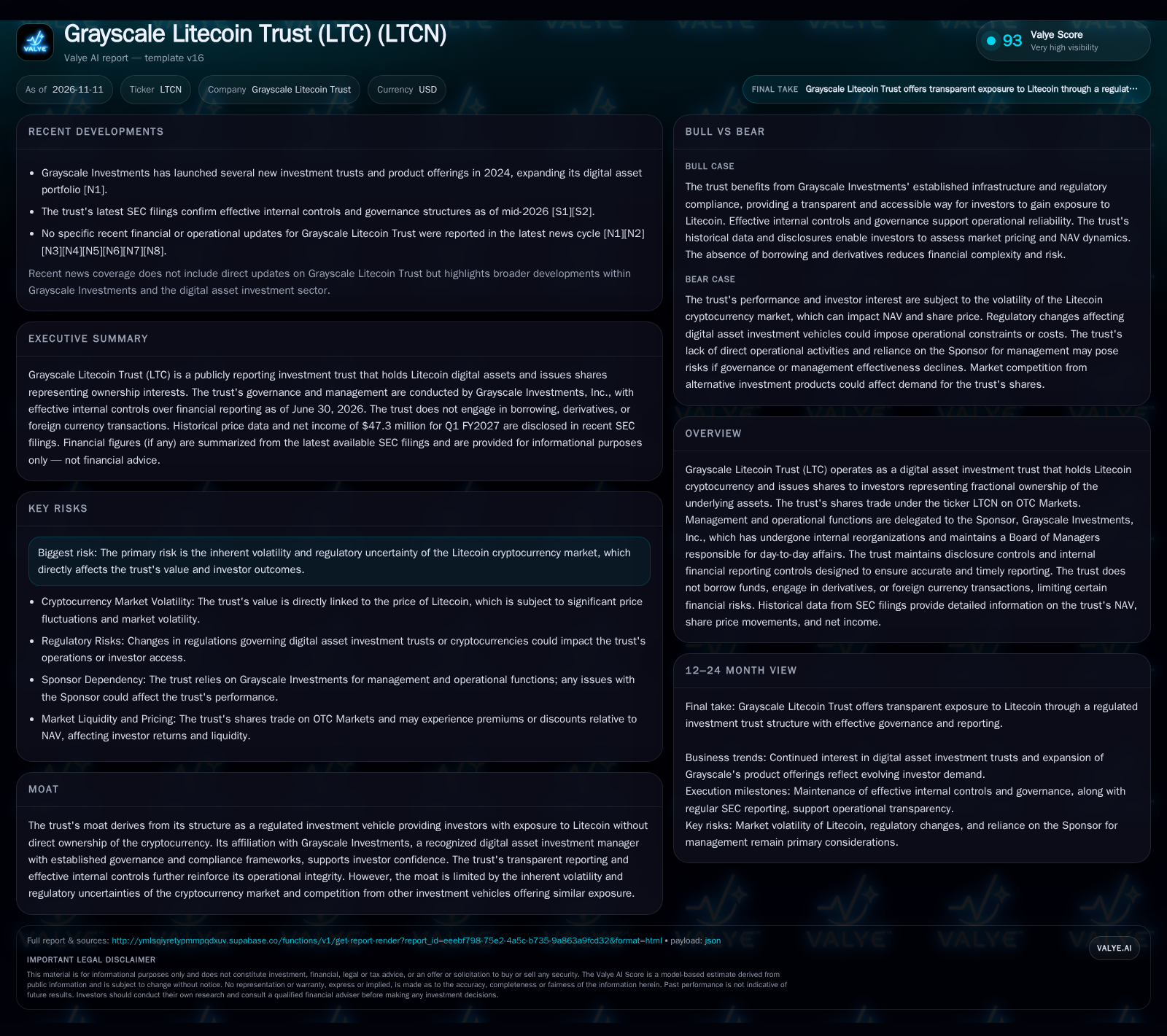
Grayscale Litecoin Trust (LTCN) provides investors with regulated, share-based exposure to Litecoin, managed by Grayscale Investments. Recent SEC filings confirm robust internal controls and significant quarterly net income, but the trust’s value is fundamentally exposed to Litecoin’s price volatility and ongoing regulatory uncertainty. Investor outcomes hinge on NAV/share dynamics, market sentiment, and the competitive landscape of crypto investment products. [S1] [S2]
Grayscale Litecoin Trust (LTCN) stands as a prominent, regulated conduit for institutional and retail investors seeking exposure to Litecoin without the operational complexity of direct crypto ownership. Its OTC-traded shares mirror the underlying value of held Litecoin, but the trust’s structure and market positioning create unique dynamics—namely, the potential for NAV premiums/discounts, regulatory scrutiny, and competitive pressure from newer investment products. With robust internal controls and a significant reported net income in its latest quarter, LTCN’s trajectory remains highly sensitive to Litecoin price movements and the evolving regulatory and product landscape for digital asset investment vehicles. [S1] [S2]
Recent SEC Filings Highlight Governance, Income, and Structural Simplicity
Grayscale Litecoin Trust (LTCN) reported net income of $47.3 million for the quarter ended September 30, 2026, underscoring the impact of Litecoin price appreciation during the period. [S2] The trust’s latest disclosures confirm that its internal controls over financial reporting and governance structures remain effective as of mid-2026. [S1] [S2] Operationally, LTCN does not engage in borrowing, derivatives, or foreign currency transactions, maintaining a simple structure that limits certain financial risks. [S1] Shares continue to trade on OTC Markets, where they can command premiums or discounts to NAV, reflecting investor sentiment and liquidity conditions. [S1] [S2]
Trust Structure Drives Economics: NAV, Premiums, and Fee Drag
The trust’s core economic model is straightforward: it holds Litecoin in custody and issues shares that represent proportional claims on the underlying crypto assets. Revenue and reported net income are primarily driven by changes in the market value of Litecoin, as trust assets are revalued in line with prevailing spot prices. Management fees, typically set as a percentage of assets under management, are deducted from trust assets and represent a structural fee drag over time—though specific fee rates are not detailed in the supplied evidence.
Unlike operating companies, LTCN does not generate cash flows from business operations, product sales, or services; all value accrual is tied to Litecoin’s price trajectory. There is no leverage or derivatives activity, which both reduces risk of forced liquidations and limits upside from financial engineering. The trust’s shares can trade at a premium or discount to NAV due to OTC market dynamics, investor demand, and liquidity constraints. This can create scenarios where investor returns diverge from changes in Litecoin’s spot price, introducing a layer of market risk unique to the trust structure.
Operating leverage is functionally absent, as costs are largely fixed or scale linearly with assets under management. Capital needs are minimal, with no significant reinvestment or working capital requirements. The trust’s simplicity is both a strength—reducing operational complexity—and a limitation, as it precludes ancillary revenue streams or active asset management.
Positioning Against Evolving Crypto Investment Vehicles
Grayscale Litecoin Trust competes in a landscape increasingly populated by alternative crypto investment products, including ETFs, ETPs, closed-end funds, and direct brokerage offerings. Its principal advantage lies in regulatory transparency, OTC market accessibility, and Grayscale’s established reputation as a digital asset manager. This can be especially attractive to investors who require or prefer regulated vehicles for crypto exposure.
However, the trust’s structure introduces counterforces: share price can diverge from NAV due to OTC trading frictions, potentially making alternatives like spot ETFs more attractive if they offer tighter tracking and lower fees. Furthermore, the trust’s value proposition is fundamentally tied to the perceived relevance and future adoption of Litecoin itself, which faces competition from both established cryptocurrencies (such as Bitcoin and Ethereum) and emerging blockchain platforms.
Switching frictions for investors are relatively low if more liquid, lower-fee, or better-tracking products become available. The trust’s moat is thus primarily derived from regulatory standing, brand affiliation, and historical presence, rather than intrinsic product differentiation.
Surging Litecoin Adoption and Regulatory Clarity Could Drive Premiums and Asset Growth
If Litecoin were to experience a surge in adoption, transaction volume, or integration into mainstream payment or DeFi platforms, demand for regulated exposure could rise sharply. This might manifest in significant inflows to LTCN, asset growth, and the return (or persistence) of share price premiums to NAV as investor demand outpaces available supply on OTC markets.
Regulatory developments that affirm or expand the legitimacy of digital asset investment trusts—and limit direct competition from spot ETFs—could further entrench LTCN’s position as a preferred vehicle for certain investor segments. Confirmation of this scenario would include sustained or widening premiums to NAV, increased trading volume, and growth in assets under management, all alongside rising Litecoin prices. Conversely, if LTCN fails to attract inflows despite favorable Litecoin trends or if share prices persistently trade at discounts, the upside thesis would be weakened.
Trust Performance Mirrors Litecoin Price with Persistent Tracking and Fee Friction
The most plausible path is that LTCN continues to provide NAV-linked exposure to Litecoin, with investor outcomes closely mirroring the underlying cryptocurrency’s volatility. Share prices may oscillate between modest premiums and discounts to NAV, depending on market sentiment, liquidity, and broader crypto investment trends.
Fee drag will gradually erode NAV per share relative to direct Litecoin holdings, but regulatory and operational simplicity may sustain a core investor base. New product launches by Grayscale or competitors could cause incremental shifts in demand, but absent major regulatory or technological shocks, the trust is likely to remain a stable, if undifferentiated, vehicle for Litecoin exposure.
Evidence for this scenario would include stable or slowly fluctuating discounts/premiums, consistent reporting of effective internal controls, and moderate trading activity. Large swings in NAV or share price would continue to reflect Litecoin’s inherent volatility rather than trust-specific developments.
Regulatory Crackdowns or Superior Alternatives Undermine Trust Appeal
A more adverse scenario would be triggered by regulatory changes that restrict or heavily scrutinize digital asset investment trusts, increase compliance burdens, or facilitate the approval of spot Litecoin ETFs with lower fees and tighter NAV tracking. In this situation, LTCN could see outflows, persistent and widening discounts to NAV, and declining trading activity as investors migrate to more attractive vehicles.
Additionally, if Litecoin itself were to lose relevance—due to technological obsolescence, security incidents, or a shift in market preference toward other cryptocurrencies—the trust’s NAV and demand for its shares would deteriorate. Confirmation would come from prolonged and deepening NAV discounts, shrinking assets under management, or regulatory actions specifically targeting the trust structure.
Milestones and Metrics That Will Shape Grayscale Litecoin Trust’s Trajectory
Trends in LTCN share price premiums or discounts to NAV, especially relative to competing products and Litecoin spot price moves.
Growth or contraction in assets under management, which would indicate changing investor demand for regulated Litecoin exposure.
Regulatory developments affecting the status, reporting requirements, or operational latitude of digital asset investment trusts.
Fee rate changes, if disclosed, and their impact on NAV erosion relative to direct Litecoin holding.
Trading volumes and liquidity on OTC Markets, which affect investor access and pricing efficiency.
Introduction or approval of competing, lower-fee, or more liquid Litecoin investment vehicles (such as ETFs).
Ongoing effectiveness of internal controls and governance, as reported in future SEC filings.
If disclosed, breakdowns of investor profile or concentration, which could reveal sensitivity to institutional vs. retail flows.
Disclaimer: This is research-only, informational analysis and not investment advice. It may include AI-generated interpretation and general industry context. Always verify important details using primary sources.

Comments