
US Energy Corp: Helium Project Execution, Fixed-Price Trade-Offs, and the Challenge of Capital Discipline in Volatile Markets
US Energy Corp’s pivot to industrial gases—anchored by a fixed-price helium sales agreement—offers revenue visibility but constrains upside and exposes the company to margin and counterparty risks. With a working capital deficit, tight liquidity, and large capital needs, the company’s future hinges on successful project delivery, disciplined capital allocation, and navigating commodity and regulatory volatility.
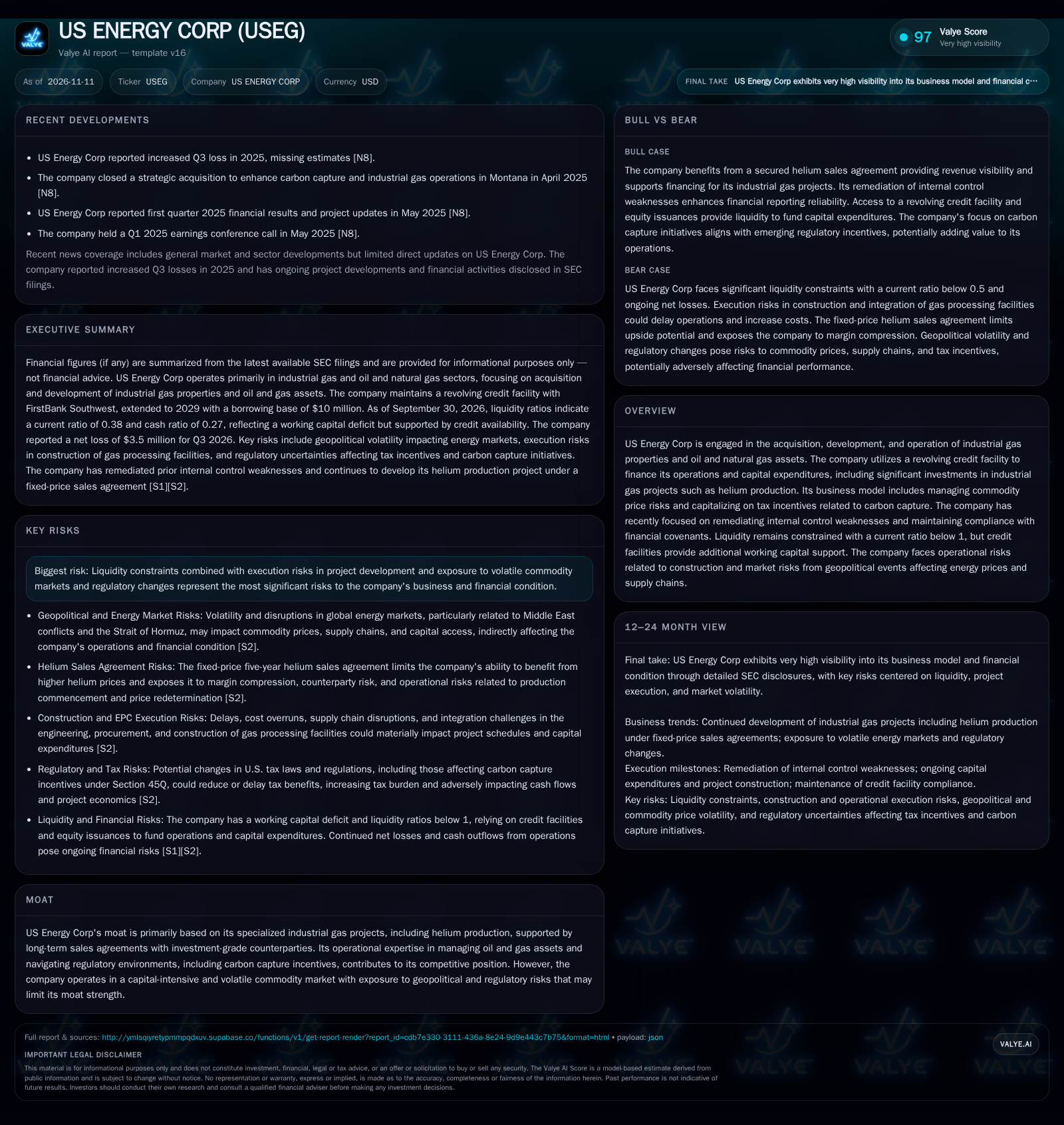
US Energy Corp is developing a domestic helium project under a fixed-price sales agreement, providing revenue visibility but capping price upside and introducing margin and counterparty risks. Execution risks in facility construction and regulatory uncertainty around carbon capture incentives remain central challenges. The company’s ability to deliver on project milestones and manage capital discipline will determine whether it can transition from cash outflows to sustainable operations. [S1] [S2]
US Energy Corp is at a strategic crossroads, shifting from a traditional oil and gas base toward industrial gas—most notably helium—while confronting the realities of capital scarcity, execution risk, and volatile commodity markets. The company’s five-year, fixed-price helium sales agreement provides rare revenue visibility in a cyclical sector but also caps potential gains if helium prices spike. With liquidity ratios below 1 and a working capital deficit, US Energy Corp’s ability to deliver its Big Sky project on time and within budget will be crucial to its future. The company must navigate tight financial resources, construction and integration risks, and an evolving regulatory landscape as it seeks to convert project investments into sustainable cash flow.
Helium Project and Fixed-Price Contract Define the Near-Term Outlook
US Energy Corp’s most material current developments are its ongoing investment in a domestic helium production project and the execution of a five-year, largely fixed-price helium sales agreement with an investment-grade counterparty. This contract provides valuable revenue visibility, a rarity in the commodity sector, and supports access to project financing. However, it also constrains upside if helium prices rise and exposes the company to potential margin compression or counterparty risk should costs escalate or the buyer default [S2].
Liquidity remains a central challenge. As of September 30, 2026, US Energy Corp held $2.915 million in cash and equivalents, with a current ratio of 0.38 and a working capital deficit. The company’s credit facility borrowing base was reduced to $10 million (from $20 million), with $2.5 million outstanding as of year-end 2025. Equity issuances and credit draws have recently funded capital needs, but the company continues to report net losses and negative operating cash flow [S1] [S2].
Execution risk around construction and commissioning of the gas processing facility is acute, with potential for delays, cost overruns, or integration missteps to derail the project timeline or economics [S2].
Industrial Gas Expansion: Capital Intensity and Revenue Visibility, but Margin Pressure Looms
US Energy Corp’s business model is evolving from a conventional oil and gas operator to an industrial gas player with a focus on helium. The economics of helium production are shaped by high upfront capital expenditures—$12 million was spent on acquisition and development in 2025—followed by operating leverage if the plant achieves designed throughput [S1]. The five-year fixed-price sales agreement provides predictable cash inflows once production commences, which is attractive to lenders and could support debt service or further project investment.
However, fixed-price contracts in a volatile market like helium can become a double-edged sword. If project costs escalate or spot helium prices rise materially, US Energy Corp may face margin compression, as it cannot pass higher costs or capture market upside. Conversely, if market prices fall, the contract provides downside protection—though this benefit must be weighed against the risk of counterparty default or contract renegotiation.
The company’s reliance on credit facility draws and equity issuances highlights the capital-intensive nature of its growth strategy. With a reduced borrowing base and ongoing negative cash from operations, US Energy Corp must carefully allocate capital and demonstrate project delivery to avoid further dilution or liquidity stress.
Specialization in Helium and Carbon Capture: Niche Advantages, but No Structural Insulation
US Energy Corp’s primary competitive differentiator is its focus on niche industrial gases—especially helium—backed by a long-term sales agreement with a credible counterparty. This provides a measure of revenue stability and may help secure financing relative to smaller or less-specialized competitors.
However, the industrial gas and helium sector is capital-intensive and exposed to global supply-demand swings. Larger, better-capitalized industrial gas companies, integrated energy majors, and private equity-backed consolidators all compete for attractive helium and specialty gas assets. The fixed-price nature of US Energy Corp’s contract, while offering stability, may limit its ability to capitalize on market shortages or price spikes that could benefit less hedged competitors.
The company’s efforts to leverage carbon capture incentives could bolster its economics if regulatory support is sustained, but this is not a proprietary advantage and may be quickly matched by peers. Operational expertise in project execution and navigating regulatory regimes is important, but not a durable moat absent cost or resource advantages.
Project Delivery and Regulatory Tailwinds Could Transform Cash Flow Profile
A favorable outcome for US Energy Corp would see the Big Sky helium project delivered on schedule and within budget, with the gas processing facility operating at or above initial throughput targets. The fixed-price sales agreement would then convert capital investment into stable operating cash flow, supporting debt service and potentially enabling reinvestment or deleveraging.
If U.S. carbon capture incentives are extended or expanded, US Energy Corp could realize additional tax benefits, improving project returns and cash generation. A benign regulatory environment and stable commodity input costs would further support margin realization.
Confirmation could also come from management guidance on throughput, cost control, and realization of tax credits.
Slow Progress and Tight Liquidity Define the Most Likely Course
The fixed-price contract provides a revenue floor but offers limited upside if market prices rise or costs increase unexpectedly.
Delays or cost overruns are possible, but not catastrophic, provided the company maintains compliance with its credit facility covenants and can access additional capital through either debt or equity. Operating leverage only materializes once the facility is fully operational and running at scale.
This scenario would be confirmed by persistent working capital deficits, continued reliance on external financing, and lumpy progress updates on project milestones. A gradual improvement in cash flow and liquidity would suggest successful execution, while further drawdowns or equity raises would indicate ongoing financial pressure.
Delays, Cost Overruns, and Margin Squeeze Could Threaten Viability
In an adverse scenario, project delays or EPC execution failures could drive up costs and push back revenue generation, forcing US Energy Corp to raise additional capital under unfavorable terms or risk technical default on its credit facility. If spot helium prices rise, the company is unable to benefit due to the fixed-price contract, while rising input or labor costs would directly erode margins.
Geopolitical disruptions or regulatory changes—such as reduced carbon capture incentives—could further squeeze cash flow or impair access to capital. In this scenario, persistent working capital deficits and net losses could lead to a downward spiral of dilution, asset sales, or even insolvency if liquidity is exhausted before the project becomes cash generative.
Evidence of this scenario would include missed construction milestones, cost overruns, covenant breaches, significant further equity dilution, or negative revisions to project economics.
Milestones and Metrics That Will Reveal Whether US Energy Corp Can Deliver on Its Industrial Gas Pivot
Progress against construction and commissioning milestones at the Big Sky helium project, including mechanical completion and initial production dates.
Operating cash flow trends: the transition from negative to positive cash generation as the helium facility ramps up would signal sustainable economics.
Changes in working capital deficit and liquidity ratios, especially if disclosed quarterly, to assess near-term funding pressure.
Utilization and compliance with the revolving credit facility, including any changes to the borrowing base or covenant waivers.
Throughput and realized pricing (if disclosed) for helium production relative to contract terms and market benchmarks.
Updates on regulatory and tax incentive landscape, particularly U.S. Section 45Q carbon capture credits or other subsidies relevant to project economics.
Any signals of counterparty risk, renegotiation, or default under the fixed-price sales agreement.
Disclosures around further equity issuances or asset sales, which would indicate ongoing capital needs or stress.
Disclaimer: This is research-only, informational analysis and not investment advice. It may include AI-generated interpretation and general industry context. Always verify important details using primary sources.

Comments