
Alto Neuroscience: Clinical-Stage Precision Psychiatry and the Capital-Fueled Race for Differentiation
Alto Neuroscience is advancing a broad pipeline of biomarker-driven psychiatric therapies, backed by substantial capital and market interest. The company’s ability to translate early clinical progress into regulatory success and eventual commercialization will test the competitive promise of its precision medicine approach amid persistent development, funding, and execution risks.
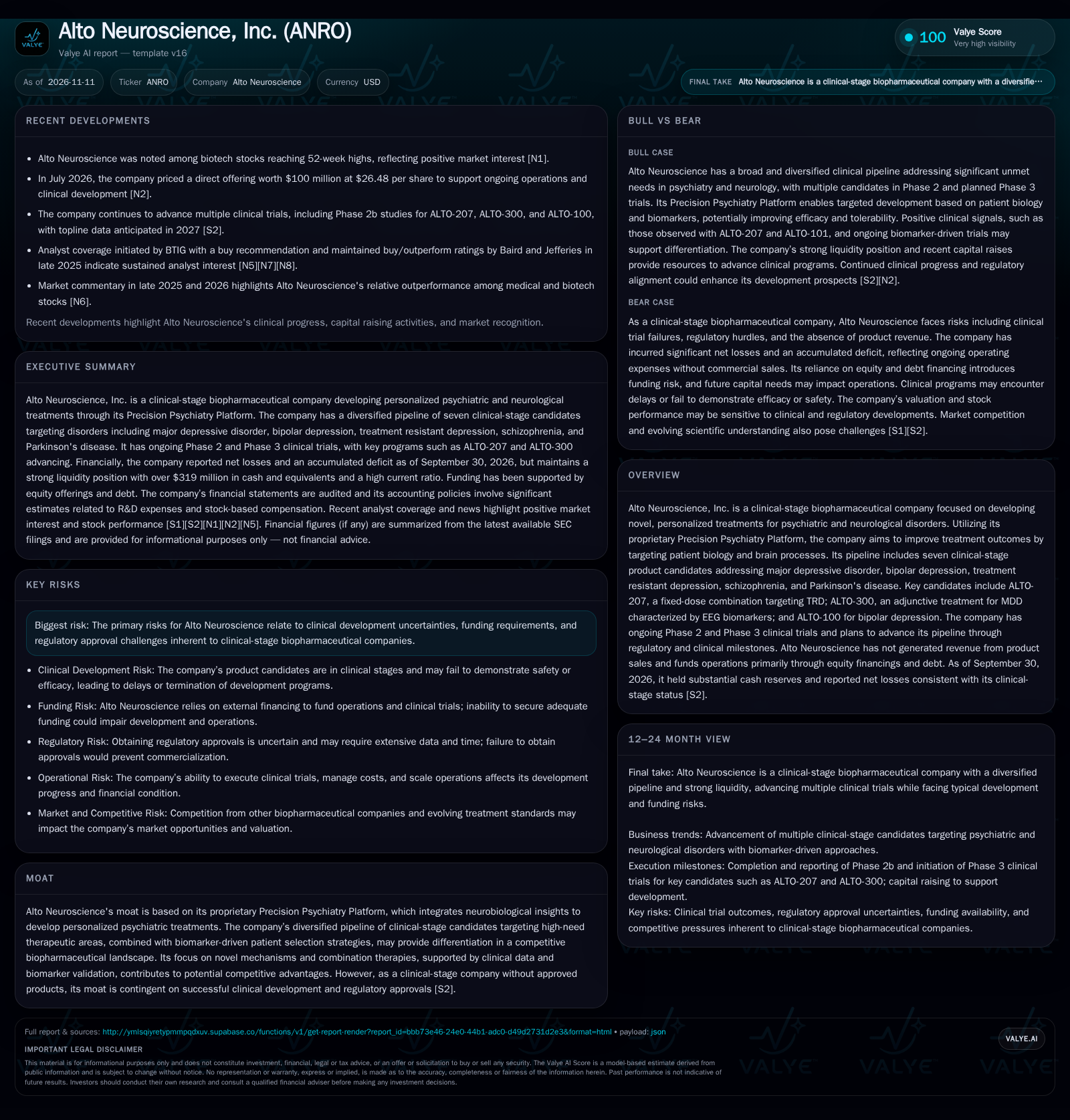
Alto Neuroscience is a clinical-stage biotech focused on personalized treatments for psychiatric and neurological disorders. With seven clinical-stage candidates and major programs in Phase 2b trials, the company is betting on its Precision Psychiatry Platform to drive future efficacy and differentiation. Despite substantial net losses, Alto holds over $319 million in cash (as of September 2026) following a $100 million equity raise in July 2026. Its trajectory hinges on clinical readouts in 2027, the scalability of its biomarker strategy, and the ability to convert pipeline breadth and capital into regulatory and commercial milestones [S2] [N2].
Alto Neuroscience is positioning itself at the intersection of precision medicine and neuropsychiatry, advancing a diverse pipeline of clinical candidates powered by its proprietary biomarker-driven platform. However, the company’s long-term value will ultimately depend on its ability to deliver compelling clinical data, navigate regulatory hurdles, and demonstrate that its approach can outperform traditional psychiatric drug development—both clinically and economically.
Recent Capital Infusion and Clinical Pipeline Milestones Shape Alto’s Near-Term Outlook
Alto Neuroscience is deep in clinical development, with seven candidates addressing major depressive disorder, bipolar depression, treatment-resistant depression, schizophrenia, and Parkinson’s disease. In 2026, the company initiated a Phase 2b trial of ALTO-207 for treatment-resistant depression and advanced ALTO-300 and ALTO-100 into Phase 2b trials for MDD and bipolar depression, respectively. Topline data for these programs is anticipated in 2027, which will be pivotal for future regulatory and commercial plans [S2].
The company reported cash and cash equivalents of $319.3 million for the period. These funds provide Alto with the capital needed to sustain operations and progress its pipeline, albeit with continued net losses ($25.1 million for Q3 2026) and a cumulative deficit of $280.6 million [S2] [N2].
The company’s stock has reached 52-week highs, and it has attracted new analyst buy ratings, underscoring market optimism but also raising expectations that will be tested by upcoming clinical and regulatory milestones [N1] [N5] [N7] [N8].
Precision Psychiatry and the Economics of Biomarker-Driven Drug Development
Alto’s business model is classic clinical-stage biotech: significant upfront R&D investment, no current product revenue, and operating losses funded by equity and debt. What distinguishes Alto is its Precision Psychiatry Platform, which aims to segment patients using neurobiological and EEG biomarkers to increase the probability of clinical success and, ultimately, commercial value. If successful, this approach may enable more targeted trials (potentially reducing sample sizes and development costs per successful candidate) and could support premium pricing for demonstrated efficacy in hard-to-treat populations.
The economics of this model are highly leveraged to clinical inflection points. Success in ongoing Phase 2b or Phase 3 trials could unlock partnerships, non-dilutive funding, or eventual revenue streams. However, each candidate’s failure risks both sunk costs and the erosion of investor confidence, with little revenue to offset R&D outlays.
Should Alto’s biomarkers prove predictive and clinically meaningful, the company could seek to license its platform or partner on co-development, creating new revenue sources beyond traditional drug sales. However, the commercial realization of biomarker-driven psychiatry remains largely unproven at scale, and payor willingness to reimburse for such stratification is not yet established.
Platform Differentiation and the Race Against Traditional and Digital Neuropsychiatry Peers
The core of Alto’s competitive position lies in its proprietary biomarker-driven approach, which, if validated, could address the well-known heterogeneity and high failure rates in psychiatric drug development. This strategy may allow Alto to carve out a differentiated niche versus traditional pharmaceutical companies developing 'one-size-fits-all' antidepressants and antipsychotics.
However, the field is competitive and evolving. Other biotechs and large pharma are increasingly integrating digital and biological markers into CNS trial design. There is also growing competition from digital therapeutics, neuromodulation devices, and psychedelic-based therapies—all targeting the same high-need populations Alto addresses. The company’s ability to demonstrate superior outcomes, particularly in treatment-resistant or biomarker-defined subgroups, will be critical to establishing a durable moat.
Switching costs in psychiatry are historically low, but if Alto’s candidates are approved and marketed with validated companion diagnostics, it could create a degree of clinical and commercial stickiness. Until then, the company remains vulnerable to shifting scientific paradigms and the rapid evolution of neuropsychiatric treatment standards.
Validation of Biomarker-Driven Efficacy Could Unlock Platform Value and Accelerate Partnerships
The most favorable scenario is that Alto’s upcoming Phase 2b and Phase 3 trials deliver robust, biomarker-driven efficacy signals—especially for ALTO-207 in treatment-resistant depression and ALTO-300 in MDD. Positive topline data would not only de-risk these lead assets but also validate the company’s Precision Psychiatry Platform, potentially attracting partnership interest from major pharmaceutical companies or enabling premium pricing in targeted populations.
Evidence supporting this scenario would include statistically significant improvements in primary clinical endpoints, strong safety/tolerability profiles, and the demonstration that biomarker-positive patients are more likely to benefit—thereby confirming the platform’s predictive value. Further, successful readouts could pave the way for expedited regulatory pathways (such as Breakthrough Therapy Designation) and non-dilutive funding opportunities.
A visible catalyst would be the announcement of a partnership, licensing deal, or acquisition interest following positive trial results, which would confirm external validation of Alto’s approach.
Clinical Progress Continues, but Commercial and Regulatory Proof Remain on the Horizon
The most plausible outcome is that Alto continues to advance its lead programs through ongoing trials, with mixed or incremental results typical of CNS drug development. Some candidates may show promising, but not unequivocal, efficacy or safety signals, justifying further development or potential partnering for specific indications.
The company may secure modest partnerships or grants, but large-scale licensing or commercialization deals remain contingent on more definitive efficacy data.
Confirmation of this scenario would be steady clinical trial enrollment and completion, timely data releases, and continued ability to raise capital on reasonable terms. Falsification would arise from a material clinical setback across multiple programs or the inability to fund additional development without excessive dilution.
Clinical Setbacks and Funding Pressures Could Erode Platform Credibility and Investor Support
The adverse scenario is defined by negative or inconclusive results from ongoing Phase 2b or Phase 3 trials—particularly if biomarker-driven stratification fails to yield meaningful efficacy or safety improvements. Such outcomes would undermine the core thesis of Alto’s platform and could trigger a sharp loss of investor confidence.
With no product revenue and high fixed R&D costs, clinical failure would force Alto to either halt programs, seek partners from a position of weakness, or raise additional capital at dilutive terms. Persistent negative data could also make it harder to attract or retain strategic partners, talent, and institutional support.
Evidence supporting this scenario would include missed clinical endpoints, adverse safety findings, delays in trial enrollment or data reporting, or an inability to raise additional funds without significant valuation concessions.
Milestones and Measures That Will Determine Alto’s Precision Psychiatry Thesis
Readout of topline data from Phase 2b trials for ALTO-207 (TRD), ALTO-300 (MDD), and ALTO-100 (bipolar depression) in 2027—these will be the clearest tests of platform efficacy [S2].
Demonstration of biomarker-driven patient stratification actually improving clinical outcomes relative to non-stratified or standard-of-care groups—if disclosed.
Initiation and progress of planned Phase 3 trials for ALTO-207 and other lead candidates, with timely enrollment and regulatory engagement.
Announcements of strategic partnerships, licensing deals, or non-dilutive funding, which would signal external validation of Alto’s approach.
Progress on ALTO-101 out-licensing or partnering for cognitive impairment in schizophrenia, which would test the company’s ability to monetize non-core assets.
Any evidence of payor or regulatory receptivity to biomarker-driven psychiatric treatments, which would support the commercial viability of Alto’s model.
Disclaimer: This is research-only, informational analysis and not investment advice. It may include AI-generated interpretation and general industry context. Always verify important details using primary sources.

Comments