
Rare Earths Americas: Capitalized Ambition, Development Risks, and the High-Stakes Path to U.S. Critical Minerals Supply
Rare Earths Americas, Inc. enters the public markets with a substantial reported cash balance and a portfolio of early-stage rare earth projects, seeking to capitalize on intensifying demand for domestic critical minerals. The core question is whether its resources and strategy can overcome the formidable technical, regulatory, and market challenges that define the rare earth mining sector.
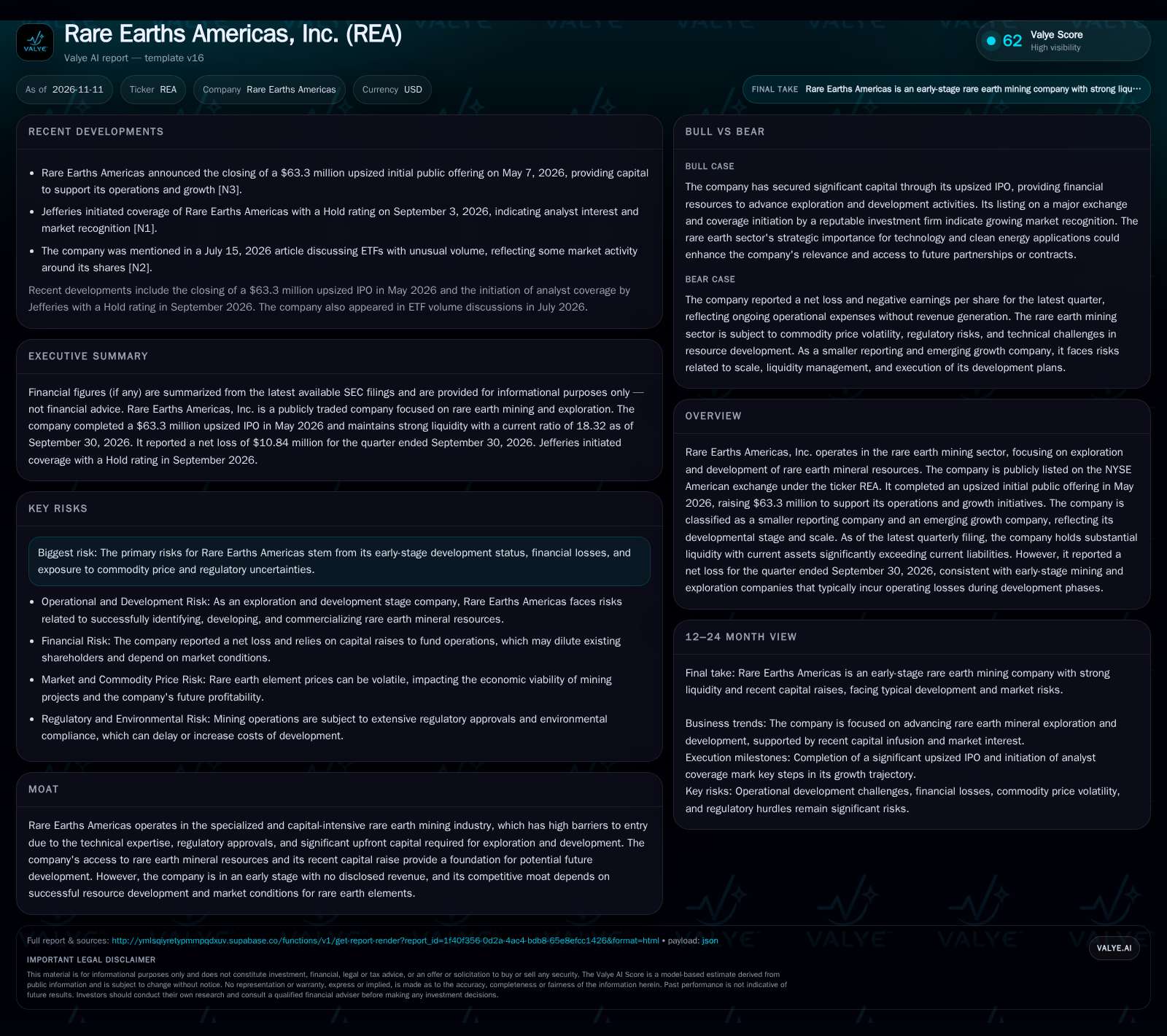
Rare Earths Americas, Inc. (REA) is an early-stage explorer in the rare earths sector, recently raising $63.3 million in an upsized IPO. The company holds $69.89 million in current assets versus $3.81 million in current liabilities, resulting in exceptionally high liquidity. However, REA is pre-revenue, posted a net loss of $10.84 million last quarter, and faces all the operational, regulatory, and commodity risks typical of its industry and stage. The thesis turns on whether its capital and assets can be converted into a viable, scalable supply of rare earth materials.
Rare Earths Americas, Inc. (NYSE American: REA) has emerged from its recent upsized IPO with a formidable cash position and a stated mission to develop a U.S.-aligned portfolio of rare earth mineral assets. With $69.89 million in current assets and no debt stress, the company enjoys a rare degree of financial runway for a pre-revenue mining explorer. Yet with all projects still in the exploration stage and quarterly net losses exceeding $10 million, the company’s future will likely hinge on its ability to rapidly convert capital into tangible progress—navigating technical, regulatory, and market risks that have historically challenged even well-capitalized rare earth ventures.
IPO Windfall and Early-Stage Losses: Setting the Stage for Rare Earths Americas
Rare Earths Americas, Inc. completed an upsized initial public offering in May 2026, raising $63.3 million—an event that positions the company with a significant liquidity advantage compared to many early-stage mining peers [N3]. As of September 30, 2026, REA reported $69.89 million in current assets versus $3.81 million in current liabilities, resulting in a current ratio of 18.32 and a cash ratio of 17.91 [S1]. This financial cushion is notable, but the company remains in the exploration phase, having reported a net loss of $10.84 million for the quarter and no revenue generation to date [S1]. Jefferies’ Hold rating initiation in September 2026 further signals financial market attention but also underscores the market’s wait-and-see attitude regarding the company’s near-term prospects [N1].
Economic Model: From Exploration Expense to Extraction Potential
Rare Earths Americas’ economics are currently defined by exploration and development outlays, with no cash inflow from mineral sales. The company’s cost structure is dominated by land acquisition, drilling, geotechnical studies, and permitting—highly variable expenses that can escalate quickly in response to technical challenges or regulatory delays. Until resource definition and feasibility studies are complete, capital is expended with the goal (but not the guarantee) of delineating commercially viable deposits.
Should REA succeed in advancing one or more projects to the development stage, the economics would shift dramatically. Rare earth mining is capital-intensive, requiring significant up-front investment in infrastructure, environmental compliance, and processing technology. However, once operational scale is reached, operating leverage can be substantial: fixed costs are high, but incremental production costs may decline if ore grades and recoveries are favorable. Pricing power is limited by global commodity markets, but U.S.-based supply could command a premium in geopolitically tense environments. The key economic unknowns are the grade, size, and accessibility of any ultimately proven deposits, all of which remain to be established.
In addition to the capital intensity inherent in rare earth mining, the timeline from exploration to production can span several years, during which market conditions and technological requirements may shift. This temporal gap introduces uncertainty in forecasting project viability and return on investment. The company must therefore balance aggressive exploration with prudent capital allocation to avoid overextension. Moreover, the integration of emerging processing technologies could materially affect cost structures and environmental footprints, potentially enhancing economic feasibility if successfully adopted. Conversely, failure to innovate or adapt to stricter environmental standards could increase operational expenses and delay project advancement.
Barriers, Substitutes, and the Global Race for Rare Earths
The rare earth sector is characterized by formidable entry barriers—technical complexity, regulatory scrutiny, and high capital requirements. REA’s U.S. focus and portfolio of exploration-stage properties seek to capitalize on both national security concerns and the drive for supply chain independence from dominant global suppliers, particularly China. The company’s potential competitive advantage rests on moving projects from exploration to development faster than rivals, establishing resource credibility, and aligning with downstream partners or government initiatives.
However, the field is crowded with both established producers and other explorers, some of whom may have more advanced projects, stronger relationships with strategic buyers, or proprietary processing technologies. Substitutes for certain rare earth elements are limited in high-tech and clean energy applications, but demand is subject to technological change and cyclical end markets. Ultimately, REA’s differentiation will depend on the quality of its deposits, speed of development, and ability to forge partnerships that convert resources into marketable products.
REA’s positioning also depends on the evolving geopolitical landscape, which influences supply chain security considerations and government policies favoring domestic production. Should international tensions escalate or trade policies tighten, domestic rare earth producers like REA could gain preferential access to funding or markets, enhancing their competitive stance. However, if global supply chains stabilize or alternative sources emerge, the strategic premium on U.S.-based production may diminish, intensifying competition. Additionally, technological advances in recycling or substitution could alter demand dynamics, requiring REA to continuously assess market trends and pivot strategies accordingly to maintain relevance and competitiveness.
Unlocking Value: How Resource Definition and Policy Tailwinds Could Transform REA
The most constructive scenario for Rare Earths Americas would see its exploration efforts yield one or more deposits that are independently verified as commercially viable, catalyzing a shift from capital consumption to value creation. If REA can publish positive resource estimates, secure permitting, and attract either strategic partners or government support, its assets could appreciate rapidly. U.S. policy incentives—such as grants, loan guarantees, or offtake agreements—could further accelerate development and enhance project economics.
Confirmation of this scenario would require disclosure of NI 43-101 or S-K 1300 compliant resource estimates, successful completion of feasibility studies, and announcements of permitting milestones or partnership agreements. Evidence that capital deployment is yielding stepwise increases in asset value, rather than simply funding ongoing losses, would strongly support the bull case.
Progress Amid Uncertainty: What Sustained Exploration Looks Like
The most plausible medium-term outcome is that REA continues to invest its IPO proceeds in advancing exploration across its portfolio, with incremental progress on drilling, resource definition, and permitting but without near-term transition to production or revenue. Costs remain elevated, and the company may need to periodically raise additional capital—potentially diluting shareholders if market conditions are not favorable.
In this base case, REA’s valuation and liquidity would be supported by positive technical updates, but the absence of proven reserves or clear development timelines would limit upside.
When Capital Runs Out: The Risks of Exploration Failure and Market Headwinds
In this scenario, the company would face the prospect of raising additional capital at unfavorable terms or suspending operations. Technical failures—such as low grades, metallurgical challenges, or insurmountable permitting hurdles—could render projects uneconomic and erode investor confidence.
External factors could also accelerate downside risk: a collapse in rare earth prices, tightening of equity capital markets, or regulatory changes could all restrict REA’s ability to advance projects or raise funds. Confirmation of this scenario would be visible in persistent operating losses, negative technical updates, and shrinking cash balances without offsetting progress on resource definition or partnership formation.
Milestones That Will Determine Rare Earths Americas’ Trajectory
Disclosure of NI 43-101 or S-K 1300 compliant mineral resource estimates for any project would provide crucial evidence of economic potential.
Updates on permitting progress, including environmental approvals and community engagement outcomes, would help assess the path to development.
Announcements of strategic partnerships, joint ventures, or offtake agreements would indicate growing market validation and external support.
A useful metric would be the rate of cash burn relative to technical milestones achieved—testing whether capital is being deployed efficiently.
Any material change in rare earth commodity prices or U.S. policy support for domestic mining would directly affect project economics and investor sentiment.
Progress reports on drilling, metallurgical test work, and engineering studies would clarify the technical derisking of REA’s asset base.
If disclosed, updates on additional equity or debt financing would reveal both market appetite and the company’s capital discipline.
Disclaimer: This is research-only, informational analysis and not investment advice. It may include AI-generated interpretation and general industry context. Always verify important details using primary sources.

Comments