
Zion Oil & Gas: Exploration Progress, Capital Risk, and the Search for Israeli Hydrocarbons
Zion Oil & Gas advances exploration in Israel with new stimulation methods and observed gas flows, but remains pre-revenue, capital-dependent, and exposed to geopolitical and operational risks. The company’s next phase hinges on converting technical gains into commercial output while sustaining investor support through continued capital raises.
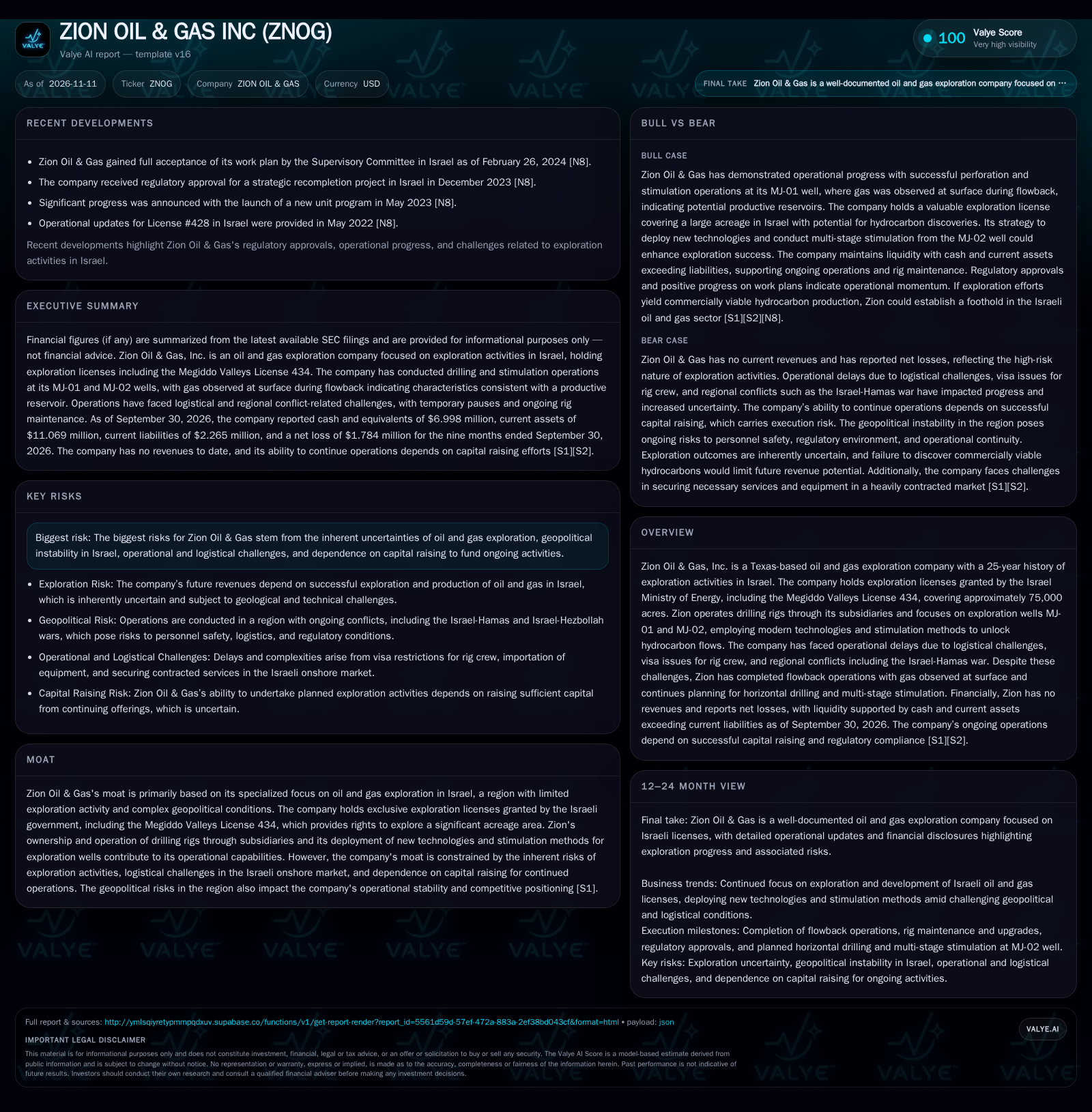
Zion Oil & Gas is progressing with modern exploration efforts in Israel, having observed gas at the surface in its MJ-01 well and planning advanced drilling at MJ-02. Despite no current revenue and ongoing net losses, the company maintains a liquidity cushion but is reliant on raising additional capital. The path to commercial success depends on whether technical progress translates to sustained hydrocarbon production and whether capital markets remain supportive amid operational and geopolitical uncertainties. [S1] [S2]
Zion Oil & Gas is at a pivotal juncture in its decades-long quest to unlock Israel’s hydrocarbon potential. With exclusive exploration licenses, recent technical progress at its MJ-01 well, and advanced drilling plans for MJ-02, the company has taken tangible steps toward commercial discovery. However, Zion remains pre-revenue, posting operating losses, and remains fundamentally reliant on capital markets to fund operations. The company’s future hinges on whether technical advances can be translated into sustained production and revenue before financial and geopolitical risks undermine its momentum. [S1] [S2]
Recent Operational Progress and Persistent Financial Dependence
Zion Oil & Gas operates as a pure-play exploration company focused on Israel, with the Megiddo Valleys License 434 as its central asset. This license, awarded in September 2023 and valid for at least three years (with possible extensions to 2030), covers approximately 75,000 acres and supersedes the company’s previous license. The MJ-01 well has shown surface gas flows during flowback, a technical milestone that suggests the presence of hydrocarbons and motivates further investment in horizontal drilling and multi-stage stimulation, particularly at the MJ-02 well. Despite these technical advances, Zion remains pre-revenue—with zero recorded revenue for 2025 and a net loss of $1.784 million for the nine months ended September 30, 2026. The company reported cash and liquidity metrics for the period; these figures do not by themselves establish operating runway, investment capacity, financial flexibility, or financing capacity. [S1] [S2]
Exploration Economics: High Fixed Costs, Uncertain Payoff, and Capital Intensity
Zion Oil & Gas’s business model is quintessentially high-risk, high-reward. The company incurs significant upfront fixed costs—leasing acreage, drilling, completing and stimulating wells, and importing specialized equipment and services into Israel’s tightly regulated market. Variable costs, while present, are dwarfed by the initial capital outlays required for each exploration phase. Revenue will only materialize upon the successful discovery, testing, and commercial production of hydrocarbons in sufficient volume and at favorable market prices.
Operating leverage is substantial: if exploration succeeds and production scales, incremental operating costs per barrel could fall rapidly, driving margin expansion. However, until a commercial discovery is proven, all expenditures are sunk costs, and cash burn is inevitable. The company’s liquidity position, while currently positive, is not self-sustaining and requires periodic capital infusions—typically through equity offerings, which dilute existing shareholders and are sensitive to market sentiment and technical milestones.
If Zion transitions from exploration to production, the economics could shift dramatically: revenue visibility would improve, capital needs would rebalance toward field development and infrastructure, and the company could potentially access debt markets. However, as of now, the path to positive cash flow remains highly contingent on exploration success.
Navigating Israel’s Niche: License Exclusivity, Geopolitical Barriers, and Service Constraints
Zion’s competitive position is shaped by its exclusive licenses and the unique geopolitical and regulatory context of Israel’s onshore oil and gas sector. Few international operators are active in the region, given its modest hydrocarbon history, complex permitting regime, and heightened security risks. This relative lack of competition gives Zion a rare opportunity to capture first-mover advantage if it proves commercial reserves.
However, these same barriers also limit access to best-in-class service providers, create procurement bottlenecks, and raise costs. Zion’s ownership of drilling rigs via subsidiaries could reduce contractor dependence, but does not fully insulate the company from import restrictions, supply chain delays, or labor constraints—challenges exacerbated by recent regional conflicts.
Substitution risk is twofold: (1) If domestic or regional competitors (including larger, better-capitalized energy firms) re-enter the Israeli market, Zion could lose its edge; (2) If alternative energy sources or imported fuels remain cheaper or less risky, market appetite for new onshore oil and gas supply may be limited. Nevertheless, Israel’s strategic interest in domestic energy security provides a potential policy tailwind if Zion delivers tangible results.
Unlocking Commercial Flows: How Technical Success Could Transform the Business
The bull case for Zion Oil & Gas centers on converting recent technical milestones—surface gas flows at MJ-01 and planned horizontal drilling at MJ-02—into sustained, measurable hydrocarbon production. If multi-stage stimulation yields commercial flow rates, the company could rapidly transition from pure exploration to appraisal and early-stage development, unlocking its acreage’s latent value.
Confirmation would come from: (1) independent third-party reserve certification; (2) regulatory approval for production; (3) initial sales contracts or offtake agreements; and (4) demonstrable, recurring production volumes. These milestones would likely catalyze investor confidence, facilitate more favorable capital raising, and potentially attract strategic partners or acquirers. Falsification would occur if repeated stimulation fails to achieve commercial rates, or if technical setbacks and regulatory delays erode operational momentum.
Technical Progress Meets Funding Reality: Most Likely Trajectory
The most plausible near-term outcome is a continuation of Zion’s current pattern: incremental technical advances, continued investment in well stimulation and evaluation, and periodic pauses driven by capital constraints or logistical bottlenecks. The company will likely raise additional equity or convertible debt as needed, diluting existing shareholders but keeping operations afloat.
Progress would be marked by successful sidetracking and lateral drilling at MJ-02, improved flowback results, and initial regulatory steps toward production approval. However, without a clear commercial discovery, the company will remain pre-revenue and vulnerable to funding fatigue. Evidence supporting this scenario includes ongoing technical updates without major discoveries, steady but modest capital raises, and the absence of large-scale partnerships or offtake deals. Falsification would involve either a breakthrough commercial flow or, conversely, an operational or financial setback that stalls progress for an extended period.
When Exploration Stalls: Risks of Non-Commercial Outcomes and Capital Exhaustion
In the adverse scenario, repeated attempts at stimulation and horizontal drilling fail to yield commercial hydrocarbon flows. Technical setbacks—such as poor reservoir quality, equipment failures, or regulatory delays—compound the operational risk. If the company is unable to demonstrate progress, investor appetite for further capital raises could dry up, leading to a liquidity crisis.
This would likely force Zion to suspend operations, relinquish licenses, or seek distressed asset sales. Confirmation of this scenario would include a prolonged absence of positive technical updates, failed or undersubscribed capital offerings, and a shrinking cash balance relative to forward commitments. Regional instability or adverse regulatory changes could accelerate this outcome, underscoring the fragility of Zion’s position absent a commercial breakthrough.
Milestones That Will Shape Zion’s Value Proposition
Results of horizontal drilling and multi-stage stimulation at the MJ-02 well—commercial flow rates or third-party reserve certification would be pivotal.
Frequency, structure, and investor uptake of new capital raises—offering terms, dilution levels, and market receptivity will gauge financial runway.
Updates on regulatory approvals for production or field development—progress here would indicate de-risking of the commercial pathway.
Any material technical setbacks, such as equipment failures or adverse reservoir findings, that could delay or derail operations.
Changes in the regional security environment in north central Israel—any direct impact on field operations, supply chains, or personnel safety.
Entry of new competitors, joint venture partners, or service providers into the Israeli onshore exploration market.
A useful metric would be recurring production volumes, if achieved, and sales contracts/offtake agreements to confirm commercial transition.
Disclaimer: This is research-only, informational analysis and not investment advice. It may include AI-generated interpretation and general industry context. Always verify important details using primary sources.

Comments