
West Coast Community Bancorp: Profitability Momentum, Volatility Signals, and the Challenge of Sustaining Outperformance
The company’s financial trajectory, analyst attention, and market response suggest both resilience and sensitivity to operational shifts.
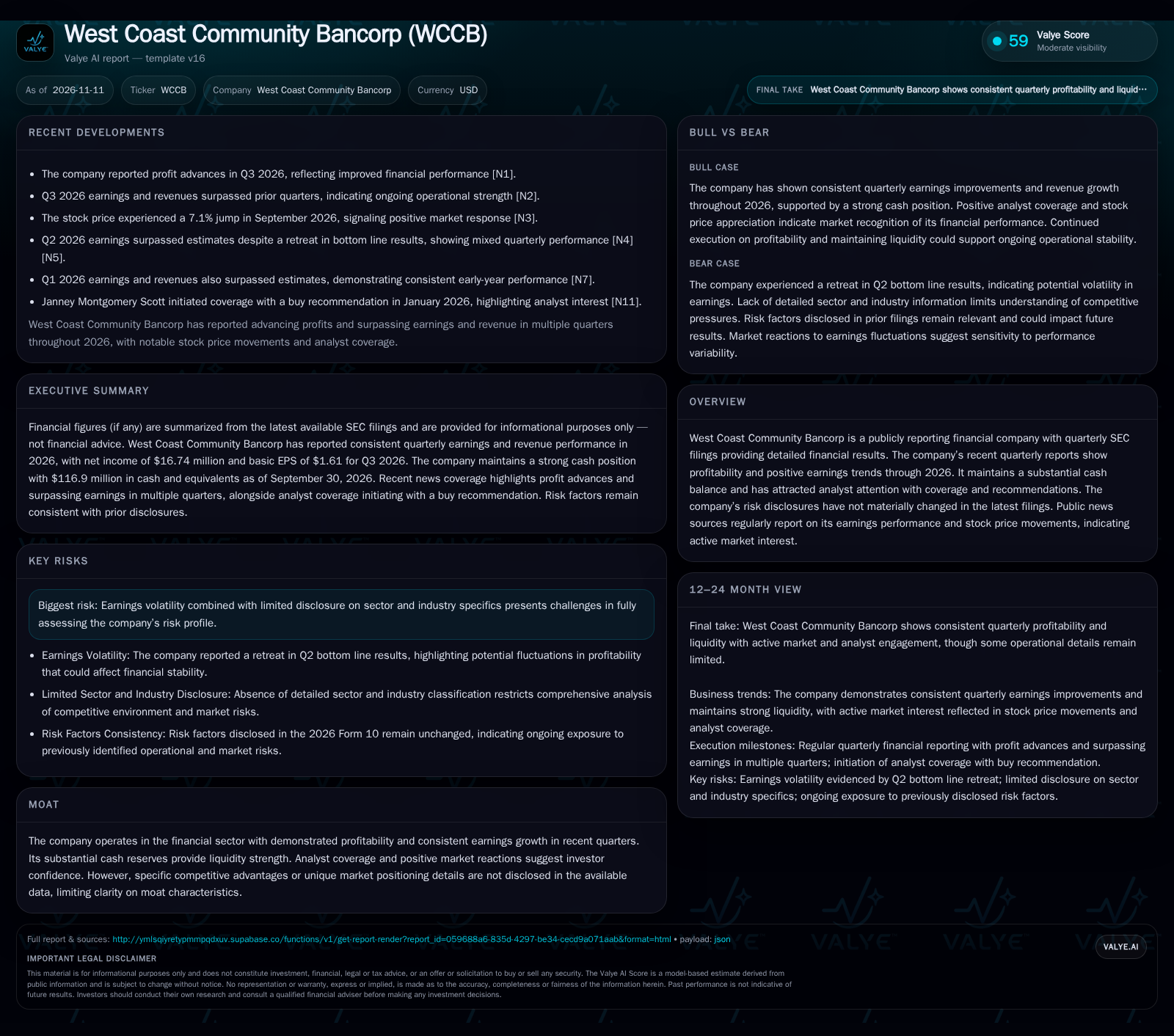
WCCB posted strong Q3 2026 results with $16.74M net income and $1.61 EPS, extending a pattern of quarterly outperformance, while maintaining $116.9M in cash. A Q2 bottom-line retreat and limited sector visibility raise questions about consistency and competitive positioning. Market and analyst enthusiasm are evident, but future resilience will hinge on sustaining core profitability amid potential volatility and opaque external pressures. [S1] [N1] [N2] [N3] [N5]
West Coast Community Bancorp’s 2026 financials paint a picture of a nimble, profitable regional bank capable of exceeding market expectations, as evidenced by strong Q3 earnings and a significant cash position. Yet, the company’s Q2 earnings retreat, coupled with limited transparency regarding its competitive environment and sector specifics, raises important questions about the durability of its outperformance. As analyst and market attention intensifies, the focus shifts from recent momentum to the mechanisms that could sustain—or erode—future profitability.
Earnings Beats, reported cash balance, and Market Recognition Define 2026 Backdrop
West Coast Community Bancorp reported net income of $16.74 million and basic EPS of $1.61 for Q3 2026, marking a rebound from a Q2 bottom-line retreat and extending a pattern of quarterly outperformance. These results have driven both analyst engagement—evidenced by a new buy recommendation—and a 7.1% stock price jump in September 2026. However, the Q2 profit dip underscores that earnings volatility remains a live issue. [S1] [N1] [N2] [N3] [N5]
How West Coast Community Bancorp’s Business Model Translates to Bottom-Line Performance
As a community bank, WCCB likely derives core revenue streams from net interest income (the spread between interest earned on loans and paid on deposits), fee-based services, and potentially investment gains. The Q3 net income surge suggests that loan growth, improved net interest margins, or a favorable funding mix may have contributed, but the absence of segment disclosure leaves these as plausible mechanisms rather than confirmed facts.
Fixed costs—branch network, compliance, technology—are partially offset by operating leverage as assets grow, but regional banks are also exposed to variable costs such as credit losses, funding volatility, and regulatory expenses.
Sustained profitability for a community bank typically hinges on disciplined underwriting, cost control, and the ability to attract low-cost core deposits. If WCCB’s earnings beats reflect these fundamentals rather than nonrecurring items, the model may be durable; otherwise, margin compression or credit normalization could threaten future results.
The sensitivity of WCCB’s net interest margin to interest rate fluctuations is a critical factor in assessing earnings durability. Community banks often have a limited ability to rapidly reprice assets and liabilities, which can lead to margin compression in rising rate environments or margin expansion when rates stabilize. The bank’s funding mix—particularly the proportion of core deposits versus wholesale or brokered deposits—affects its cost of funds and thus profitability. Additionally, the impact of regulatory capital requirements on lending capacity and risk-weighted asset management can constrain growth opportunities or necessitate more conservative underwriting, influencing both revenue and credit risk profiles.
Competitive Dynamics: Opaque but Critical for Assessing Durability
The lack of detailed sector or geographic disclosure clouds a precise evaluation of WCCB’s competitive landscape. Generally, community banks face pressure from larger national banks, fintech entrants, and credit unions, all vying for the same lending and deposit base. Scale advantages, technology investments, and customer relationships are central to defending against margin erosion and deposit flight.
If WCCB’s recent outperformance is due to a sticky local customer base, superior underwriting, or niche market focus, it may enjoy higher switching costs or lower credit losses. Conversely, absent a clear moat or technology edge, it could be vulnerable to aggressive rate competition, digital disintermediation, or regulatory shifts. The positive market reaction and analyst coverage suggest some perceived strength, but the absence of segment or product-level data limits confidence in the sustainability of any advantage.
Technology adoption and digital transformation capabilities are increasingly pivotal competitive factors for community banks. Without clear evidence of investment in scalable digital platforms or fintech partnerships, WCCB may face challenges in customer acquisition and retention, especially among younger demographics. Conversely, a focused strategy leveraging local market knowledge and personalized service can create competitive differentiation if executed effectively. The bank’s ability to innovate in product offerings—such as tailored lending solutions or fee-based wealth management services—could also mitigate margin pressure from commoditized loan products, though this requires balancing incremental revenue against operational complexity and cost.
Consistent Execution and Defensive Balance Sheet Could Drive Multi-Year Outperformance
If WCCB continues to deliver above-peer profitability through disciplined lending, stable deposit retention, and prudent risk management, it could compound earnings and potentially deploy capital into organic or inorganic growth. Confirmation would come from sustained net interest margin expansion, stable or improving efficiency ratios, and low credit losses across multiple quarters.
Analyst upgrades and continued stock price appreciation would likely follow if these strategies translate into durable EPS growth and improved return on equity.
Falsification would be evident if future quarters show margin compression, rising credit losses, or deposit outflows, signaling that recent beats were not repeatable.
Profitability Remains Solid but Volatility and External Uncertainties Persist
The most plausible trajectory is that WCCB maintains positive, though potentially variable, earnings with a healthy reported cash balance, reflecting prudent management but not sector-leading growth. Quarterly results may oscillate due to interest rate movements, credit cycles, or local economic conditions, but the bank sustains core profitability in line with other well-managed community peers.
This base case would be confirmed by continued, albeit less spectacular, earnings beats, stable capital ratios, and no material changes to risk disclosures. It would be challenged if the company posts consecutive quarters of underperformance, negative credit trends, or unexpected regulatory or competitive shocks.
Earnings Volatility and Competitive Pressures Could Erode Recent Gains
A plausible negative scenario is that WCCB’s Q2 profit retreat proves a leading indicator of margin compression or deteriorating credit quality, driven by rising funding costs, deposit attrition, or increased loan losses. Without a differentiated value proposition or technology edge, the bank could struggle to defend its spread and client base against larger or more nimble competitors.
Confirmation of this scenario would come through declining net interest margins, rising nonperforming assets, or negative operating leverage reflected in future quarterly filings. Prolonged underperformance could pressure capital ratios, limit growth options, and trigger unfavorable market reactions.
Increased regulatory scrutiny or changes in compliance costs could exacerbate margin pressure, particularly if WCCB lacks scale efficiencies. Smaller banks often face a disproportionate regulatory burden relative to their size, which can erode profitability and limit capital allocation flexibility. Additionally, shifts in macroeconomic conditions—such as a regional economic downturn or elevated unemployment—could lead to higher credit losses and reduced loan demand, compounding earnings volatility. If WCCB’s risk management frameworks are not sufficiently robust to anticipate or mitigate these external shocks, the bank’s financial resilience and market confidence could deteriorate more rapidly than currently anticipated.
What Should Investors Scrutinize to Test the Thesis for West Coast Community Bancorp?
Quarterly net interest margin trends—if disclosed—would clarify whether outperformance is being driven by core banking economics or temporary rate tailwinds.
Loan growth rates and credit quality metrics (e.g., nonperforming asset ratios) would help assess underwriting discipline and potential vulnerability to credit cycles.
Deposit growth and composition (core vs. time deposits) would illuminate the bank’s funding stability and customer loyalty.
Efficiency ratio movements could reveal whether cost control and operational leverage are sustainable as the business scales.
Updates to risk factor disclosures in future SEC filings would signal any new or escalating operational, credit, or regulatory risks.
Market share gains or losses in key service areas, if disclosed, would test for competitive momentum or slippage.
Analyst estimate revisions and future rating changes may foreshadow shifts in market confidence or underlying performance expectations.
Disclaimer: This is research-only, informational analysis and not investment advice. It may include AI-generated interpretation and general industry context. Always verify important details using primary sources.

Comments