
QT Imaging: Precision Breast Imaging Bets on SaaS Transition and Platform Differentiation
QT Imaging Holdings, Inc. is leveraging FDA-cleared, non-ionizing breast imaging technology and an evolving AI-driven SaaS platform to disrupt legacy mammography, but must prove commercial viability, manage dilution risk, and scale in a competitive, cost-sensitive market.
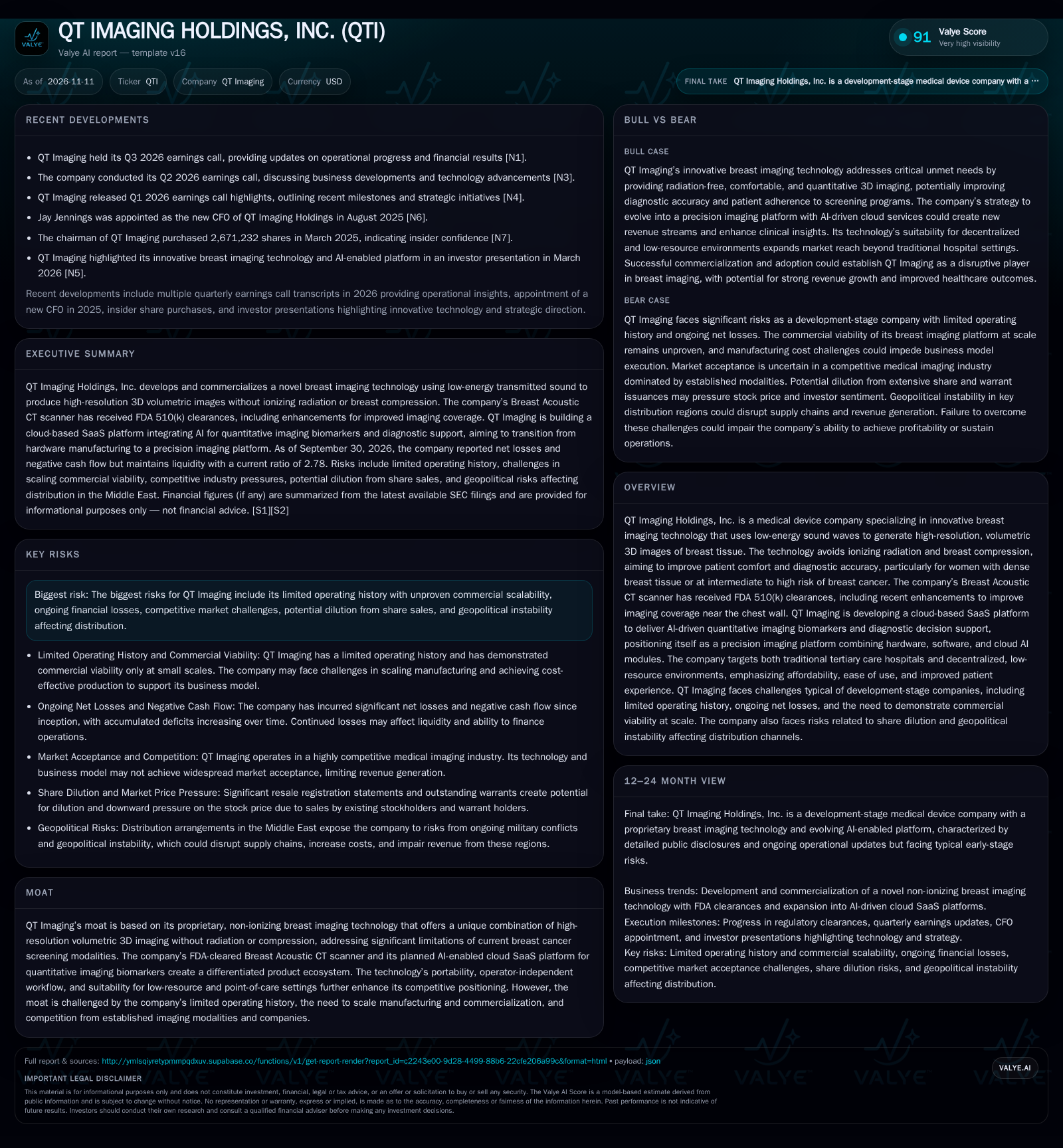
QT Imaging has developed a proprietary, radiation-free breast imaging system with multiple FDA 510(k) clearances and is building a cloud-based AI platform for diagnostic support. The company reports ongoing net losses and has $8.12 million in cash as of September 2026, with a current ratio of 2.78. Its value proposition hinges on improved patient experience and quantitative imaging for dense breast tissue, but risks include unproven commercial scale, competitive pressures, dilution from share overhang, and Middle East distribution exposure. Achieving adoption beyond pilot sites and demonstrating SaaS monetization will be critical to its thesis. [S1] [S2]
QT Imaging Holdings, Inc. aims to disrupt the breast imaging market with a proprietary, non-ionizing 3D imaging platform and an emerging cloud-based AI software suite. While its FDA-cleared hardware addresses key clinical gaps—especially for women with dense breast tissue—commercial viability at scale, recurring SaaS revenue, and durable competitive differentiation remain unproven. The next phase will test whether QT Imaging can convert clinical promise into scalable, profitable adoption in both traditional and decentralized care settings. [S1] [S2] [N7]
Recent Financials, FDA Progress, and Platform Expansion Set the Stage
QT Imaging’s Breast Acoustic CT scanner—a non-ionizing, 3D volumetric imaging device—has received multiple FDA 510(k) clearances, including recent enhancements for better chest wall coverage. As of September 30, 2026, the company held $8.12 million in cash and equivalents, with current assets of $28.2 million and current liabilities of $10.16 million, reflecting a current ratio of 2.78 and a cash ratio of 0.8. The company reported cash and liquidity metrics for the period; these figures do not by themselves establish operating runway, investment capacity, financial flexibility, or financing capacity. The company is actively developing a cloud-based SaaS platform that integrates AI-driven quantitative imaging biomarkers and diagnostic decision support, signaling a shift from pure hardware to a hybrid hardware-software business model. Notably, insider activity in 2025 included a significant share purchase by the chairman, and recent investor presentations have highlighted strategic focus on AI-enabled imaging. [S1] [S2] [N5] [N7]
Revenue Pathways: Hardware Sales, SaaS Upside, and Cost Pressures
QT Imaging’s business model is evolving from capital equipment sales to a more integrated platform approach, combining hardware with recurring software and cloud-based analytics. Traditionally, medical imaging companies generate revenue through upfront hardware sales, service contracts, and, increasingly, subscription-based software. For QT Imaging, initial revenue likely depends on capital sales of its FDA-cleared Breast Acoustic CT scanner to hospitals, imaging centers, and potentially decentralized providers. However, scaling this model requires cost-effective manufacturing and overcoming purchasing inertia in a capital-intensive hospital procurement environment.
The company’s SaaS ambitions—centered on AI-based diagnostic support and imaging biomarkers—could enable higher-margin, recurring revenue streams if adoption is achieved. In this model, hospitals or clinics might pay per scan, per user, or via enterprise contracts for access to the platform’s advanced analytics. This would shift revenue mix toward software, improving gross margins and adding resilience, provided the company can demonstrate clinical value and win integration into radiology workflows.
Operating leverage is plausible if software adoption outpaces fixed cost growth, but the company currently faces negative cash flow and ongoing net losses. Manufacturing scale-up, regulatory compliance, and go-to-market efforts will require additional capital, either via equity, debt, or partnerships. The risk is that dilution from existing warrants and share overhang erodes per-share value if commercialization lags.
Competitive Landscape: Differentiation, Incumbents, and Barriers to Adoption
QT Imaging competes in a medical imaging industry dominated by established mammography vendors, ultrasound providers, and MRI manufacturers. Its proprietary use of low-energy sound waves for volumetric 3D imaging is positioned as an alternative to X-ray mammography, especially for dense breast tissue where traditional modalities are less effective. The absence of ionizing radiation and breast compression offers a potential patient-experience and safety advantage, which could appeal to both clinicians and patients.
However, adoption faces several counterforces: entrenched hospital procurement processes, strict reimbursement environments, and the need for robust clinical validation to shift standard-of-care behavior. Incumbents benefit from scale, installed base, and established distribution. Potential substitutes include digital mammography, tomosynthesis, breast MRI, and advanced ultrasound—all with their own reimbursement codes and clinical familiarity.
QT Imaging’s emerging SaaS strategy could deliver a differentiated value proposition if its AI-driven biomarkers and decision support tools prove clinically superior or cost-saving. Yet, barriers remain: integration into existing radiology IT systems, regulatory hurdles for software as a medical device, and the need to demonstrate real-world impact on diagnostic accuracy and workflow efficiency.
A SaaS-Enabled Platform Breaks Through: What Would Confirm the Bull Thesis
The most favorable scenario is that QT Imaging’s cloud-based SaaS platform, coupled with its FDA-cleared hardware, achieves widespread adoption as a cost-effective, patient-friendly alternative to mammography—particularly for women with dense breast tissue or at elevated cancer risk. Success would likely be driven by robust clinical evidence demonstrating superior detection rates, improved patient adherence, and workflow efficiency.
Confirmation would come from meaningful revenue growth attributable to SaaS subscriptions or usage-based software contracts, expansion of multi-site commercial deployments, and positive clinical or economic data published in peer-reviewed settings. Additional FDA clearances for new indications or software modules would further validate the platform approach. Evidence of cost-effective manufacturing and improvements in gross margin would support long-term scalability.
Falsification would occur if pilot deployments fail to convert to scaled contracts, if SaaS adoption remains limited, or if clinical studies do not demonstrate a clear advantage over incumbent modalities.
Navigating Early-Stage Challenges While Building Clinical and Commercial Footing
The most plausible near-term outcome is incremental commercial progress—QT Imaging continues to secure pilot or limited commercial placements in select hospitals and imaging centers, while advancing its SaaS platform and collecting clinical data. Revenue growth may be modest and lumpy, with most income still tied to hardware sales rather than recurring software fees.
Management may pursue additional financing to support growth, with potential dilution from equity or warrant conversions. Clinical validation and user feedback drive iterative improvements, but broad market adoption and scale efficiencies remain several product cycles away.
Signals confirming this scenario would include steady but unspectacular revenue growth, continued net losses, and periodic capital raises. Falsification would come from either a dramatic inflection in SaaS adoption or a failure to maintain even limited commercial traction.
Commercialization Stalls: Dilution, Distribution Risks, and Unmet Adoption Hurdles
In the adverse scenario, QT Imaging struggles to achieve commercial traction beyond early pilot sites. Manufacturing costs remain high, undermining gross margins and limiting pricing flexibility. Hospitals and imaging centers may be slow to adopt a new modality that lacks reimbursement clarity or sufficient clinical validation, especially in a cost-constrained healthcare system.
The company’s cash position erodes as losses continue, forcing further equity raises. Significant resale registration statements and outstanding warrants create persistent dilution pressure, depressing per-share value and potentially constraining access to new capital. If geopolitical instability disrupts Middle East distribution, anticipated revenue from those regions may not materialize, compounding financial strain.
Evidence for this outcome would include flat or declining hardware sales, minimal SaaS revenue, repeated equity financings at lower valuations, and negative updates regarding distribution in key international markets.
Milestones to Clarify QT Imaging’s Commercial and Platform Trajectory
Quarterly revenue breakdown between hardware sales and software/SaaS contracts, if disclosed, to gauge progress toward a recurring revenue model.
Updates on the number and type of active commercial installations—especially multi-site deployments or expansion into decentralized/low-resource settings.
Gross margin trends over time, revealing whether manufacturing scale and SaaS mix are improving profitability.
Clinical validation milestones: publication of peer-reviewed studies demonstrating improved diagnostic accuracy, workflow efficiency, or patient adherence versus standard-of-care.
Customer retention, renewal rates, or SaaS usage metrics, if disclosed, to assess the stickiness and value of the platform.
Capital-raising activity—frequency, size, and valuation of new financings—providing signals on dilution risk and investor confidence.
Regulatory progress: additional FDA clearances for software modules, new clinical indications, or international approvals.
Operational updates on supply chain stability and distribution, particularly regarding exposure to Middle East geopolitical risks.
Disclaimer: This is research-only, informational analysis and not investment advice. It may include AI-generated interpretation and general industry context. Always verify important details using primary sources.

Comments