
Grove Collaborative Refocuses on DTC Sustainability, Navigating Revenue Pressure and Strategic Inflection
Grove Collaborative’s pivot to a pure-play direct-to-consumer model, underpinned by rigorous sustainability commitments, meets a challenging backdrop of revenue contraction, leadership turnover, and evolving consumer priorities. The company’s ability to translate its mission-driven brand into durable economics and customer loyalty remains central to its long-term viability.
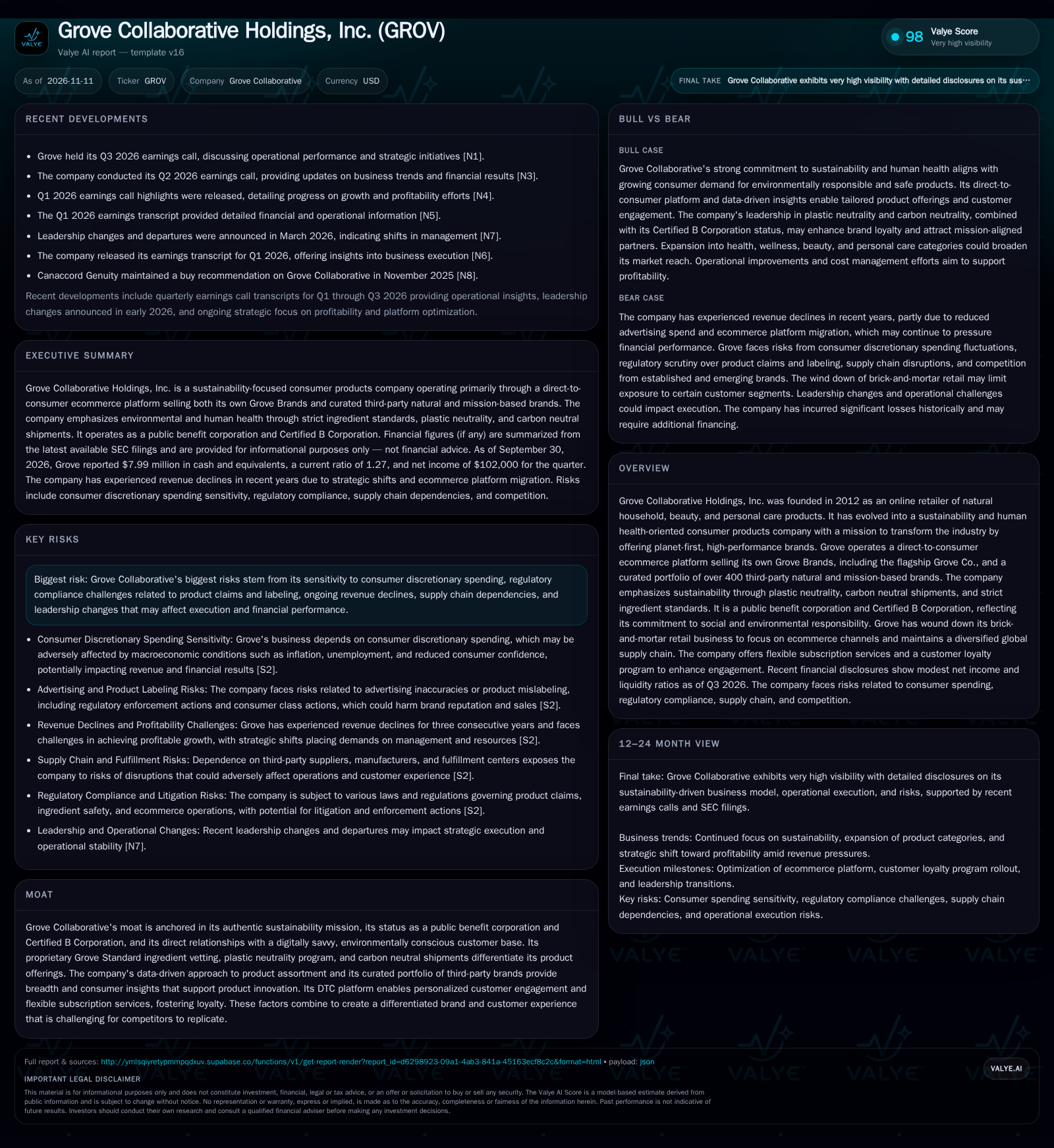
Grove Collaborative has exited brick-and-mortar retail to concentrate on its online direct-to-consumer platform, emphasizing sustainability and ingredient transparency. Despite a modest Q3 2026 net income, the company faces ongoing revenue declines and leadership changes. Its future hinges on leveraging its mission-driven brand to sustain customer engagement, expand product categories, and navigate a competitive, regulation-heavy environment. [S1] [S2] [N7]
Grove Collaborative Holdings, Inc. stands at a crossroads: having fully exited brick-and-mortar retail, the company is now a focused direct-to-consumer platform aiming to marry sustainability with modern consumer packaged goods. Its recertified B Corp status and proprietary ingredient standards set it apart in a crowded CPG landscape. However, persistent revenue declines, leadership turnover, and the need to demonstrate profitable growth cast a long shadow over its mission-driven ambitions. The next phase will test whether Grove’s brand and operational pivots can translate into economic resilience and market relevance.
Recent Financials and Strategic Moves Define Grove’s Starting Point
As of Q3 2026, Grove Collaborative reported a modest net income of $102,000, though basic and diluted EPS remained negative at -$0.01. The company’s cash and equivalents stood at $7.99 million, with a current ratio of 1.27 and a cash ratio of 0.28. The company reported cash and liquidity metrics for the period; these figures do not by themselves establish operating runway, investment capacity, financial flexibility, or financing capacity. [S2]
The company finalized its exit from brick-and-mortar retail in 2025, consolidating around its online direct-to-consumer (DTC) platform and select third-party ecommerce channels. This shift is strategic, aiming to concentrate resources on higher-margin, scalable digital operations. [S1]
Grove’s revenue has declined for three consecutive years, with management attributing this contraction to lower advertising spend, platform migration, and a pivot toward adjusted EBITDA profitability. [S1]
Leadership changes announced in early 2026 introduce an additional layer of execution risk, as new management must deliver on both operational improvements and strategic repositioning. [N7]
How Grove’s Direct Model and Mission Could Shape Its Financial Outcomes
Grove’s business model rests on selling its own Grove Brands—accounting for 41% of 2025 net revenue—and a curated portfolio of over 400 third-party brands through its DTC platform. The company’s flagship Grove Co. line leads in revenue, particularly in home care, which made up 73% of Grove Brands sales. [S1]
The economics of DTC favor higher gross margins compared to traditional retail, as Grove bypasses intermediaries and captures more of the value chain. However, this model also entails substantial customer acquisition costs (CAC), especially as digital advertising becomes more competitive and expensive. Grove’s recent reduction in advertising spend, while supporting near-term profitability, could also constrain top-line growth if not offset by organic or loyalty-driven customer retention.
Grove’s flexible subscribe-and-earn shipment model and Green Rewards loyalty program, launched in December 2025, are intended to drive recurring revenue and customer stickiness. If successful, these could improve customer lifetime value (LTV) and reduce churn—critical levers for DTC profitability.
The company’s fixed cost base has likely come down with the retail exit, but variable costs—including fulfillment, logistics, and supply chain management—remain significant. Operating leverage may improve if Grove can reignite growth, but the risk remains that a flat or shrinking revenue base could amplify the impact of fixed costs, limiting profitability.
Sustainability as Differentiator: Advantage or Table Stakes?
Grove’s core competitive proposition is its authentic sustainability mission, reinforced by B Corp certification, strict ingredient vetting ('No Way Ingredients' list), plastic neutrality, and carbon neutral shipping. These attributes resonate with a growing segment of environmentally conscious consumers, particularly in urban and millennial/Gen Z demographics.
However, the CPG landscape is increasingly crowded with both legacy brands launching 'green' lines and digitally native competitors targeting the same audience. Large incumbents have significant scale, distribution, and marketing resources, while emerging DTC players can move quickly and experiment with novel business models.
Grove’s ability to curate over 7,000 third-party products and maintain direct customer relationships offers breadth and data-driven insight, but the absence of physical retail may limit its exposure to new customer segments and impulse buyers. The key question is whether Grove’s sustainability moat is deep enough—via trust, product performance, and community engagement—to command premium pricing or drive loyalty at scale.
Switching costs in CPG are traditionally low, though subscription models and rewards programs can increase friction. True retention advantages would need to be confirmed by disclosed churn or repeat purchase rates.
Mission-Driven Loyalty and Category Expansion Unlock Profitable Growth
The most favorable scenario for Grove sees its sustainability leadership and B Corp credibility translating into high customer retention, organic advocacy, and pricing power. If the Green Rewards program and subscription model drive meaningful increases in customer lifetime value and reduce churn, Grove could achieve profitable growth even amid a challenging consumer spending environment.
Successful expansion into adjacent categories—health, wellness, beauty, and personal care—could increase average order value and diversify revenue streams, leveraging existing customer trust. If Grove can demonstrate that its proprietary ingredient standards and product curation extend credibly into these markets, it may capture a disproportionate share of wallet among mission-aligned consumers.
Confirmation of this scenario would come from sustained improvement in net revenue (not just margin gains), rising repeat purchase rates (if disclosed), and evidence of category-level growth outpacing the broader DTC CPG market. A stabilizing or expanding management team with proven execution in digital consumer brands would further support this outcome.
Gradual Margin Stabilization Amid Revenue Headwinds and Execution Challenges
The most plausible near-term trajectory is a period of modest margin improvement driven by cost discipline, reduced advertising spend, and operational efficiencies following the retail exit. Revenue may remain flat or continue to decline slightly as Grove balances the tension between profitability and growth investment.
Customer acquisition could become more difficult and expensive, especially if digital advertising costs remain elevated and organic growth does not accelerate. The new loyalty and subscription programs may incrementally improve retention, but likely not enough to fully offset broader industry headwinds.
Category expansion may yield slow gains, but risks diluting focus and increasing operational complexity. Leadership transitions could delay or complicate execution on strategic initiatives.
Evidence for this scenario would include continued small net income or break-even quarters, limited top-line improvement, and management commentary emphasizing cost management over aggressive expansion.
Sustained Revenue Declines and Strategic Drift Threaten Viability
A less favorable scenario sees Grove unable to reverse its multi-year revenue contraction. Reduced advertising spend fails to deliver sustainable customer acquisition, and loyalty programs do not meaningfully offset churn. Category expansion efforts either stall or stretch resources thin, with little payoff.
Leadership turnover leads to strategic drift or operational missteps, undermining both morale and execution. Supply chain disruptions or regulatory challenges—especially related to product claims or labeling—could trigger negative publicity or legal costs, compounding financial pressure.
If cash burn accelerates and the company cannot return to growth or raise additional capital, Grove may be forced to pursue asset sales, further retrenchment, or strategic alternatives.
Confirmation would include ongoing net losses, declining cash balances, missed product launch or customer growth milestones, and management turnover without clear succession or vision.
What Will Determine Whether Grove’s Mission Converts to Durable Economics?
Net revenue trends by quarter: Is the company able to arrest or reverse its multi-year revenue declines? [S2]
Gross margin progression: Are operational efficiencies, product mix shifts, or scaling effects driving meaningful improvement?
Customer retention and repeat purchase rates: If disclosed, do subscription and loyalty programs measurably increase LTV and reduce churn?
Ad spend efficiency and CAC: Does reduced advertising spending compromise customer acquisition, or can Grove achieve more with less through organic/loyalty channels?
Category mix evolution: Is the expansion into health, wellness, beauty, and personal care delivering material new revenue, or diluting focus?
Leadership stability and execution: Are recent management transitions resulting in clear strategic direction and operational follow-through?
Regulatory or supply chain disruptions: Any adverse developments in labeling, product safety, or logistics could quickly erode trust and potential financial flexibility.
Disclaimer: This is research-only, informational analysis and not investment advice. It may include AI-generated interpretation and general industry context. Always verify important details using primary sources.

Comments