
Metagenomi Therapeutics: Transitioning Genome Editing Ambition from Preclinical Promise to Clinical Execution
Metagenomi has received FDA clearance to begin clinical trials for MGX-001, its first genome-editing therapeutic candidate, signaling a pivotal shift from preclinical research.
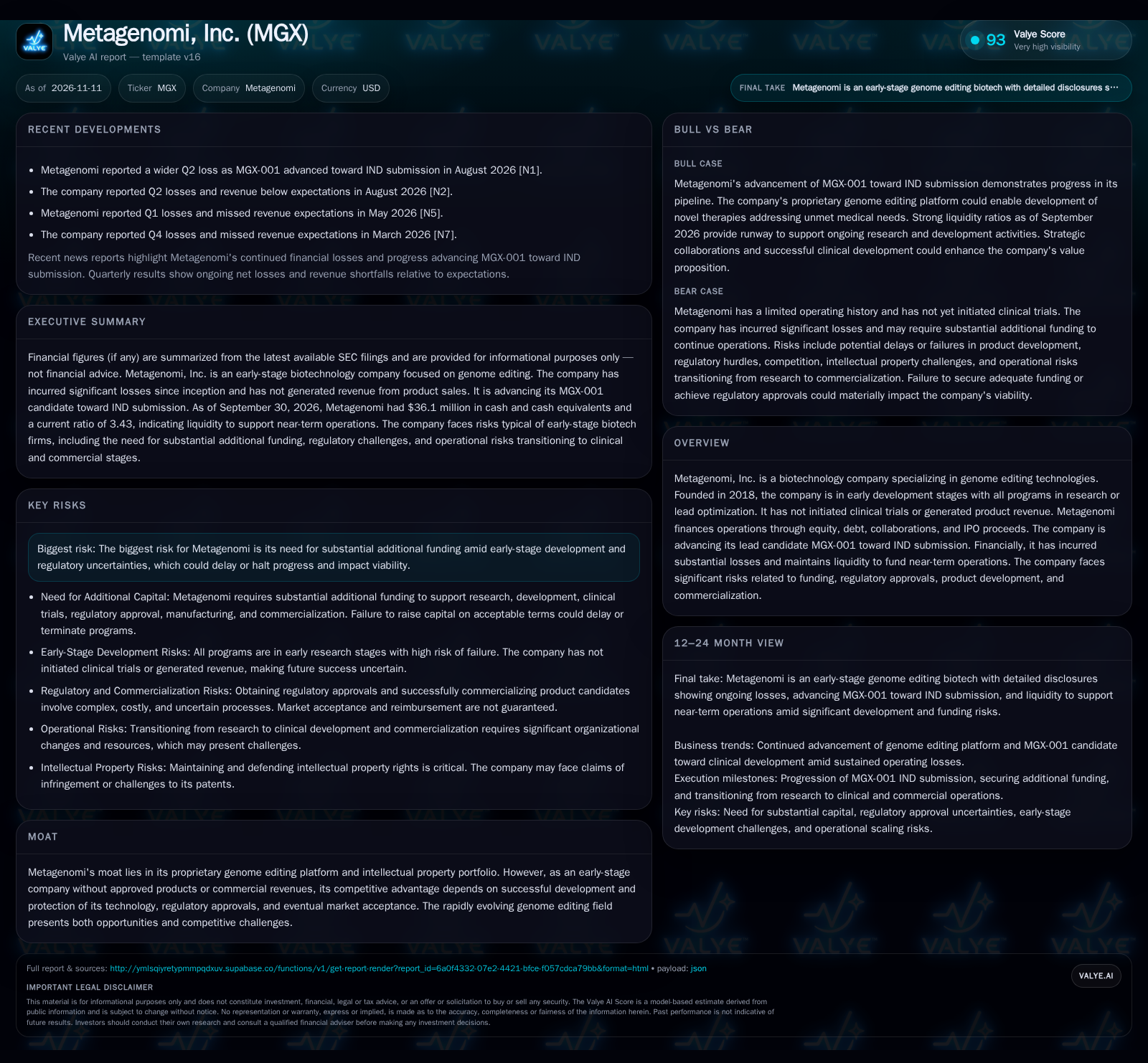
Metagenomi has received FDA clearance to begin clinical trials for MGX-001, its first genome-editing therapeutic candidate, signaling a pivotal shift from preclinical research. However, the company continues to report significant losses, has yet to generate product revenue, and faces a constrained cash runway—making future funding and successful clinical progress essential for its long-term prospects. [S2] [N1]
Metagenomi Therapeutics’ journey from early-stage genome editing research to the cusp of clinical development is now underway, as the FDA’s recent clearance of its investigational new drug application for MGX-001 marks a critical inflection point. Despite this milestone, the company’s financials underscore the persistent challenges of early-stage biotech: mounting losses, an absence of product revenue, and a reliance on external funding to sustain operations. Whether Metagenomi can convert scientific promise into commercial reality will hinge on its ability to execute in the clinic, secure new capital, and differentiate itself in a field marked by intense competition and rapid innovation. [S2] [N1]
FDA Clearance for MGX-001 Reshapes Metagenomi’s Trajectory
The most significant recent development for Metagenomi is FDA clearance of its IND for MGX-001, enabling the company to initiate a Phase 1/2 clinical trial in adult patients with moderately severe to severe hemophilia A. This event transitions Metagenomi from a purely preclinical organization to a clinical-stage entity—an essential step for value creation in biotech. As of September 30, 2026, Metagenomi reported $36.1 million in cash and cash equivalents, a net loss of $21.1 million for the quarter, and an accumulated deficit of $382.5 million. The company has not generated product revenue and continues to miss on revenue expectations. These facts underscore the urgency of both clinical execution and capital raising as the company’s cash runway narrows. [S2] [N1] [N2]
Genome Editing Economics: High Fixed Costs, Deferred Revenue, and Funding Reliance
Metagenomi’s business model is characterized by high upfront R&D investment, long product development timelines, and uncertain future cash flows. The company’s cost structure is dominated by research, personnel, and regulatory expenses—costs that will likely escalate as clinical trials begin. With no product revenue and only modest income from collaborations or grants, Metagenomi’s operations are funded primarily by equity issuances and partnership agreements. The company’s shelf registration and ATM facility provide a mechanism to raise up to $250 million and $75 million, respectively, but actual access to this capital depends on market conditions and investor appetite.
Operating leverage in the near term is negative: costs will rise as MGX-001 enters clinical trials, while meaningful revenue—even if trials succeed—remains several years away. The company’s ultimate profitability hinges on successfully advancing one or more candidates through clinical and regulatory hurdles, achieving market approval, and establishing reimbursement and adoption. If MGX-001 or subsequent programs demonstrate compelling efficacy and safety, potential out-licensing, partnerships, or acquisition could accelerate financial returns, but these are contingent on favorable trial outcomes and robust intellectual property protection.
Given the capital-intensive nature of genome editing therapeutics, Metagenomi’s financial sustainability hinges critically on its ability to extend its cash runway through strategic capital management and operational efficiency. The timing and scale of clinical milestones will directly influence investor sentiment and funding availability, creating a feedback loop that can either accelerate or constrain development. Furthermore, the company’s reliance on equity financing exposes it to dilution risk, which may impact shareholder value unless offset by commensurate increases in enterprise value. Conditional on clinical progress, alternative funding mechanisms such as milestone-based partnerships or upfront licensing fees could provide non-dilutive capital, but such arrangements typically require demonstrable clinical proof points and strong intellectual property positions.
The deferred revenue model inherent in genome editing therapeutics also creates challenges for financial forecasting and operational planning. Since product commercialization is years away, Metagenomi must balance investment in pipeline advancement with prudent cash management to bridge the gap between R&D expenditures and eventual revenue generation. This dynamic underscores the importance of scalable platform technologies that can support multiple candidates, thereby distributing risk and potentially creating multiple value inflection points. If the platform demonstrates broad applicability and differentiates on editing precision and safety, it may enable more efficient candidate progression and attract diverse partnership opportunities, which could improve the firm’s financial resilience over time.
Crowded Genome Editing Arena: Platform Innovation vs. Incumbent Scale
Metagenomi operates in an intensely competitive segment, with established genome editing companies, large pharmaceutical firms, and emerging biotech startups all vying for leadership. The company’s proprietary genome editing platform and intellectual property portfolio are positioned as its core differentiators. However, the competitive environment is shaped by rapid advances in CRISPR, base editing, and other gene-editing technologies, as well as by the scale, capital, and clinical experience of larger rivals.
Switching costs for downstream partners or payers are relatively low until clinical efficacy is proven and intellectual property is entrenched. Moreover, established players often have first-mover advantages in regulatory relationships, manufacturing scale, and clinical trial infrastructure. For Metagenomi to secure a durable competitive advantage, it must not only deliver clinical proof-of-concept, but also demonstrate clear advantages in editing precision, delivery, durability, and safety—areas where competitive pressure is high and innovation cycles are short.
In assessing Metagenomi’s competitive positioning, it is essential to consider the evolving regulatory landscape and its influence on market entry barriers. Genome editing therapies face complex regulatory scrutiny due to their novel mechanisms and potential off-target effects, which can extend development timelines and increase costs. Larger incumbents often benefit from established regulatory relationships and experience navigating these pathways, potentially accelerating approvals and market access. Metagenomi’s ability to differentiate through innovative delivery methods or enhanced safety profiles could mitigate some competitive disadvantages, but this requires sustained investment in both scientific innovation and regulatory strategy to anticipate and address emerging compliance requirements.
Additionally, the competitive landscape is shaped not only by technological innovation but also by manufacturing capabilities and supply chain robustness. Scalability of genome editing therapies remains a significant challenge due to complex production processes and stringent quality controls. Incumbent players with established manufacturing infrastructure may achieve cost advantages and faster time-to-market, creating pressure on smaller entrants like Metagenomi to develop or partner for manufacturing solutions. Conditional on successful clinical outcomes, securing reliable and cost-effective manufacturing capacity will be critical to translating clinical validation into commercial success. Strategic collaborations or investments in manufacturing technology could therefore be pivotal in sustaining competitive advantage and meeting future demand.
Clinical Success and Capital Inflows Could Accelerate Value Creation
The most favorable scenario for Metagenomi sees MGX-001 demonstrating strong safety and efficacy signals in early-stage clinical trials, leading to increased investor confidence and potential partnership or licensing deals with larger pharmaceutical companies. Early positive clinical data would also enable Metagenomi to access capital markets on more attractive terms, extend its runway, and potentially accelerate additional pipeline candidates into the clinic.
Confirmation of this scenario would come from robust Phase 1/2 data—evidence of durable factor VIII expression, low immunogenicity, and absence of off-target effects in hemophilia A patients. A significant partnership announcement, milestone payments, or a non-dilutive capital raise would further reinforce the upside thesis. Evidence that would falsify this scenario includes early clinical setbacks (safety signals, lack of efficacy), slow patient enrollment, or inability to secure follow-on funding despite clinical progress.
Incremental Progress: Advancing MGX-001 While Managing Cash Constraints
The most likely near-term outcome is measured progress: Metagenomi initiates its Phase 1/2 trial for MGX-001, but proceeds cautiously given reported cash balance and a challenging funding environment. The company may pursue small-scale partnerships or grant funding to supplement its ATM facility without taking on excessive dilution.
In this scenario, topline clinical results are not expected for at least 12–24 months, and operating losses continue to mount. The company’s ability to secure additional funding—either through equity, partnerships, or non-dilutive sources—will be critical to sustaining operations through the clinical readout. Evidence supporting this scenario would include steady trial enrollment, continued cost discipline, and modest but sufficient capital raises. A deviation from this path would occur if clinical timelines slip, cash burn accelerates, or capital markets become inaccessible, forcing program delays or downscaling.
Clinical or Funding Setbacks Could Force Strategic Retrenchment
A negative scenario unfolds if MGX-001 encounters safety concerns, fails to show efficacy, or faces regulatory setbacks in its initial clinical trial—undermining investor and partner confidence. In this environment, Metagenomi’s access to additional capital tightens, and the company may be forced to halt or scale back clinical programs, pursue asset sales, or seek a strategic transaction under distressed conditions.
Early warning signs would include adverse events in the first cohort, clinical holds, or slow trial enrollment. A cash crunch could become acute if capital markets deteriorate or if ATM sales are not viable at prevailing share prices. Evidence confirming this scenario would be the announcement of program discontinuation, layoffs, or a going-concern warning that signals immediate financial distress.
Testing Metagenomi’s Transition: Milestones That Will Define Clinical and Financial Viability
Pace of patient enrollment and initiation of dosing in the INTEGR8 Phase 1/2 trial for MGX-001.
Announcement and quality of initial safety and efficacy data from the MGX-001 trial.
Cash burn rate and remaining runway as clinical operations scale up; updates on ATM facility utilization if disclosed.
Ability to secure new capital via equity, partnerships, grants, or non-dilutive funding.
Progress on advancing additional pipeline candidates toward IND-enabling studies, if disclosed.
Updates on intellectual property developments—new patents granted, challenges, or litigation outcomes.
Any changes to management, board composition, or scientific leadership that could impact execution.
Macro environment factors—capital market conditions and regulatory climate for gene-editing therapies.
Disclaimer: This is research-only, informational analysis and not investment advice. It may include AI-generated interpretation and general industry context. Always verify important details using primary sources.

Comments