
Regulatory Uncertainty and Market Structure Shape the Outlook for Grayscale Stellar Lumens Trust (XLM)
Grayscale Stellar Lumens Trust (XLM) delivers institutional access to Stellar Lumens, but faces persistent regulatory ambiguity and competitive threats from non-tokenized blockchain solutions. The Trust's Q3 2026 net income reflects asset price trends and management structure, while its future will hinge on regulatory rulings and digital asset adoption patterns.
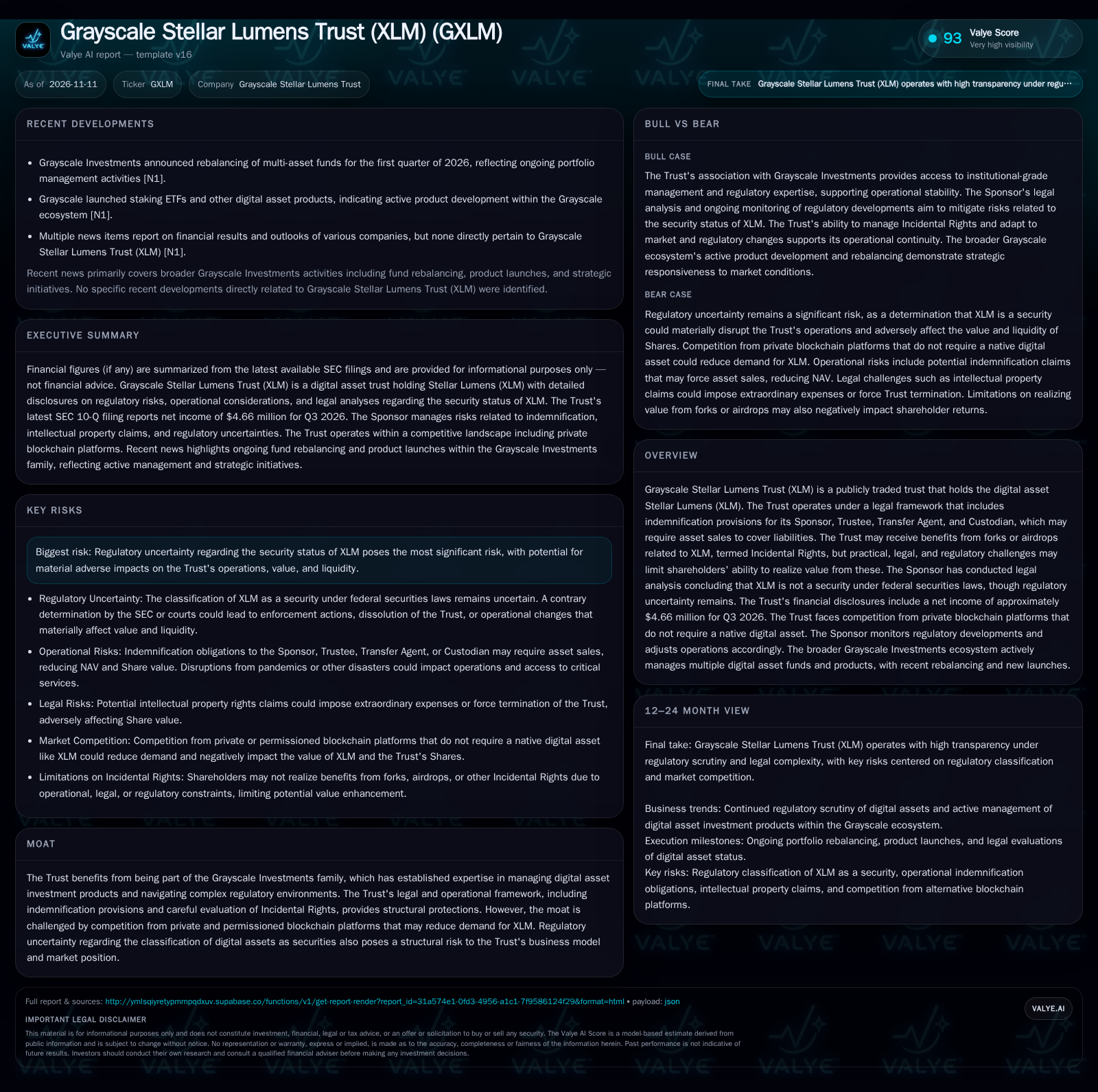
Grayscale Stellar Lumens Trust (XLM) is a public trust holding Stellar Lumens, posting $4.66 million net income in Q3 2026. Its structure protects service providers via indemnification, but asset sales for liabilities could reduce NAV. The Trust’s fate is closely tied to whether regulators classify XLM as a security and to competition from private blockchains that do not require a native token. Shareholder returns may be limited by legal and operational hurdles to realizing value from forks and airdrops. The Trust’s prospects depend on digital asset regulatory clarity and continued demand for token-based settlement platforms. [S2]
Grayscale Stellar Lumens Trust (XLM) offers public-market exposure to Stellar Lumens through a familiar trust structure, catering to investors seeking institutional-grade access to digital assets. The Trust’s reported net income for Q3 2026 underscores the impact of XLM’s market performance and the operational efficiency of the Grayscale management platform. However, the Trust’s value proposition is fundamentally shaped by two unresolved questions: the regulatory status of XLM under U.S. securities law, and the competitive threat posed by blockchain platforms that sidestep the need for a native token. These factors will determine not only the Trust’s future relevance, but also the risk profile for current and prospective shareholders. [S2]
Recent Financial Performance and Structural Safeguards
The Grayscale Stellar Lumens Trust (XLM) reported net income of $4,657,000 for the third quarter of 2026, a figure driven by the value of underlying XLM holdings and the Trust’s management structure. This result is not a reflection of traditional operating income, but rather of the change in fair value of assets held by the Trust, minus expenses. The Trust operates with indemnification provisions for its Sponsor, Trustee, Transfer Agent, and Custodian, which may require asset sales to meet liabilities—potentially reducing the Trust’s NAV and, by extension, share value. Furthermore, while the Trust may receive Incidental Rights from forks or airdrops, legal and operational constraints often prevent shareholders from realizing value from these events. The most significant risk remains regulatory: if XLM is deemed a security, the Trust may be forced to dissolve or radically alter its operations, disrupting liquidity and value. [S2]
How the Trust Monetizes Digital Asset Exposure
The Grayscale Stellar Lumens Trust is structured as a pass-through investment vehicle, monetizing exposure to Stellar Lumens by issuing publicly traded shares that represent proportional ownership in a fixed pool of XLM. The Trust generates revenue through management fees, typically set as a percentage of assets under management (AUM), which are paid in XLM or cash and reduce the total asset pool over time. This creates a slow ‘leakage’ effect for long-term holders, as AUM declines with fee accrual and occasional asset sales to cover expenses or indemnification obligations.
The core economics are driven by the price of XLM, investor demand for regulated, institutional-grade crypto exposure, and the Trust’s ability to maintain low tracking error to the underlying asset. The Trust has limited operating leverage, as expenses are mostly proportional to AUM. Capital requirements are minimal beyond asset custody and compliance, but the structure exposes shareholders to unique risks—such as dilution in the event of indemnification-triggered asset sales or regulatory costs. The Trust does not conduct active trading, lending, or staking of XLM, which limits yield enhancement opportunities but simplifies regulatory compliance.
Token-Based Structures Versus Private Blockchain Alternatives
The Trust’s competitive advantage is rooted in Grayscale’s reputation, regulatory expertise, and operational scale, which attract investors seeking transparent, regulated exposure to digital assets. However, this advantage is increasingly challenged by the rise of private and permissioned blockchain platforms. These alternatives can offer similar transaction speed and settlement efficiency as Stellar, but without requiring a native token such as XLM. For institutional users, the appeal of blockchain without token price volatility or regulatory baggage is significant.
Tokenized trusts like GXLM also compete with spot crypto ETFs, retail on-ramps, and direct custody solutions. Their primary edge—regulatory clarity and ease of access—could erode if competing products achieve similar regulatory standing or if private blockchains gain traction for institutional use cases. The Trust’s market share is thus vulnerable to both direct substitutes (other token trusts, ETFs) and indirect substitutes (permissioned blockchains, stablecoin-centric systems).
Clarity on Digital Asset Regulation Unlocks Institutional Flows
If U.S. regulators affirm that XLM is not a security and provide a stable framework for digital asset trusts, the Grayscale Stellar Lumens Trust could see renewed inflows from institutional and retail investors seeking compliant access to crypto. This scenario would likely coincide with broader adoption of public blockchain platforms for payments, settlement, or cross-border transactions—use cases where Stellar and XLM have positioned themselves.
Further upside could come if the Trust can effectively capture value from future forks or airdrops, or if Grayscale’s ongoing product development leads to integration with financial infrastructure (such as brokerage platforms or retirement accounts). Confirmation would come from regulatory guidance explicitly exempting XLM from securities laws, a sustained increase in AUM, rising net inflows, or successful realization of Incidental Rights value for shareholders.
Navigating Regulatory Ambiguity and Platform Competition
The most plausible outcome is continued regulatory uncertainty, with the Trust maintaining its current structure but facing periodic headline risk. XLM’s status remains unresolved, leading some institutional allocators to stay on the sidelines while others cautiously participate. The Trust continues to generate income in line with XLM price movements, with AUM fluctuating based on crypto market sentiment.
Competition from permissioned blockchains and spot ETFs intensifies, but the Trust retains relevance for investors prioritizing Grayscale’s brand and operational transparency. Shareholder returns are primarily a function of XLM price, minus management fees and occasional asset sales for indemnification or legal costs. Evidence supporting this scenario would include regulatory statements maintaining the status quo, stable or modestly growing AUM, and no major disruptions to Trust operations.
Adverse Rulings or Industry Shifts Undermine the Trust’s Viability
A negative regulatory determination—such as the SEC or courts classifying XLM as a security—would force the Trust to dissolve or undertake costly compliance measures, eroding liquidity and potentially causing forced asset sales at unfavorable prices. This could trigger significant NAV reductions and impair secondary market liquidity for GXLM shares.
Alternatively, if institutional adoption of blockchain migrates decisively toward private or permissioned systems that do not require XLM, demand for the Trust could collapse even in the absence of regulatory shocks. Confirmation would come from regulatory enforcement actions, sharp outflows and AUM declines, or a public announcement of Trust dissolution or restructuring.
Factors That Will Determine the Future of GXLM and Tokenized Trusts
Any formal SEC or court ruling regarding the security status of XLM, or new regulatory guidance impacting digital asset trusts.
Reported net inflows or outflows, and changes in AUM, as a proxy for investor sentiment and institutional adoption.
Frequency and magnitude of indemnification-related asset sales, which could dilute NAV and shareholder value if disclosed.
Incidental Rights outcomes—such as whether the Trust is able to realize and distribute value from forks or airdrops.
Competitive launches of spot crypto ETFs or institutional-grade custody solutions for Stellar Lumens.
Adoption trends for private or permissioned blockchains targeting the same settlement and payment use cases as Stellar.
Any changes in Grayscale’s fee structure or management approach that could affect long-term holder outcomes.
Legal or operational cost disclosures related to potential intellectual property disputes or regulatory compliance.
Disclaimer: This is research-only, informational analysis and not investment advice. It may include AI-generated interpretation and general industry context. Always verify important details using primary sources.

Comments