
B&G Foods at a Crossroads: Portfolio Reshaping, Margin Focus, and Execution Risk in Branded Foods
Recent leadership changes, ongoing brand divestitures, and margin initiatives put B&G Foods in a period of strategic transition. Execution on portfolio reshaping and operational efficiency will determine whether the company can overcome profitability headwinds and competitive pressures in the evolving packaged food sector.
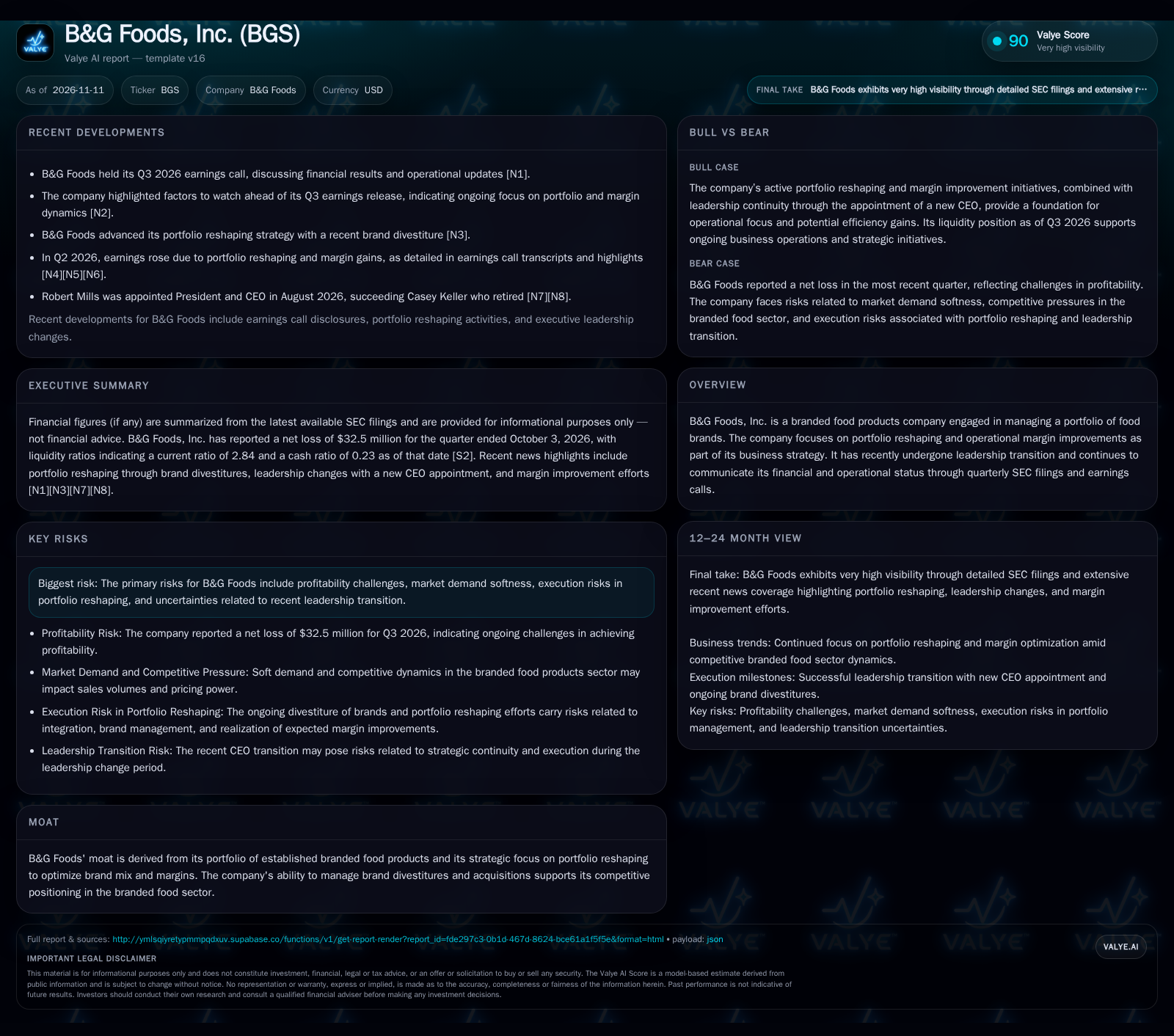
B&G Foods is actively restructuring its brand portfolio and targeting margin improvements, but reported a net loss of $32.5 million in Q3 2026. The appointment of a new CEO and continued divestitures underscore a pivot toward operational focus, yet execution risks remain high as the company seeks to stabilize financial performance and regain profitability in a competitive environment. [S2] [N3] [N7]
B&G Foods, Inc. is undergoing a pivotal transformation, marked by a series of brand divestitures and the recent appointment of a new CEO. While margin enhancement and portfolio optimization have become central to its strategy, the company’s Q3 2026 net loss of $32.5 million underscores the scale of its profitability challenge. As B&G seeks to reposition itself within the shifting landscape of branded food products, its ability to execute operational improvements and realize the benefits of portfolio reshaping will be tested by persistent competition and evolving consumer trends. The outcome will depend on management’s discipline in managing change, capturing efficiencies, and navigating the risks inherent in a sector known for both brand loyalty and intense price-based rivalry. [S2] [N3] [N7]
Recent Losses, Portfolio Shifts, and New Leadership Define B&G’s 2026 Pivot
B&G Foods reported a net loss of $32.5 million for the quarter ended October 3, 2026, with basic and diluted EPS of -$0.40 per share. This marks a continuation of profitability struggles, even as the company highlights margin improvement initiatives in its financial communications. [S2]
The company advanced its portfolio reshaping strategy with a recent brand divestiture, indicating a move to optimize its mix and focus on higher-margin or core brands. Such divestitures are intended to streamline operations and potentially enhance profitability, but also introduce transition risk and possible near-term revenue dilution. [N3]
Leadership transition is underway, as Robert Mills was appointed President and CEO in August 2026, succeeding Casey Keller following his retirement. This change brings new strategic direction but may disrupt continuity during a critical period. [N7] [N8]
As of October 3, 2026, B&G Foods held $61.7 million in cash and cash equivalents, with a current ratio of 2.84 and a cash ratio of 0.23. While these metrics indicate available liquidity, they do not resolve the company’s underlying profitability or execution challenges. [S2]
How Portfolio Reshaping Could Alter B&G’s Margin Structure
B&G Foods’ core business model revolves around acquiring, managing, and optimizing a diverse portfolio of branded packaged food products. Revenue is generated through retail, foodservice, and (to a lesser extent) e-commerce channels, with pricing power and volumes heavily influenced by brand equity, category trends, and competitive intensity.
The company’s recent pivot toward portfolio reshaping—evidenced by ongoing brand divestitures—suggests a focus on concentrating resources on brands and categories with higher margins or greater growth potential. In theory, shedding lower-margin or underperforming brands could improve aggregate gross and operating margins, provided that fixed costs are reduced or reallocated efficiently.
However, the economics of this transition are complex. Divestitures may result in lower absolute revenue and require cost rationalization to avoid margin compression. The challenge lies in extracting operational efficiencies, leveraging scale in procurement and distribution for the retained brands, and maintaining or growing volumes in a mature, price-sensitive market.
Operating leverage could improve if the company successfully aligns its cost structure with a more focused brand portfolio, but there is execution risk if cost reductions lag revenue lost from divested brands. Capital requirements may moderate if fewer brands require marketing and innovation spend, though targeted investments in core brands could still be needed to sustain relevance and shelf space.
Brand Equity and Scale: Durable Advantages or Diminishing Defenses?
B&G Foods’ competitive position historically relies on its portfolio of established brands and its ability to manage them efficiently. In the branded food sector, advantages can stem from brand recognition, shelf presence, and scale-driven procurement or distribution efficiencies.
However, these advantages are under pressure. The broader packaged food industry faces shifting consumer preferences toward private labels, niche brands, and health-oriented alternatives. Large grocers and mass retailers exert pricing pressure, while digital channels allow challenger brands to reach consumers more directly.
B&G’s moat could be reinforced if its reshaped portfolio concentrates on brands with true consumer loyalty or defensible market share. Conversely, if divestitures leave the portfolio with less differentiated or declining brands, the company risks further erosion of pricing power and shelf space.
The company competes not only with other branded food conglomerates but also with private label manufacturers and regionally focused upstarts. Its ability to maintain or grow share will depend on how well it balances cost discipline with brand investment in a category where switching costs are typically low and promotional intensity remains high.
Unlocking Margin Expansion Through Disciplined Brand Focus and Cost Control
A favorable outcome for B&G Foods would see the company successfully complete its portfolio reshaping—divesting non-core or lower-margin brands while concentrating resources on a set of defensible, higher-margin core brands. If management executes effective cost reductions in tandem with these divestitures, operating margins could improve even as total revenues decline or stabilize.
Margin expansion would be further supported if the retained brands demonstrate resilience in volumes and pricing, aided by targeted marketing and innovation. The new CEO, Robert Mills, could bring renewed operational discipline and strategic clarity, accelerating the realization of efficiency gains.
Evidence that would confirm this scenario includes sequential improvement in gross and operating margins, stabilization or growth in core brand sales, positive operating cash flow, and clear articulation of cost savings achieved post-divestiture. Reduction in net losses or a return to profitability over the next few quarters would also support the upside case.
Reshaping Brings Incremental Margin Gains, But Growth Remains Elusive
The most plausible trajectory is a period of incremental margin improvement as B&G Foods continues to reshape its portfolio and rationalize costs, but struggles to return to sustained profitability or meaningful growth in the near term. Revenue may contract due to divestitures, and while gross and operating margins could improve modestly, fixed cost absorption and competitive pricing pressure may limit the speed and magnitude of gains.
Leadership transition may slow decision-making or introduce strategic uncertainty, even as new management seeks to assert discipline. Market demand for legacy brands could soften further, requiring increased promotional activity or investment to maintain share.
Confirmation of this scenario would come from continued net losses (albeit narrowing), gradual margin gains, and periodic updates on brand sales and cost savings. Failure to deliver a step-change in profitability, or continued reliance on cost-cutting rather than growth, would reinforce the base case.
Execution Missteps and Demand Weakness Compound Profitability Risks
The adverse scenario emerges if B&G Foods’ divestitures fail to yield the expected margin improvements, or if cost reductions lag revenue loss, leading to further erosion of profitability. Execution missteps—such as poor integration of retained brands, loss of key customers, or supply chain disruptions—could exacerbate the financial strain.
Demand softness, intensified competition from private labels or discount brands, and inability to invest adequately in remaining brands could drive further volume declines. If the new CEO’s transition is rocky or strategic vision is unclear, uncertainty could destabilize operations and relationships with retailers.
Evidence confirming this scenario would include widening net losses, declining cash flow, further asset sales under distressed terms, or negative commentary from management regarding the pace of improvement.
Milestones That Will Test B&G Foods’ Strategic Reshaping
Sequential trends in gross and operating margin—improvement would support the restructuring thesis, while stagnation or decline would challenge it.
Updates on the pace, terms, and proceeds of brand divestitures, and whether these are accretive to margins or dilute revenue excessively.
Core brand sales performance and volume trends, particularly in categories targeted for growth or higher-margin contribution.
Progress on cost-reduction initiatives, including disclosure of specific savings realized and impact on the cost structure (if disclosed).
Cash flow from operations and changes in working capital, as evidence of underlying business health and ability to self-fund transition.
Management commentary and strategic updates from new CEO Robert Mills, indicating operational discipline and clarity of direction.
Competitive developments in the branded food sector, such as price wars, major private label gains, or new product launches that could alter category dynamics.
Disclaimer: This is research-only, informational analysis and not investment advice. It may include AI-generated interpretation and general industry context. Always verify important details using primary sources.

Comments