
Inhibikase Therapeutics: Liquidity Strength, Pipeline Ambition, and the Test of Clinical Execution
Inhibikase Therapeutics maintains an unusually reported liquidity position and a focused neurodegenerative disease pipeline, but persistent net losses and the absence of commercial-stage programs keep the company’s long-term sustainability and value realization tied to clinical, regulatory, and partnering outcomes.
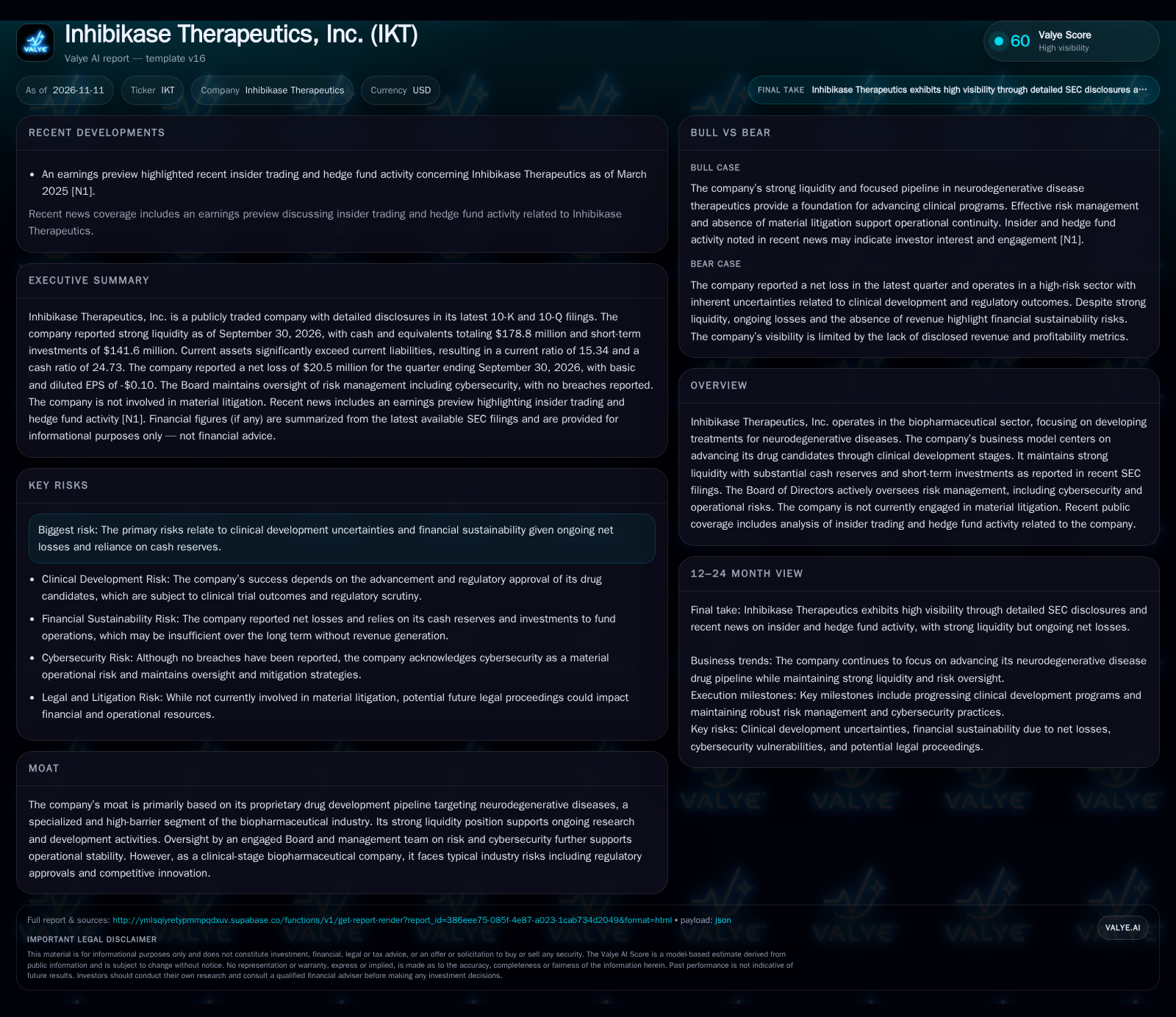
As of September 2026, Inhibikase Therapeutics holds over $198 million in current assets and reports a reported current ratio, but continues to operate at a net loss with no disclosed revenue. The business remains dependent on clinical progress in neurodegenerative disease candidates. The core question is whether its financial runway and risk management can bridge the gap to pivotal clinical milestones and, ultimately, commercial or strategic validation. [S2]
Inhibikase Therapeutics, a clinical-stage biopharmaceutical company targeting neurodegenerative disorders, enters late 2026 with a balance sheet that stands out in the sector: over $198 million in current assets and a current ratio exceeding 15. Despite this financial strength, the company remains in a pre-commercial phase, posting a $20.5 million net loss for the latest quarter and disclosing no revenue. The next phase will test the company’s ability to sustain value creation through the inherent volatility of drug development. [S2]
Liquidity Outpaces Liabilities, But Losses Persist
As of September 30, 2026, Inhibikase Therapeutics reported $141.6 million in short-term investments and approximately $198.7 million in current assets, compared to $12.96 million in current liabilities—yielding a current ratio of 15.34 and a cash ratio of 24.73. These figures signal a liquidity cushion that is notably robust for a clinical-stage biotech. However, the company also reported a net loss of $20.5 million for the quarter and basic/diluted EPS of -$0.10, with no disclosed revenue. This combination of ample cash resources and ongoing losses makes the company’s ability to deliver on its pipeline the central determinant of future value. [S2]
Recent news coverage has highlighted insider trading and hedge fund activity, indicating that the stock remains on the radar of sophisticated investors, though the operational implications of this activity are not established by the evidence. [N1]
While the liquidity metrics indicate a strong short-term financial position, it is important to consider the qualitative aspects of cash management and capital allocation. The company's ability to efficiently deploy these resources toward advancing clinical programs will be critical, as inefficient spending could erode this liquidity buffer faster than anticipated. Therefore, a nuanced analysis of the burn rate relative to the pipeline’s development schedule is necessary to assess how long the company can sustain operations without dilutive financing or revenue generation.
How the Economic Model Hinges on R&D Progress and Capital Efficiency
Inhibikase Therapeutics’ business model is typical of clinical-stage biopharmas: it invests heavily in R&D to advance drug candidates, aiming for value inflection points at key clinical and regulatory milestones. The company’s current financials suggest a high fixed cost base—driven by research, development, and regulatory activities—without offsetting revenue streams. This structure produces high operating leverage: any future revenue from successful approvals or partnerships would drop rapidly to the bottom line, but until then, fixed costs drive ongoing losses.
However, the absence of current revenue or disclosed partnering income means that, without a clinical or strategic breakthrough, eventual dilution or further financing may be required. The economic model is thus a race between the runway provided by existing assets and the timeline to value-creating events.
Pricing and commercial mechanics are not disclosed, but for neurodegenerative disease therapies, successful candidates can command premium pricing and large addressable markets. However, the pathway to such outcomes is long, capital-intensive, and fraught with attrition risk.
The economic model’s sensitivity to R&D progress underscores the importance of capital efficiency and milestone-driven investment. If clinical trials progress as planned and yield positive interim data, the company may unlock successive funding tranches or attract licensing partners, thereby reducing reliance on equity financing. Conversely, delays or setbacks could increase the required investment without corresponding value creation, pressuring liquidity and potentially diluting shareholder value. Furthermore, the absence of disclosed pricing strategy or market access planning means that even successful clinical outcomes must be complemented by robust commercialization planning to realize economic returns, particularly given the competitive landscape and payer scrutiny in neurodegenerative diseases.
Barriers, Substitutes, and the Challenge of Differentiation in Neurodegeneration
The neurodegenerative disease therapeutics space is characterized by scientific complexity, high regulatory hurdles, and significant unmet need—factors that create both opportunity and formidable barriers. Inhibikase’s proprietary pipeline may offer differentiation if clinical data can establish clear efficacy or safety advantages, but the field also attracts large pharmaceutical companies with deeper resources and development infrastructure.
Switching costs and retention are not directly relevant until commercialization, but intellectual property protection and first-mover clinical data can create defensibility if the company succeeds. The main substitutes are both existing symptomatic treatments and competing experimental assets, many of which are also in clinical development. The risk is that parallel programs by larger or better-capitalized peers could outpace or overshadow Inhibikase’s candidates unless it achieves compelling, early clinical results.
Partnerships, licensing, or acquisition remain plausible endgames, but the company’s ability to command premium terms will depend on the perceived strength of its clinical data and intellectual property.
Differentiation in neurodegenerative therapeutics often hinges on demonstrating not only clinical efficacy but also meaningful improvements in patient quality of life or disease modification. Given the high attrition rates in this therapeutic area, the ability to generate early signals of clinical benefit can materially influence competitive positioning and partnership interest. If Inhibikase’s candidates can show a novel mechanism of action or superior safety profile, this could justify premium valuation and create barriers to entry. However, the company must also navigate the evolving regulatory environment, where accelerated approval pathways may favor competitors with more mature data or broader clinical programs, potentially compressing the window for market differentiation.
Breakthrough Clinical Data Could Unlock Non-Dilutive Funding or Strategic Value
The most favorable scenario is one in which Inhibikase’s lead pipeline candidates produce strong, differentiated clinical data—either in efficacy, safety, or both. This could attract interest from large pharmaceutical partners or acquirers, potentially enabling non-dilutive funding through licensing deals or milestone payments. Alternatively, positive data could support a direct path to late-stage trials, allowing the company to retain more upside.
Confirmation of this scenario would require the announcement of successful clinical readouts, partnership agreements with upfront or milestone payments, or regulatory designations (such as fast track or breakthrough status) that increase the probability of approval and commercial adoption.
Falsification would come from negative or inconclusive clinical data, regulatory setbacks, or the absence of strategic interest following key data releases.
Clinical Progress Continues, But Value-Defining Events Remain on the Horizon
The most plausible trajectory is that Inhibikase continues to advance its pipeline through ongoing clinical studies, incurring steady R&D and operating expenses while drawing down its cash reserves. Incremental progress—such as enrollment completions, early safety data, or regulatory feedback—could support moderate investor interest but may not suffice to drive a step change in valuation without clear efficacy signals.
This scenario is confirmed by continued disclosures of clinical progress, maintenance of financial discipline, and absence of major negative surprises. Evidence against it would include unexpected safety issues, major delays, or an accelerated cash burn that compresses the company’s financial runway.
Pipeline Attrition or Delays Erode Runway and Strategic Optionality
Adverse outcomes—such as negative clinical trial results, unexpected safety findings, or regulatory setbacks—could undermine the value of Inhibikase’s pipeline and force the company to reconsider its strategic options.
Confirmation would come from the announcement of failed or discontinued programs, material increases in net losses or cash burn, or the absence of partnering interest following pivotal readouts. The risk is compounded by the lack of diversified revenue streams or commercial-stage assets, which leaves the company exposed to binary clinical outcomes.
Milestones and External Factors That Will Shape Inhibikase’s Thesis
Updates on the progress and results of key clinical trials, especially for lead neurodegenerative disease candidates, will be the most material driver of valuation and strategic options.
Cash burn rate and quarterly net loss trends, if disclosed, will help test the sufficiency of the company’s financial runway relative to its development timelines.
Any new partnership, licensing deal, or acquisition interest—particularly with upfront or milestone payments—would provide external validation and non-dilutive funding.
Regulatory designations or feedback (such as fast track, orphan drug, or breakthrough therapy status) could de-risk clinical and commercial pathways.
Material changes in insider or hedge fund activity, if disclosed, may offer clues about market sentiment or impending developments.
Announcements of new patent issuances, IP challenges, or competitive clinical results from other neurodegenerative disease programs would help assess the defensibility and urgency of Inhibikase’s pipeline.
Disclosure of commercial strategy or pricing assumptions, if provided, would clarify the potential economic impact of future approvals.
Any cybersecurity incidents or litigation developments, though not currently reported, could impact operational continuity if they arise.
Disclaimer: This is research-only, informational analysis and not investment advice. It may include AI-generated interpretation and general industry context. Always verify important details using primary sources.

Comments