
Grayscale Solana Staking ETF: Staking Exposure, Third-Party Reliance, and the Unwritten Rules of Digital Asset ETFs
Its Q3 2026 net income provides evidence of current viability, yet the business model’s long-term resilience hinges on external factors beyond the Sponsor’s control.
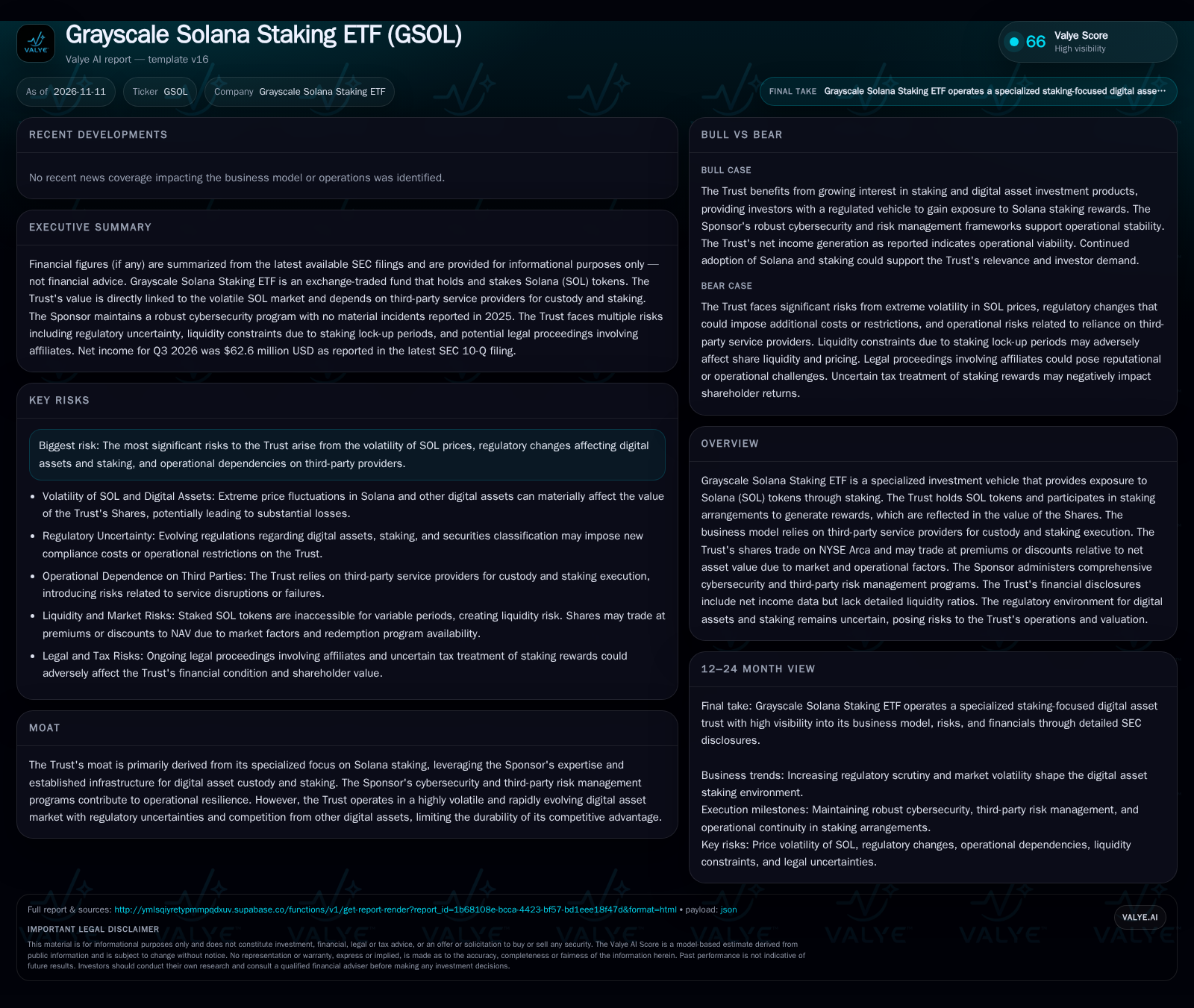
The Grayscale Solana Staking ETF provides investors with access to staked SOL tokens, generating income from staking rewards. Q3 2026 net income demonstrates operational viability, but the ETF’s structure exposes it to SOL price volatility, regulatory shifts, and third-party operational risks. Share liquidity is affected by staking lock-ups, and ongoing legal and tax uncertainties remain unresolved. The ETF’s future is tightly coupled to the digital asset ecosystem’s evolution and external regulatory determinations. [S2]
Grayscale Solana Staking ETF offers a regulated gateway to Solana staking rewards, blending digital asset yield with the ETF wrapper’s accessibility. The Trust’s Q3 2026 net income demonstrates that staking economics can be profitably captured in a public vehicle. However, the ETF’s structure introduces unique risks: reliance on third-party custodians and staking providers, exposure to SOL’s volatility, and regulatory ambiguity around staking and digital assets. The ETF’s long-term performance will depend less on internal execution than on how external legal, market, and operational forces reshape the digital asset investment landscape. [S2]
Profitable Staking Operations, but Regulatory and Liquidity Headwinds Remain
As of September 30, 2026, Grayscale Solana Staking ETF reported net income of $62.6 million for Q3, reflecting the effectiveness of its staking strategy and the positive spread between staking rewards and operating costs. This validates the ETF’s ability to generate income from staked SOL, at least in a favorable market environment. [S2]
The company reported cash and liquidity metrics for the period; these figures do not by themselves establish operating runway, investment capacity, financial flexibility, or financing capacity. [S2]
The Trust’s structure exposes shareholders to the value of SOL, which remains highly volatile. Shares may trade at premiums or discounts to NAV, especially during periods when staked SOL is locked and unavailable, constraining liquidity and potentially amplifying price dislocations. [S1] [S2]
No material cybersecurity incidents or adverse legal proceedings were reported as of the latest filings, suggesting operational stability for now. Nonetheless, the Trust acknowledges ongoing legal proceedings involving affiliates and the persistent risk of regulatory or tax changes impacting its operations. [S1] [S2]
How the ETF Captures Staking Rewards—and Where the Friction Lies
The ETF’s revenue model is fundamentally driven by the staking rewards generated from holding SOL tokens. These rewards accrue to the Trust and, net of fees and expenses, are intended to boost the value of each share. The ETF’s primary cost base comprises Sponsor fees, custody, and operational expenses, much of which are linked to third-party service providers.
Staking economics are inherently variable, tied to network-wide staking yields, validator performance, and any changes in the Solana protocol’s reward structure. The ETF’s ability to maintain or grow net income thus depends on both the level of SOL staked and the prevailing yield environment—both of which are outside its direct control.
Operating leverage is present but capped: as the ETF’s AUM grows, fixed Sponsor and administrative costs may be spread over a larger base, improving margins.
Capital needs are modest in a steady-state scenario, as the business does not require significant ongoing investment beyond custody, legal, and compliance outlays. However, should regulatory or tax treatment change, additional legal, compliance, or restructuring expenses could become material.
Staking Specialization, Sponsor Reputation, and the Limits of Differentiation
Grayscale Solana Staking ETF’s edge is its specialized focus on Solana staking and its ability to package staking exposure within a familiar ETF structure. This appeals to investors who want staking yield without the technical or custody hurdles of direct participation.
The Sponsor’s established reputation in digital asset products and its comprehensive cybersecurity and risk management frameworks create a perception of operational resilience. However, these advantages are not structural moats: other asset managers can launch competing staking vehicles, and the ETF’s reliance on third-party service providers limits its ability to control the full value chain.
Competition comes from both regulated ETFs tracking other digital assets and direct staking platforms, as well as emerging decentralized finance (DeFi) protocols that may offer higher yields or more flexible redemption terms. In periods of high volatility or regulatory uncertainty, the ETF’s premium/discount to NAV could widen, potentially making it less attractive than direct staking or alternative vehicles.
Switching frictions for investors are relatively low, as shares can be bought and sold on the exchange, but operational frictions—such as staking lock-ups and redemption program limitations—can impact liquidity and investor experience.
If Regulatory Clarity and Solana Adoption Converge, Staking Yields Could Drive Persistent Premiums
A favorable scenario unfolds if global regulators clarify the treatment of staking and digital asset ETFs, affirming that SOL is not a security and enabling continued or expanded staking operations. In this environment, Solana network usage and staking participation could rise, supporting higher or stable yields, and driving investor inflows into the ETF.
If the Sponsor’s risk management infrastructure continues to prevent material cybersecurity or operational incidents, and if third-party providers deliver reliable custody and staking execution, the ETF could maintain or even expand its net income margins as assets scale. This would likely be confirmed by sustained or growing net income, narrowing share price discounts to NAV, and evidence of rising AUM.
Confirmation would also come from the successful resolution of any outstanding legal proceedings and the absence of adverse tax rulings on staking rewards. Conversely, the upside would be falsified by new regulatory restrictions, material operational failures, or a significant contraction in Solana network activity and staking yields.
Navigating Volatility: Variable Outcomes Tied to SOL Price and Third-Party Performance
The most plausible path is one of ongoing volatility, with the ETF’s net income and share price fluctuating in line with SOL’s market value and staking yields. The Trust continues to operate profitably in most quarters, but net income and share liquidity are periodically challenged by network-level events, custody incidents, or sharp price swings.
Third-party service providers remain reliable but not immune to operational hiccups, and the Sponsor’s risk management programs prevent major disruptions. Regulatory and tax uncertainty persists, but no existential threat materializes in the near term.
This scenario is confirmed by continued net income (albeit with quarter-to-quarter variability), no material legal or regulatory setbacks, and the persistence of share price discounts/premiums within historical ranges. It would be falsified by a regulatory crackdown, a major service provider failure, or a prolonged SOL bear market that erodes both NAV and staking rewards.
Regulatory Shock or Third-Party Failure Could Force Structural Change—or Unwind
The most acute downside emerges if regulators reclassify SOL as a security or restrict staking within public investment vehicles, forcing the ETF to halt staking operations, unwind positions, or undertake expensive legal and operational restructuring.
Alternatively, a major failure by a custody or staking provider—such as loss of access to staked SOL or a cybersecurity breach—could trigger operational losses, legal liabilities, and reputational damage, potentially leading to sustained NAV discounts or even redemptions at fire-sale prices.
Tax authorities could also retroactively alter the treatment of staking rewards, imposing unexpected liabilities that erode net income or require shareholder compensation.
Evidence of this scenario would include regulatory enforcement actions, disclosure of significant service provider failures, sharp and persistent NAV discounts, or a sudden reversal from net income to net loss in SEC filings.
Factors That Will Shape the ETF’s Staying Power and Investor Outcomes
Quarterly net income trends and any material changes in the composition of revenues and expenses. [S2]
Updates on the availability and mechanics of the redemption program, and evidence of persistent NAV premiums or discounts. [S1] [S2]
Disclosure of any material cybersecurity incidents, operational disruptions, or service provider failures in SEC filings or Sponsor communications. [S1] [S2]
Regulatory developments related to the classification of SOL, staking activities in ETFs, and digital asset tax guidance. [S1] [S2]
Resolution or escalation of legal proceedings involving affiliates, particularly if they affect the Trust’s operations or reputation. [S1] [S2]
Any changes to the Trust’s third-party risk management framework or key provider relationships.
Solana network-level events (if disclosed), such as major protocol changes, validator failures, or shifts in staking reward rates, that could impact the yield or risk profile of the Trust.
A useful metric would be the duration and magnitude of staking lock-up periods, as these affect share liquidity and redemption flexibility.
Disclaimer: This is research-only, informational analysis and not investment advice. It may include AI-generated interpretation and general industry context. Always verify important details using primary sources.

Comments