
Grayscale Sui Staking ETF: Staking-Linked Returns, Third-Party Risks, and the Volatility-Regulation Nexus
The Grayscale Sui Staking ETF offers investors direct exposure to SUI’s price and staking rewards, but faces a complex web of risks—most notably digital asset volatility, evolving regulation, and operational reliance on external custodians and validators.
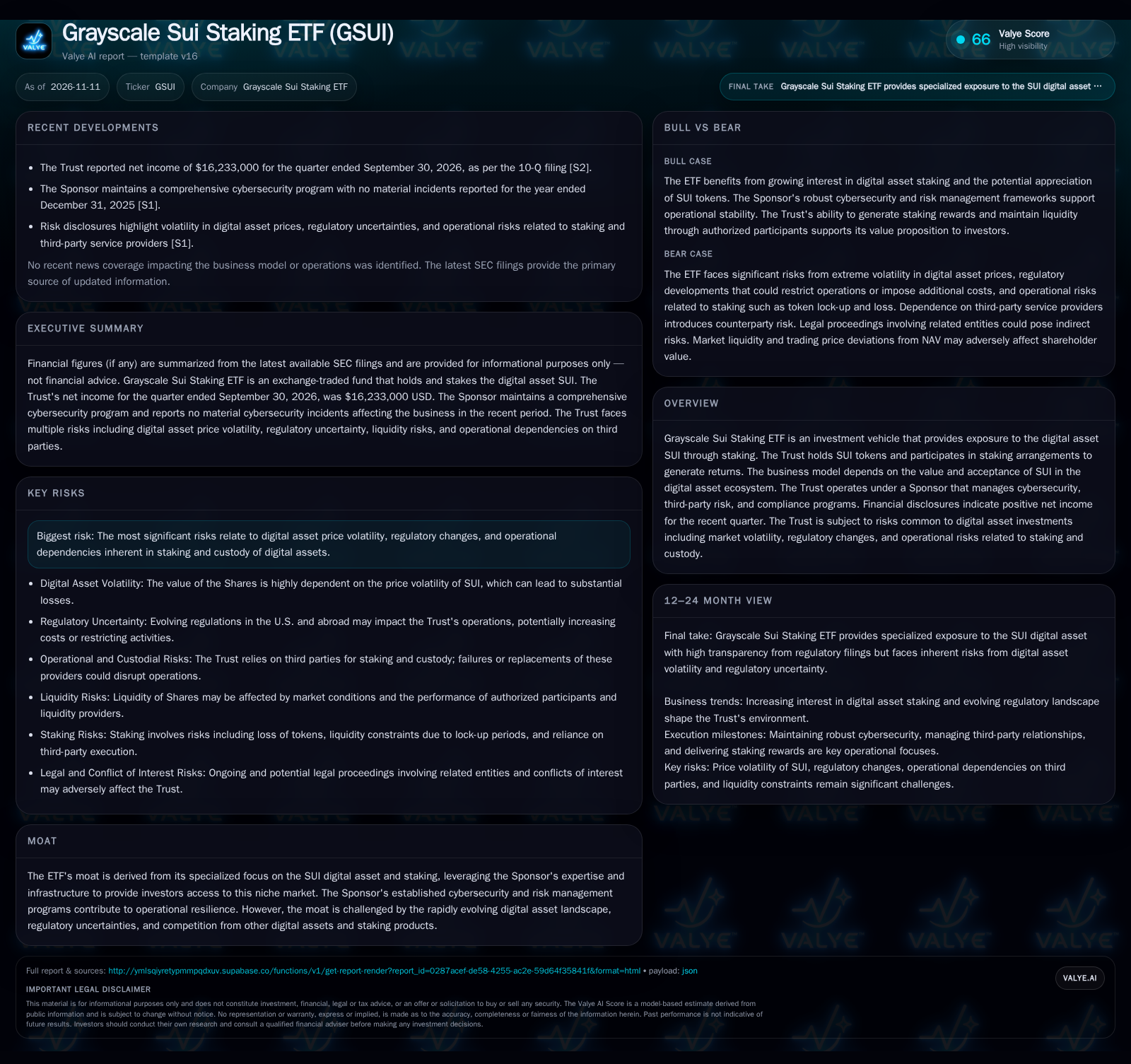
Grayscale Sui Staking ETF reported $16.2M in net income for Q3 2026, reflecting the combined impact of SUI token price performance and staking yield. The ETF’s business model hinges on the viability and acceptance of the SUI network, with operational stability underpinned by the Sponsor’s cybersecurity program. However, its future is highly sensitive to regulatory developments, SUI price swings, and the reliability of third-party service providers. Investors should focus on regulatory clarity, SUI protocol health, and operational execution as the main drivers of value and risk [S2] [S1].
Grayscale Sui Staking ETF stands at the intersection of digital asset innovation and regulatory scrutiny, offering investors a vehicle to access SUI price movements and staking rewards through a familiar ETF wrapper. The Trust’s recent net income points to the potential for robust returns in favorable market conditions, but the underlying mechanics—staking, custody, and digital asset management—are fraught with dependencies and risks. As digital asset regulation evolves, and with SUI’s future far from guaranteed, the ETF’s fortunes rest on its ability to navigate market volatility, maintain operational resilience, and adapt to shifting legal frameworks.
Recent Results and the Risk Backdrop Define the ETF’s Present Position
The Grayscale Sui Staking ETF reported net income of $16,233,000 for the quarter ended September 30, 2026, highlighting the potential profitability of its model during periods of favorable SUI token price performance and staking yield generation [S2]. This figure is meaningful given the ongoing volatility in digital asset markets, and suggests that the ETF has, at least recently, been able to convert its staking and asset management activities into tangible returns.
The Sponsor’s cybersecurity program, overseen by a CISO with over 15 years of experience, reported no material incidents through 2025, signaling a degree of operational robustness in an industry frequently targeted by cyber threats [S1].
However, the Trust’s disclosures emphasize persistent risks: high sensitivity to SUI price swings, regulatory uncertainty that could alter ETF operations or impose new constraints, and the operational vulnerabilities inherent in relying on third-party custodians and staking providers [S1]. These facts collectively shape the ETF’s near-term outlook, with financial results, operational stability, and external risk factors all in dynamic interplay.
How Staking, Price Volatility, and the ETF Structure Interact to Drive Economics
The ETF generates value by holding SUI tokens and participating in staking, earning rewards that are pooled for the benefit of shareholders. Its revenue is thus a function of two main variables: the prevailing price of SUI and the staking yield (which is itself influenced by network participation rates and protocol-level rules). The ETF’s structure allows investors to access these returns via public markets, rather than directly managing SUI wallets or staking arrangements.
Fixed costs are likely dominated by Sponsor fees, custody arrangements, and compliance, while variable economics are dictated by SUI price and staking yields. Periods of high SUI valuation and attractive staking rewards can drive significant income, as seen in the recent quarter [S2]. However, a sharp drop in SUI price or a protocol change reducing staking yield could rapidly compress returns. Unlike traditional ETFs, which often rely on diversified asset pools or income streams, this Trust’s economics are tightly coupled to a single protocol’s market and technical health.
The company reported cash and liquidity metrics for the period; these figures do not by themselves establish operating runway, investment capacity, financial flexibility, or financing capacity. These lock-ups could result in NAV deviations if share redemptions outpace the ability to access underlying assets.
Differentiation Hinges on SUI Exposure, Staking Access, and Operational Trust
The ETF’s primary differentiator is its ability to offer regulated, exchange-traded exposure to SUI price and staking rewards—an access point not easily replicated by traditional asset managers or retail investors lacking the technical sophistication to stake SUI directly. The Sponsor’s established cybersecurity and compliance infrastructure further distinguishes the product, especially for institutional investors wary of digital asset custody risk [S1].
However, competition is intensifying both from rival ETFs and from decentralized finance (DeFi) platforms offering direct or pooled staking. Substitution risk is high: investors can access SUI directly, utilize centralized exchanges with staking options, or pursue other digital assets with higher yields or perceived lower risk. The ETF’s moat is thus narrow and vulnerable to both regulatory harmonization (which could lower barriers for new entrants) and technological shifts within the SUI ecosystem or broader digital asset market.
Operational dependence on third-party custodians and staking providers is a double-edged sword—it enables scale and security, but also introduces counterparty and execution risk. Any failure or reputational issue with these partners could erode the ETF’s perceived reliability.
If SUI Thrives and Regulation Stabilizes, Staking-Linked Income Could Accelerate
In a favorable scenario, SUI gains traction as a leading smart contract platform, driving sustained price appreciation and high network participation. Staking yields remain attractive due to robust network activity, and the ETF’s share price tracks or exceeds NAV thanks to efficient market making and liquidity provision.
Regulatory clarity emerges—possibly in the form of explicit approval or guidance for staking-linked ETFs—reducing compliance costs and expanding the addressable investor base. The Sponsor’s operational excellence and clean cybersecurity record attract institutional inflows, reinforcing the ETF’s scale advantages.
Evidence confirming this scenario would include persistent net inflows, narrowing discounts (or premiums) to NAV, SUI network growth metrics, and regulatory developments that affirm or expand the permissibility of staking-based ETFs. Conversely, signs of regulatory hostility or stagnating SUI adoption would challenge this positive chain.
Sustained Volatility and Gradual Regulatory Movement Define a Middle Path
The most plausible near-term outlook is one of continued digital asset price volatility, with SUI experiencing cycles of enthusiasm and retrenchment alongside the broader crypto sector. Staking yields fluctuate but remain positive, and the ETF’s income closely tracks these market swings. Regulatory developments proceed incrementally, with no existential threats but also no sweeping approvals or bans.
Operationally, the Sponsor maintains its record of cybersecurity and third-party management, but occasional market dislocations (such as temporary liquidity mismatches or NAV discounts) occur, especially during periods of SUI price stress or protocol changes.
Confirmation of this scenario would come from quarterly income that oscillates with SUI market cycles, moderate but non-structural discounts to NAV, and steady (but not dramatic) changes in assets under management. Disproportionate outflows, a major regulatory intervention, or a sustained technical setback for SUI would suggest a deviation from this base case.
Rapid SUI Depreciation or Adverse Regulation Could Trigger Structural Stress
A sharp decline in SUI’s price—whether due to protocol failure, competitive displacement, or broad crypto market collapse—would directly erode the ETF’s NAV and income, potentially leading to heavy redemptions and persistent discounts. If staking yields simultaneously compress (due to network disuse or protocol changes), the ETF’s income could turn negative or negligible.
Regulatory actions targeting staking, digital asset ETFs, or the SUI network itself could impose new restrictions, increase compliance costs, or force operational changes (such as delisting or unwinding positions). Operational failures at third-party custodians or validators, including cyberattacks or insolvency, could further amplify losses or disrupt redemptions.
Evidence confirming this scenario would include a rapid drop in quarterly net income, sustained redemptions and widening NAV discounts, regulatory enforcement actions, or publicized failures among key service providers. Conversely, resilience in the face of SUI price shocks or adverse news would argue against this downside chain.
What Could Change the Thesis for Grayscale Sui Staking ETF
Sustained divergence between ETF share price and NAV, especially during periods of SUI price volatility or redemption surges.
Quarterly net income trends, particularly if they decouple from SUI price and staking yield benchmarks, would help test the linkage between protocol health and ETF returns.
Material regulatory developments—such as new guidance, enforcement actions, or explicit approvals—that directly affect staking-based ETFs or the SUI protocol.
Incidents or disruptions involving third-party custodians or staking service providers, including cyber breaches or operational failures, if disclosed.
Changes in SUI protocol rules (e.g., staking lock-up periods, validator requirements, or yield mechanics) that could alter the ETF’s liquidity or income profile.
Patterns of net inflows or outflows, especially if they signal shifts in investor confidence or market structure for staking-linked products.
Legal proceedings involving related entities that escalate in scope or pose new risks to the Trust’s operations, if disclosed.
Disclaimer: This is research-only, informational analysis and not investment advice. It may include AI-generated interpretation and general industry context. Always verify important details using primary sources.

Comments