
Kura Oncology: From Niche AML Approval to Pipeline Diversification and the Commercialization Crucible
With its first FDA-approved therapy for NPM1-mutated AML and early commercial traction, Kura Oncology faces the challenge of scaling revenues, expanding its precision oncology pipeline, and executing on a new diabetes venture—while managing clinical, regulatory, and financial risks typical of emerging biopharma.
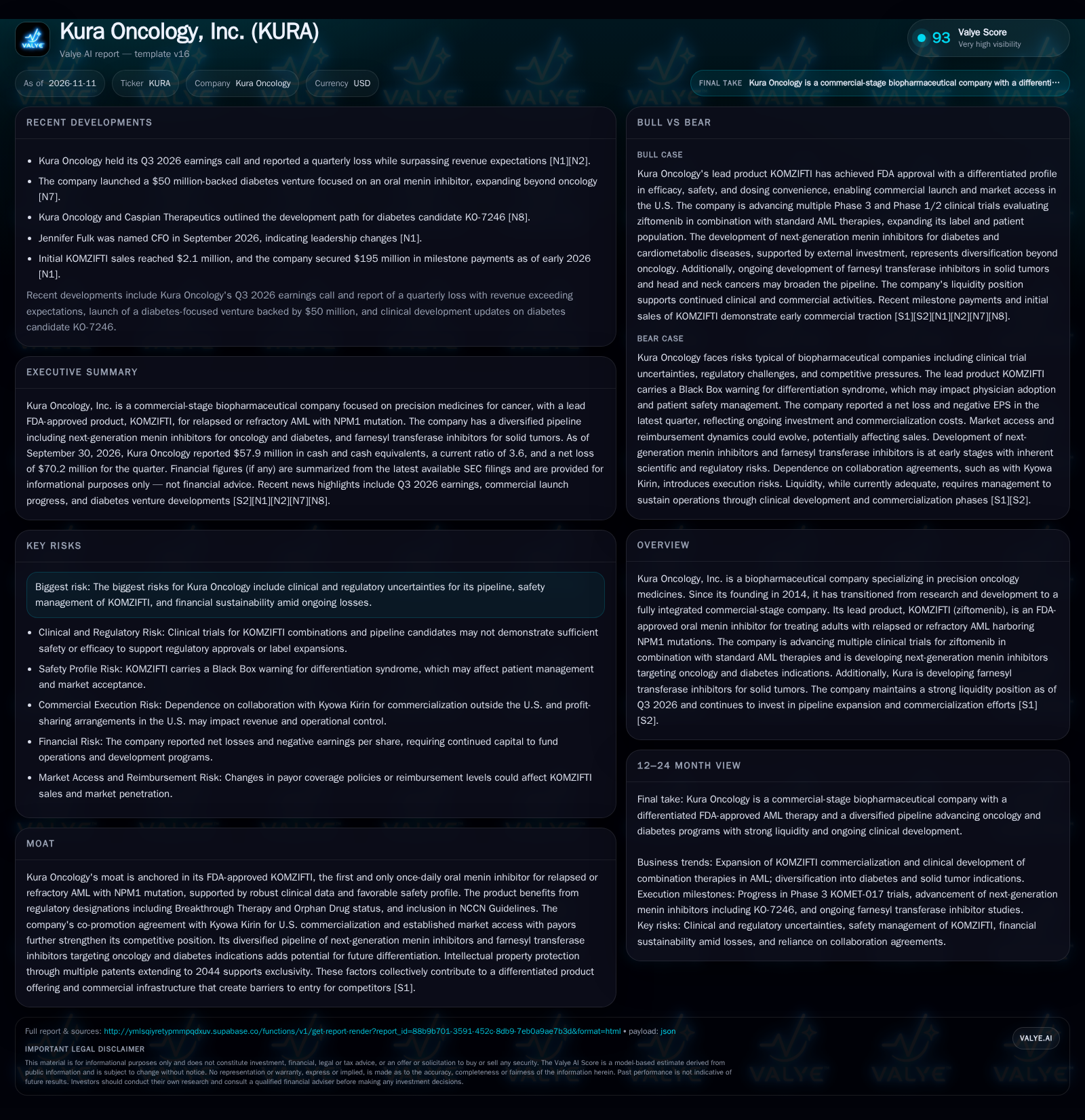
Kura Oncology has transitioned to a commercial-stage biopharmaceutical company following the FDA approval of KOMZIFTI for NPM1-mutated AML. Early sales and substantial milestone payments mark initial commercial progress, while the pipeline spans next-generation menin inhibitors and farnesyl transferase inhibitors across oncology and diabetes. [S1] [S2] [N1] [N2] [N7] [N8]
Kura Oncology’s evolution from a clinical-stage innovator to a commercial-stage oncology company is now defined by the real-world performance of KOMZIFTI, its first-in-class menin inhibitor for NPM1-mutated AML. The company’s initial commercial foray is accompanied by a broadened pipeline that includes next-generation menin inhibitors for both oncology and diabetes, as well as farnesyl transferase inhibitors targeting solid tumors.
KOMZIFTI’s Launch and Pipeline Expansion Define the Present
Kura Oncology’s most substantial current development is the commercial launch of KOMZIFTI (ziftomenib) following its FDA approval in November 2025 for relapsed or refractory AML with NPM1 mutation. This approval, based on the KOMET-001 trial with a 21.4% CR+CRh rate and median response duration of five months, positions KOMZIFTI as the first and only FDA-approved once-daily oral menin inhibitor for this indication. Early commercial sales in the U.S. reached $2.1 million, and the company secured $195 million in milestone payments tied to the launch and development progress as of early 2026. [S1] [N1]
Kura has since initiated multiple Phase 3 and combination trials for ziftomenib in broader AML settings, while also launching a $50 million-backed diabetes venture around next-generation menin inhibitors. The company’s liquidity position remains notable, with $57.9 million in cash and a current ratio of 3.6 at September 30, 2026, supporting its commercial and R&D activities. [S2] [N7] [N8]
The commercial launch of KOMZIFTI also introduces complexities related to patient identification and diagnostic infrastructure. Given the specificity of the NPM1 mutation as a biomarker, widespread adoption depends on the integration of rapid and accurate genetic testing in clinical workflows. If diagnostic penetration remains limited or inconsistent, the addressable patient population may be under-realized, constraining sales growth. Conversely, initiatives to enhance molecular diagnostics or partnerships with diagnostic companies could accelerate patient identification, improving market penetration and supporting label expansion efforts.
How Kura’s Revenue Model and Cost Structure Could Evolve
Kura’s commercial model for KOMZIFTI is built on specialty oncology drug economics: high per-patient pricing, a concentrated prescriber base, and profit-sharing with Kyowa Kirin in the U.S. Under this structure, U.S. revenues are split equally, while Kyowa Kirin handles ex-U.S. commercialization, likely returning milestones and royalties to Kura. Early sales are modest, reflecting the rarity of NPM1-mutated AML and the staggered pace of adoption for new therapies with Black Box warnings. Profitability is challenged by high fixed costs in R&D, medical affairs, and commercial buildout, with variable costs tied mainly to manufacturing and distribution.
Operating leverage could materialize if KOMZIFTI expands into broader AML populations or new combinations, increasing patient volume without proportional increases in SG&A or COGS. However, the need for ongoing clinical investment and post-marketing surveillance will keep R&D and commercial expenses elevated. The diabetes venture, if successful, could bring in milestone payments or partnership funding, but will require significant upfront development capital before commercialization. Kura’s ability to manage burn while scaling revenues will be critical to its long-term economics.
Kura’s cost structure is inherently influenced by the dual demands of commercialization and sustained innovation. While initial fixed costs are substantial, a critical inflection point occurs if KOMZIFTI achieves label expansion or gains traction in combination regimens, which could leverage existing commercial infrastructure and reduce incremental selling costs per patient. However, this assumes that reimbursement environments remain favorable and that patient adherence supports consistent revenue streams. Additionally, the diabetes venture introduces a different risk-reward profile, as development timelines and regulatory pathways may diverge significantly from oncology, requiring tailored capital allocation and strategic prioritization within the broader portfolio.
Differentiation, Imitation, and the Threat of New Entrants in Precision Oncology
KOMZIFTI’s competitive edge stems from its status as the first FDA-approved oral menin inhibitor for relapsed/refractory NPM1-mutated AML, a differentiated clinical profile (notably a lack of QTc prolongation warning), and inclusion in NCCN guidelines. This first-mover advantage is reinforced by intellectual property protection extending to 2044 and regulatory designations such as Breakthrough Therapy and Orphan Drug status, which offer exclusivity and market access benefits. [S1]
Counterforces include the emergence of rival menin inhibitors, both in development and potentially approved for overlapping indications. Some payors already require step therapy before other menin inhibitors, hinting at future competition and possible price pressure. Broader threats come from alternative targeted therapies, immunotherapies, and evolving standards of care in AML. In diabetes and solid tumors, Kura faces established incumbents and well-funded biotech peers, making differentiation via clinical data and safety profile critical for future pipeline success.
The durability of KOMZIFTI’s competitive advantage will also hinge on the company’s ability to generate compelling real-world evidence demonstrating differentiation in safety and efficacy. Payers and providers increasingly demand outcomes data that justify premium pricing, especially in rare oncology indications. Should emerging competitors offer similar efficacy with improved tolerability or convenience, Kura may face pressure to adjust pricing or invest further in patient support programs. Moreover, the evolving landscape of AML treatment, including potential advances in cellular therapies or novel immuno-oncology agents, could reshape standard-of-care paradigms, necessitating adaptive strategies to maintain market relevance.
Pipeline Synergy and Commercial Execution Unlock Multi-Asset Value
The most compelling upside scenario is one in which KOMZIFTI’s adoption accelerates, supported by robust real-world outcomes, favorable payor dynamics, and expanded indications through successful combination trials. If the ongoing Phase 3 KOMET-017 trials confirm meaningful benefit in newly diagnosed or broader AML populations, the addressable market could expand significantly, driving higher patient volume and revenue leverage.
Simultaneously, success in early-stage diabetes trials and further out-licensing or partnerships for next-generation menin inhibitors could diversify revenue streams and reduce reliance on a single product. Confirming evidence would include strong prescription growth, rapid updates to clinical guidelines, additional regulatory approvals, and external validation in the form of new collaborations or high-value licensing deals.
Incremental Uptake and Clinical Progress Amid Biopharma Realities
The most plausible outcome is a measured ramp of KOMZIFTI sales in its initial narrow indication, with gradual physician adoption shaped by real-world experience, the Black Box warning, and evolving market access requirements. Revenue growth may track guideline updates and payor coverage, but is likely to remain constrained by the size of the eligible population and competitive entry.
Pipeline programs, including combination regimens and new indications for ziftomenib, progress through clinical milestones but face the usual risks of attrition and delay. The diabetes initiative advances to early clinical proof-of-concept, supported by external investment but not yet generating commercial returns. Confirmation would come from steady sales growth, clinical trial enrollment, and continued regulatory and reimbursement support.
Stalled Adoption, Setbacks in the Pipeline, and Financial Pressures
A negative trajectory could emerge if KOMZIFTI’s adoption is hindered by safety concerns (notably differentiation syndrome), disappointing real-world efficacy, or rapid competitive encroachment. Payor restrictions, such as step therapy requirements or unfavorable reimbursement, could further limit uptake and erode pricing power.
Pipeline setbacks—such as missed endpoints in Phase 3 trials, safety signals in combinations, or failure to advance diabetes candidates—would undermine growth prospects and investor confidence. Persistent operating losses and R&D burn could outpace available liquidity, pushing Kura toward dilutive capital raises or forced pipeline prioritization. Evidence would include stagnant or declining sales, negative clinical trial news, increased reliance on equity financing, or unfavorable changes in payor policy.
Thesis-Testing Developments That Will Shape Kura Oncology’s Trajectory
KOMZIFTI quarterly net sales trends and trajectory of new patient starts post-launch.
Updates on Phase 3 KOMET-017 enrollment, interim results, and regulatory interaction for label expansion.
Real-world safety outcomes and incidence of differentiation syndrome in commercial KOMZIFTI use, if disclosed.
Changes in U.S. payor coverage policies, including step-therapy requirements or reimbursement adjustments.
Progress in clinical development of KO-7246 and other next-generation menin inhibitors, including diabetes trial initiations and early readouts.
Evidence of new licensing, collaboration, or out-licensing deals for pipeline assets.
Cash burn rate and runway projections, particularly in relation to major trial milestones and commercialization costs.
Competitive landscape updates, including new menin inhibitor approvals or major trial results from rival programs.
Disclaimer: This is research-only, informational analysis and not investment advice. It may include AI-generated interpretation and general industry context. Always verify important details using primary sources.

Comments