
Mobile Infrastructure Corp: Parking Asset Focus, Loss Trajectory, and the Search for Operational Leverage
With a single board member wielding majority voting power and management performance critical to strategy, the company’s path forward depends on extracting value from its parking portfolio while mitigating technological and governance risks.
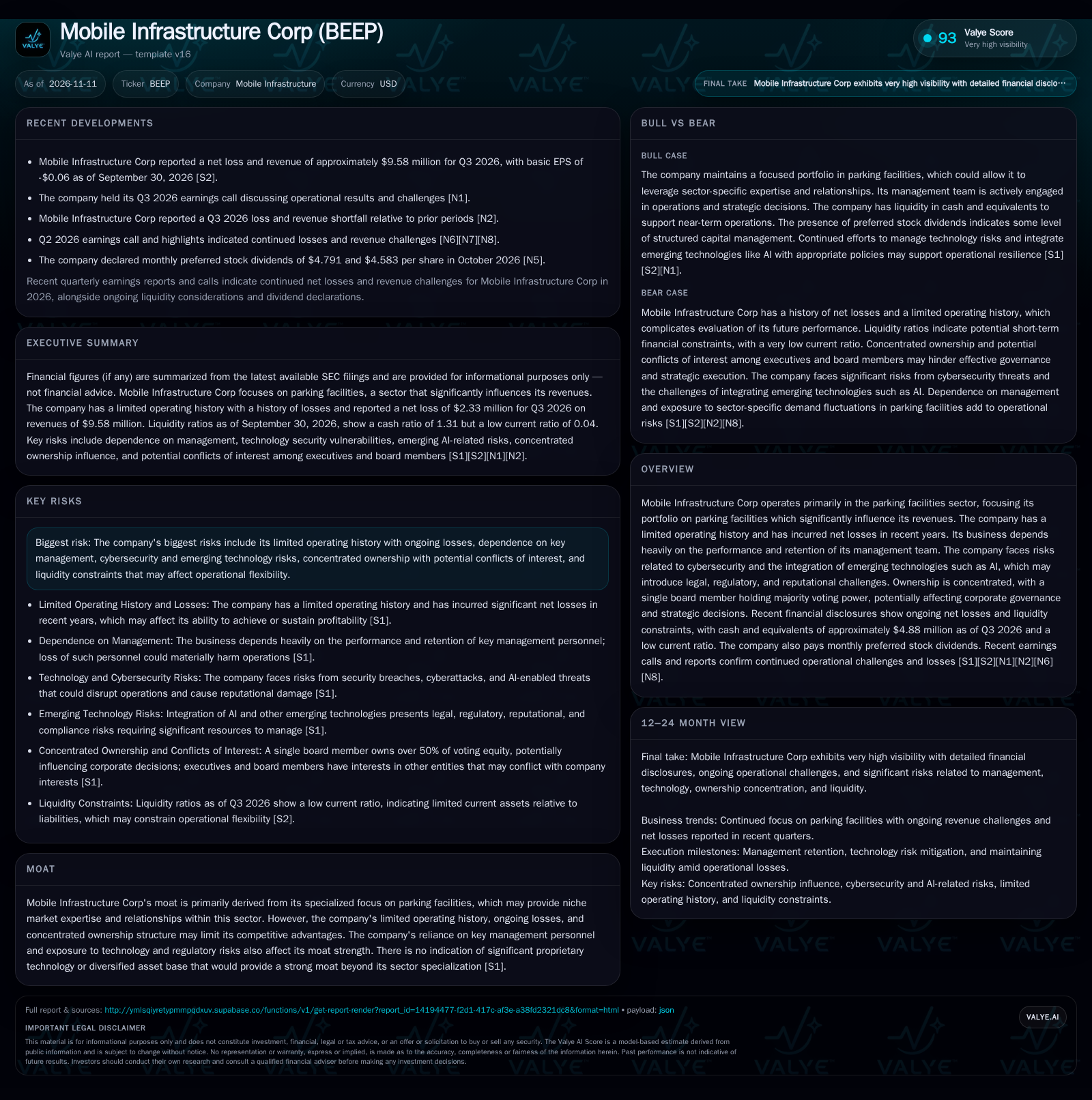
The company’s trajectory is shaped by its limited operating history, sector concentration, dependence on key management, and a governance structure dominated by a single board member with majority voting power. While specialized expertise may offer a platform for improvement, persistent losses and operational risks raise questions about long-term viability and margin expansion potential. [S2] [N1] [N2] [N6] [N8]
Mobile Infrastructure Corp sits at a challenging intersection of sector concentration and structural headwinds. Its unwavering focus on parking facilities, while offering the potential for operational expertise, has yet to yield financial stability. For investors and analysts, the central question is whether the company can translate its sector specialization into operational leverage and margin improvement, or whether persistent losses and strategic rigidity will continue to limit upside.
Recent Financial Performance Highlights Persistent Losses and Tight Liquidity
As of Q3 2026, Mobile Infrastructure Corp reported $9.58 million in revenue and a net loss of $2.33 million, translating to a basic EPS of -$0.06. The company’s liquidity position was constrained, with cash and equivalents of $4.88 million, a current ratio of 0.04, and a cash ratio of 1.31. The company reported cash and liquidity metrics for the period; these figures do not by themselves establish operating runway, investment capacity, financial flexibility, or financing capacity. Ownership remains highly concentrated, with a single board member holding over 50% of voting equity, giving them significant influence over major corporate decisions. [S2] [S1]
Parking-Facility Revenue Model: Fixed Costs and the Leverage Dilemma
Mobile Infrastructure Corp’s business model is anchored in the ownership and operation of parking facilities—a sector typically characterized by high fixed costs (property, maintenance, taxes) and variable operating expenses (staffing, utilities, management fees). Revenue is primarily driven by parking occupancy, pricing per vehicle, and potentially ancillary services such as event parking or short-term leases. The key to profitability in this model is achieving high utilization rates, as incremental revenue above break-even occupancy can contribute disproportionately to operating income due to the fixed-cost base.
However, the company’s persistent net losses suggest that current occupancy, pricing, or cost control are insufficient to cover its operating and financing expenses. The capital intensity of parking assets means that funding needs can be substantial, especially if the company seeks to upgrade facilities, adopt new technologies, or expand its portfolio. Absent material operating leverage or pricing power, the path to profitability remains uncertain. [S2]
Additionally, the company pays monthly preferred stock dividends, which impose a fixed capital cost and may constrain the flexibility to reinvest cash into operations or growth initiatives.
The capital intensity inherent in parking infrastructure also introduces a complex interplay between asset depreciation schedules and cash flow generation. Given the long-lived nature of parking facilities, the timing of capital expenditures for maintenance and upgrades can significantly affect reported profitability and liquidity. If the company defers necessary capital investments to conserve cash, it risks asset degradation that could depress occupancy and revenue over time. Conversely, aggressive reinvestment without commensurate revenue growth may exacerbate losses and strain liquidity further. Thus, the company’s ability to balance capital expenditure timing with operational cash flow is critical to sustaining its business model.
Sector Specialization: Niche Expertise vs. Diversification Constraints
Mobile Infrastructure’s singular focus on parking assets may confer some sector-specific operational expertise and localized market knowledge, which could be an advantage in asset management, pricing optimization, or regulatory navigation. However, the absence of meaningful diversification exposes the company to fluctuations in parking demand—driven by local economic activity, work-from-home trends, public transit expansion, and urban policy shifts.
The competitive landscape for parking assets includes traditional property owners, municipal operators, technology-driven aggregators, and real estate investment trusts (REITs) with broader portfolios. Without proprietary technology, scale-driven purchasing power, or a differentiated customer experience, the company’s competitive moat appears limited. Concentrated ownership and potential conflicts of interest among management and board members further complicate strategic agility and governance. [S1]
Moreover, the company’s narrow sector focus limits its ability to leverage cross-sector synergies that could stabilize cash flows and reduce volatility. For example, diversified real estate operators often offset cyclical downturns in one asset class with stable or countercyclical performance in others, thereby enhancing resilience. Mobile Infrastructure’s concentration in parking assets exposes it to localized economic shocks and policy changes without such buffers. Additionally, the absence of proprietary technology or differentiated service offerings may hinder the company’s capacity to command premium pricing or build customer loyalty, further constraining competitive positioning in an evolving mobility landscape.
Unlocking Operating Leverage Through Occupancy Growth and Technology Adoption
A favorable scenario for Mobile Infrastructure would involve a sustained uptick in parking demand—perhaps through urban recovery, event-driven surges, or strategic partnerships with local businesses and municipalities. Higher occupancy, even at stable pricing, could drive substantial incremental margin due to the company’s high fixed-cost structure. If the company can leverage emerging technologies (such as dynamic pricing, digital reservations, or automated access systems) to improve asset utilization or lower operating costs, operating leverage could accelerate.
Additional upside could come from targeted acquisitions of undervalued parking assets or by layering in ancillary revenue streams (advertising, EV charging, or logistics partnerships). Confirmation of this scenario would require evidence of rising occupancy rates, improving margin trajectories, and disclosed investments in technology or asset upgrades. Falsification would be indicated by continued flat or declining utilization rates, stagnant or worsening margins, and lack of disclosed initiatives to modernize operations.
Continued Struggle for Break-Even Amid Sector Headwinds
The most plausible near-term trajectory is one of ongoing operational and financial pressure. The company is likely to experience continued net losses as it attempts to stabilize occupancy and pricing in a market where demand for parking may be challenged by secular shifts (remote work, urban transport policy) and cyclical economic factors. Management’s ability to retain key personnel, maintain asset quality, and manage technology risks will be central to performance.
There may be incremental improvements from cost control or selective asset repositioning, but the absence of meaningful diversification and the drag from preferred stock dividends limit the prospect of rapid recovery. Confirmation of this scenario would include persistent quarterly losses, stagnant or modestly improving revenue, and limited disclosures of new growth or efficiency initiatives. A falsification would require a step-change in revenue growth, margin expansion, or evidence of successful strategic pivots. [S2] [N1] [N2] [N6] [N8]
Liquidity Stress and Governance Risks Amplify Downside
An adverse scenario would see continued or accelerating declines in parking demand, further constraining cash flows and pushing the company toward a liquidity crunch. With a current ratio of just 0.04, even minor shocks to operating cash flow could create urgent capital needs. The fixed obligation to pay preferred stock dividends further reduces flexibility.
Should key management depart, or governance conflicts arise due to concentrated ownership, the company could face strategic paralysis or value-destructive decisions. Disruptions from technology failures, cyberattacks, or regulatory changes affecting urban parking could exacerbate losses. Confirmation of this scenario would be a sharp decline in cash balances, missed or reduced dividend payments, management turnover, or evidence of distress-driven asset sales. [S2] [S1]
Liquidity stress could also be compounded by external financing constraints, particularly if credit markets tighten or investor appetite for parking-focused assets diminishes. In such an environment, refinancing existing debt or raising capital for operational needs or technology investments may become more costly or inaccessible. This scenario would intensify pressure on management to prioritize near-term cash preservation over strategic initiatives, potentially accelerating asset disposals at unfavorable valuations. Furthermore, governance risks associated with concentrated ownership might reduce transparency and hinder timely decision-making, exacerbating operational challenges during periods of financial distress.
Thesis-Testing Markers for Mobile Infrastructure’s Turnaround or Further Strain
Quarterly trends in occupancy rates and average revenue per parking space (if disclosed) would indicate whether the company is achieving the utilization needed for operating leverage.
Gross and operating margin progression on a quarterly basis will help test whether incremental revenue is translating into improved profitability or being offset by rising costs.
Disclosure of new technology initiatives—such as dynamic pricing systems, reservation platforms, or digital access—would signal a push toward modernization and potential cost or revenue upside.
Management turnover or changes in board composition, especially relating to the controlling board member, could materially affect strategy and governance.
Announcements of asset acquisitions, dispositions, or partnerships would provide insight into portfolio strategy, capital allocation, and potential growth vectors.
Any regulatory or legal disclosures related to cybersecurity incidents, AI integration, or compliance failures would be important for assessing operational risk.
Disclaimer: This is research-only, informational analysis and not investment advice. It may include AI-generated interpretation and general industry context. Always verify important details using primary sources.

Comments