
Electromed’s SmartVest Strategy: Direct Sales, Clinical Validation, and the Battle for Bronchiectasis Adoption
Electromed’s SmartVest® system stands at the intersection of clinical need, underpenetrated diagnosis, and evolving homecare economics. With fresh product innovation, a direct-to-patient sales model, and robust financial footing, the company faces both a sizable runway for growth and the stubborn headwinds of underdiagnosis and payer complexity.
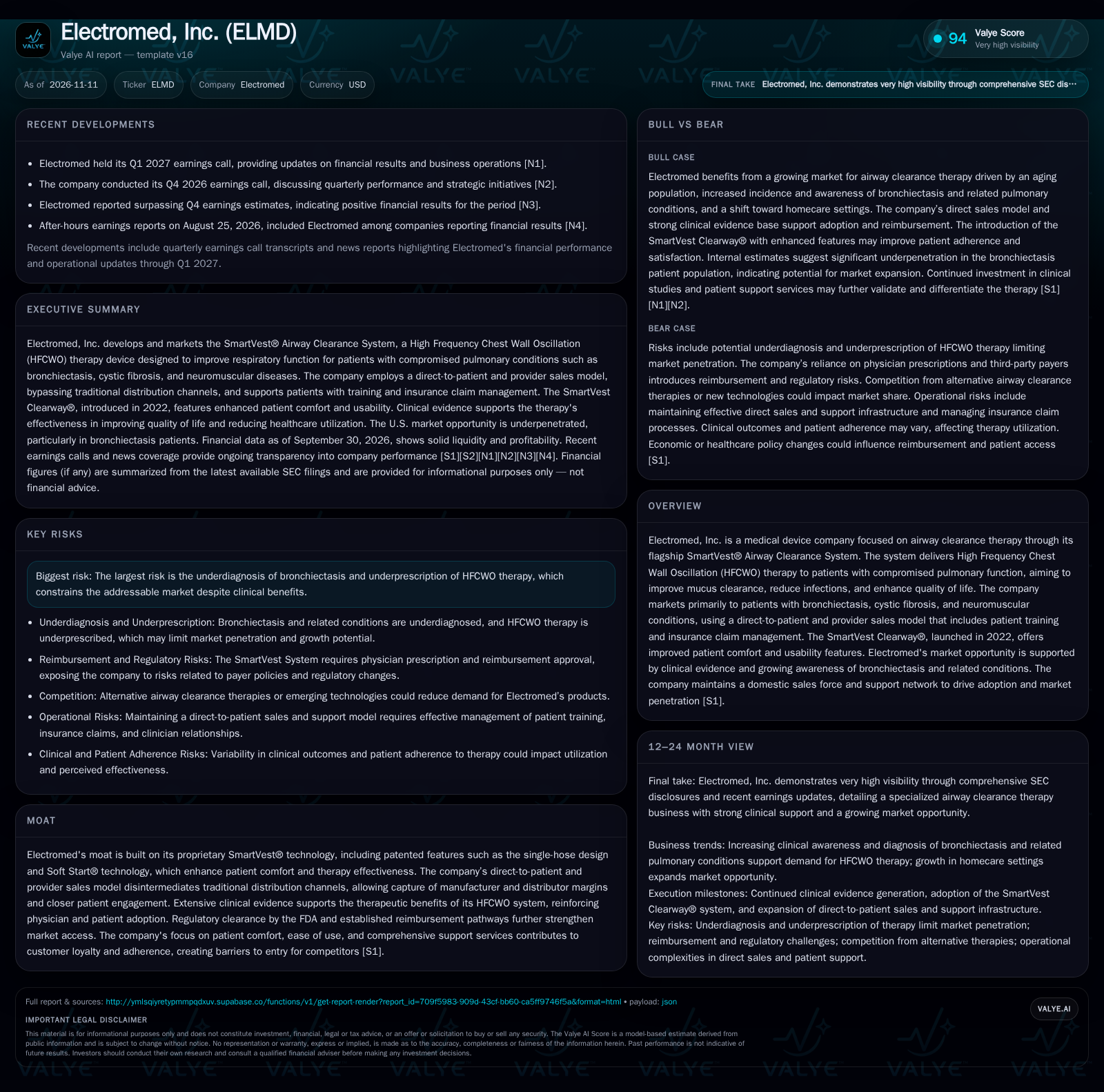
Electromed markets the FDA-cleared SmartVest® airway clearance system, targeting bronchiectasis and other pulmonary conditions. The company’s direct sales approach, new Clearway® product, and strong clinical evidence support growth potential in an underpenetrated U.S. market. However, underdiagnosis, payer dependency, and alternative therapies remain meaningful obstacles to broader adoption and sustained expansion. Financially, Electromed reports solid profitability and liquidity as of Q1 FY2027. Execution on market education and clinical validation will likely determine the pace—and ceiling—of future growth. [S1] [S2]
Electromed, Inc. is positioned at the convergence of rising clinical awareness, shifting care to the home, and the persistent challenge of underdiagnosis in pulmonary disease. Its SmartVest® Airway Clearance System—anchored by robust clinical data and a patient-centric design—targets a market where only a minority of eligible bronchiectasis patients currently receive HFCWO therapy. The company’s direct sales and support infrastructure, coupled with new product introductions, create both competitive advantages and operational complexities. The next phase of growth will depend less on incremental product tweaks and more on shifting clinical mindsets, payer policies, and patient identification.
Recent Performance Highlights a Strong Platform and Market Opportunity
Electromed’s Q1 FY2027 financials underscore a business with both profitability and a substantial liquidity buffer: $15.9 million in cash, a current ratio of 7.19, and net income of $2.76 million [S2]. The company’s market thesis is reinforced by the launch of the SmartVest Clearway® system in late 2022, which aims to improve patient adherence through comfort and usability enhancements [S1]. At the same time, internal estimates suggest HFCWO therapy is used by only about 16% of diagnosed U.S. bronchiectasis patients, indicating a large underpenetrated population [S1]. The company’s direct sales and patient engagement model is designed to capture both margin and loyalty, while published clinical studies support the system’s efficacy in reducing exacerbations and healthcare utilization [S1].
How Direct Sales, Reimbursement, and Product Differentiation Shape Unit Economics
Electromed’s revenue model is anchored in high-value capital equipment sales—primarily the SmartVest® system—supplemented by recurring sales of replacement garments and accessories. The direct-to-patient/provider approach allows the company to capture the full manufacturer and distributor margin, but it also absorbs the costs of patient training, insurance claim management, and ongoing support. Variable costs include manufacturing, logistics, and clinical support, while fixed costs are dominated by salesforce, R&D, and compliance infrastructure.
Reimbursement is a critical economic lever: most SmartVest systems are purchased via third-party payer coverage after physician prescription. This introduces variability in realized prices and payment timing, and successful claims management is essential for cash flow stability. Product differentiation—such as the single-hose design and Soft Start® technology—may support premium pricing and adherence if clinicians and payers value the improved patient experience.
Operating leverage could be significant if sales volume expands, given the relatively fixed nature of sales and support overhead. However, the need for continual education, payer engagement, and post-sale support constrains how much operating margin can expand without further investment. Capital needs are limited for core operations, but expansion into new indications or international markets could require additional investment.
Assessing Defensible Advantages in a Crowded and Evolving Therapeutic Space
Electromed operates in a niche but competitive segment of the respiratory device market. Its most direct competition is from other HFCWO device manufacturers, as well as alternative airway clearance therapies (such as oscillatory PEP devices, manual CPT, and emerging digital or wearable solutions). The company’s defensible advantages include FDA clearance, a meaningful body of clinical evidence, proprietary comfort and usability features, and a direct sales/service infrastructure that fosters physician and patient loyalty [S1].
However, the market is vulnerable to substitution if new therapies demonstrate superior outcomes, lower cost, or easier integration into care pathways. Furthermore, the requirement for physician prescription and payer approval creates a gatekeeper dynamic—if clinicians are slow to diagnose or prescribe, or if payers tighten criteria, addressable demand can be choked off. Scale advantages accrue to companies that can navigate payer relationships and build awareness among clinicians, which favors those with established salesforces and clinical support teams. Electromed’s ability to maintain or expand its clinical and commercial moat will depend on continued evidence generation, product refinement, and payer engagement.
Unlocking Underdiagnosed Demand: What a Step-Change in Adoption Would Look Like
The most favorable scenario for Electromed is one in which clinical awareness and diagnosis of bronchiectasis accelerate, leading to a higher proportion of eligible patients being prescribed HFCWO therapy. This could be triggered by updated clinical guidelines, new studies linking therapy to reduced hospitalizations, or effective patient and provider education campaigns. If the company’s direct sales model and SmartVest Clearway® product successfully convert this latent demand, revenue growth could outpace the underlying 8–12% market growth rate [S1].
Confirmation of this scenario would include a rising rate of new patient starts, growing market share within bronchiectasis, and evidence of improved payer acceptance or less administrative friction in reimbursement. Additional clinical data supporting cost-effectiveness and patient quality of life would further strengthen the case. Falsification would occur if diagnosis and prescription rates remain flat despite increased sales efforts, or if new therapies erode SmartVest’s clinical or economic value proposition.
Incremental Progress in a Complex Market: Gradual Growth Amid Systemic Frictions
The most plausible outcome is steady but unspectacular growth, as diagnosis of bronchiectasis and adoption of HFCWO therapy increase slowly due to persistent underdiagnosis and payer hurdles. Electromed is likely to capture a modestly expanding share of a gradually growing market, supported by the Clearway® product’s usability improvements and ongoing direct sales engagement. Operating leverage improves incrementally as fixed costs are spread over higher volumes, but margins are tempered by the ongoing requirement for sales, clinical, and payer support.
Evidence confirming this scenario would be modest, sustained increases in revenue and patient starts, stable or slightly improving gross margin, and continued profitability. Falsification would be seen if there is a sharp slowdown in sales momentum, increased payer pushback, or a marked rise in competitive encroachment.
When Underdiagnosis, Payer Barriers, or Substitution Stall Expansion
A negative scenario could materialize if efforts to improve diagnosis and prescription rates fail, keeping HFCWO therapy penetration stagnant. This could be exacerbated by changes in reimbursement policy, increased payer scrutiny, or the emergence of cheaper or more convenient competitor therapies. In this scenario, Electromed’s growth would stall, and operating leverage could reverse if fixed costs outpace revenue growth. Declining utilization or adverse clinical data could also undermine the perceived value of SmartVest.
Evidence pointing to this downside would include declining new patient starts, increased claim denials or reimbursement delays, margin compression due to pricing pressure, or loss of clinical guideline support. Falsification would require a demonstrable uptick in diagnosis, improved payer dynamics, or clear outperformance versus alternative therapies.
Milestones That Will Shape Electromed’s Penetration and Payer Trajectory
Trends in new patient starts for the SmartVest system, as this would signal success in expanding diagnosis and prescription rates (if disclosed).
Gross margin evolution, which would reflect pricing power, mix, and the impact of operational leverage or competitive pressure (if disclosed).
Rates of insurance claim approval and average time-to-payment, indicating payer acceptance and reimbursement friction (if disclosed).
Clinical study publication cadence and outcomes, especially data linking SmartVest use to reduced hospitalizations or healthcare costs.
Competitive product launches or guideline changes that could alter the clinical or economic landscape for HFCWO therapy.
Salesforce expansion, turnover, or productivity metrics, as these affect the reach and efficiency of the direct sales model (if disclosed).
Updates on the penetration rate of HFCWO therapy among diagnosed bronchiectasis patients, which serves as a barometer for overall market expansion.
Disclaimer: This is research-only, informational analysis and not investment advice. It may include AI-generated interpretation and general industry context. Always verify important details using primary sources.

Comments