
Velo3D’s Advanced Metal AM Ambitions: Forging Scale, Defending Margins, and Navigating the Production Ramp-Up Crucible
Velo3D’s push to industrialize metal additive manufacturing hinges on successfully scaling its integrated platform, deepening blue-chip relationships in high-value sectors, and proving the economics of its new Forge 1 facility—all while navigating competitive pressure and the capital intensity of production expansion.
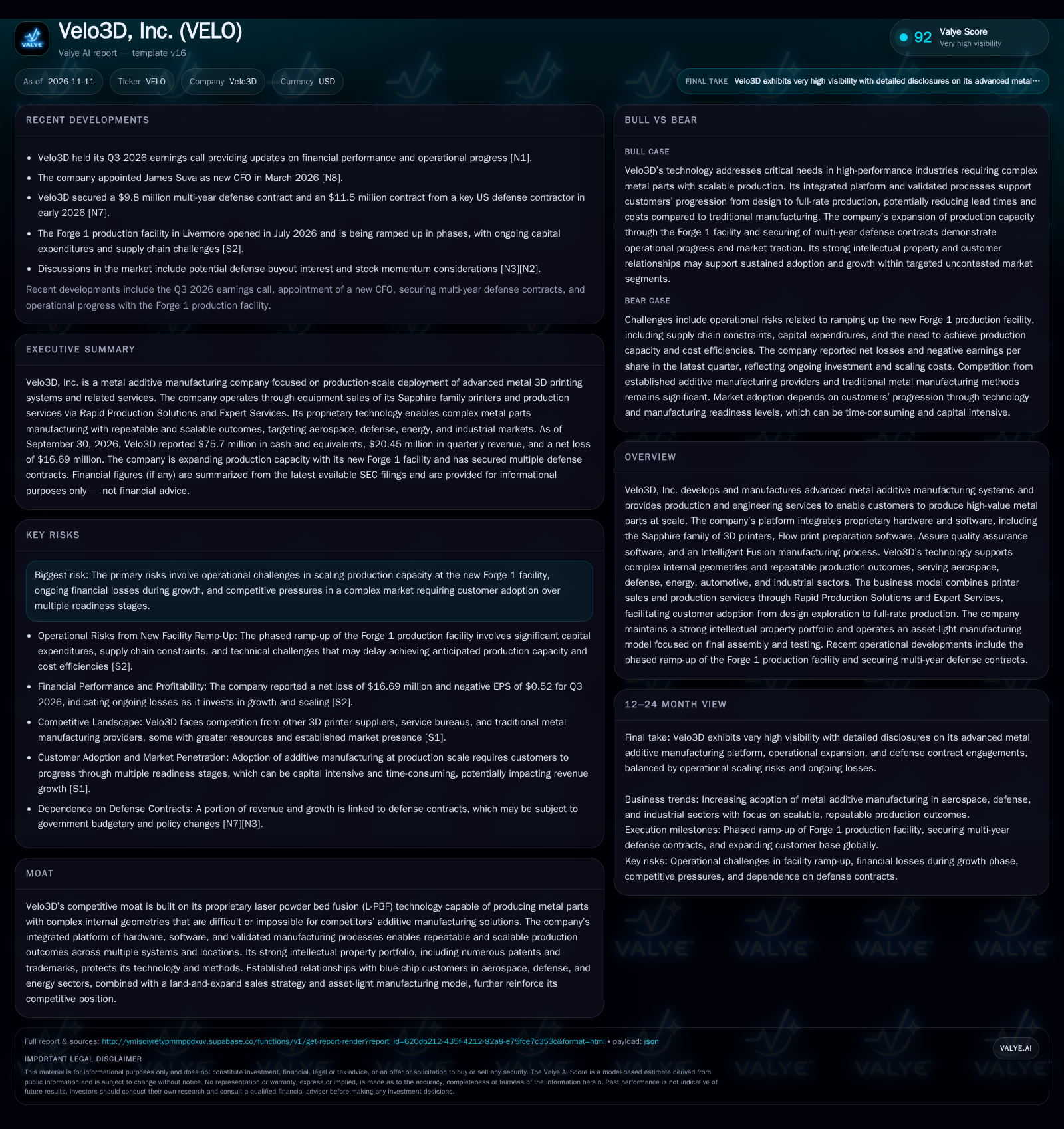
Velo3D is expanding its industrial metal additive manufacturing platform, aiming to capture aerospace, defense, and energy applications requiring complex geometries. The company’s phased ramp-up of its Forge 1 facility and recent multi-year defense contracts mark operational and market milestones, but ongoing net losses and execution risk around scaling remain material. The company’s asset-light model and robust IP portfolio may support long-term positioning if it can demonstrate cost efficiency and production repeatability at scale. [S1] [S2]
Velo3D sits at the intersection of industrial 3D printing innovation and the practical demands of high-performance manufacturing. Its proprietary platform—spanning hardware, software, and process know-how—enables customers in aerospace, defense, and energy to produce metal components with previously unattainable complexity and repeatability. The company’s recent operational and financial disclosures highlight both critical progress and persistent challenges: it is scaling up its new Forge 1 facility amid supply chain and infrastructure constraints, while continuing to post significant net losses as it invests in capacity and customer acquisition. The central question is whether Velo3D can demonstrate sustainable unit economics and defend its technology edge as the market for production-grade metal additive manufacturing matures.
Operational Scale-Up and Loss Trajectory Define the 2026 Snapshot
Velo3D reported $20.45 million in revenue and a net loss of $16.69 million for Q3 2026, with basic and diluted EPS of -$0.52. Cash and equivalents at quarter-end stood at $75.7 million, with a current ratio of 5.12 and a cash ratio of 2.69, reflecting reported liquidity position on paper. [S2] The company’s Forge 1 production facility, opened in July 2026, is ramping up in phases but has encountered supply chain constraints and the need for electrical service upgrades, contributing to ongoing capital expenditures and operational complexity. [S2] Velo3D has also secured multi-year defense contracts, indicating progress in penetrating target end-markets. [N7] These facts underscore the duality of Velo3D’s situation: it is gaining commercial traction and building production capacity, but the business remains loss-making and operationally intensive.
How Velo3D’s Blended Revenue Model Could Shape Margins and Scale
Velo3D’s economics are driven by two complementary revenue streams: the sale of its Sapphire family of metal additive manufacturing printers (including associated software, installation, and support) and recurring production/engineering services delivered through Rapid Production Solutions (RPS) and Expert Services. [S1] Equipment sales are likely high-ticket, lumpy, and capital-intensive for customers, while production services offer a recurring, lower-barrier entry point and enable customers to access advanced additive manufacturing without upfront capital outlay.
The company’s asset-light approach focuses on final assembly, testing, and shipment, which helps contain fixed costs and limits capital expenditure compared to vertically integrated manufacturing. [S1] However, the ramp-up of Forge 1 introduces a new layer of fixed and semi-fixed costs—utilities, labor, and equipment—against which Velo3D must drive sufficient throughput to achieve operating leverage.
Gross margins may be pressured in the near term by the phased nature of the Forge 1 ramp, under-absorbed overhead, and the practical realities of scaling production in a technically demanding environment. If Velo3D can drive up utilization of its new facility and expand its installed base, higher-margin software, recurring services, and consumables (if any) could improve blended margins over time. The fundamental economic question is whether the company can transition from a high-investment, negative-margin phase to a recurring-revenue, operating-leverage-positive model as adoption deepens in core markets.
Defending a Technological Moat in a Crowded Additive Manufacturing Arena
Velo3D’s central competitive advantage is its proprietary laser powder bed fusion (L-PBF) platform, which enables the production of metal parts with intricate internal geometries that are difficult or impossible for competing additive or conventional methods. [S1] The integration of Flow print preparation software, Assure quality assurance, and the Intelligent Fusion process creates a full-stack solution that addresses quality, repeatability, and scalability—core adoption barriers for production-grade additive manufacturing.
The company’s 57 issued patents, trademarks, and copyrights protect key technological differentiators, but the market remains competitive and dynamic. [S1] Velo3D faces direct competition from other metal AM companies, traditional manufacturing, and service bureaus with established customer bases and, in some cases, broader product portfolios or deeper resources.
Switching costs in this industry are potentially high for mission-critical parts, especially in regulated sectors like aerospace and defense. However, entrenched incumbents and the slow, qualification-heavy adoption curve for new manufacturing technology create obstacles to rapid displacement or market share gains. The outcome will likely turn on Velo3D’s ability to demonstrate superior part quality, lower total cost of ownership, and validated production repeatability at customer sites.
If Forge 1 Delivers: Operational Leverage, Expanded Adoption, and Margin Inflection
A favorable scenario for Velo3D would see the Forge 1 facility ramp to targeted production capacity on schedule, with supply chain and infrastructure bottlenecks resolved. This would enable higher throughput, improved absorption of fixed costs, and a path toward positive operating leverage. As a result, gross margins could expand, and net losses narrow or reverse, especially if the company can convert pilot customers into repeat, high-value adopters via its land-and-expand strategy.
Additional upside could come from the expansion of multi-year defense and aerospace contracts, deeper penetration of international markets, and growing contribution from software and services. Confirmation of this scenario would require evidence of sequential revenue growth with improving gross margins, higher utilization rates at Forge 1, new or expanded contracts with blue-chip customers, and a visible reduction in cash burn as scale is achieved. Announcements of successful customer qualification runs, repeat orders, or new product launches within the Sapphire family would further validate the company’s ability to industrialize its technology.
Gradual Capacity Ramp and Mixed Progress as Industrial Adoption Proves Out
The most plausible medium-term outcome is a gradual, sometimes uneven, ramp-up at Forge 1, with periodic operational setbacks and incremental improvements in throughput and cost structure. Velo3D may continue to post net losses as it absorbs higher operating costs, while revenue grows in fits and starts depending on the timing of equipment sales and production contracts.
Adoption cycles in aerospace, defense, and energy are likely to remain long and qualification-heavy, with production services providing a bridge for customers not yet ready to commit to full printer purchases. Margins may improve modestly if utilization rises, but the company will need to demonstrate that its technology translates into durable customer relationships and that the economics of its blended model can support eventual profitability.
Evidence supporting this scenario would include modest sequential revenue growth, stable or slightly improving gross margins, continued signing of new customers (even if initially at lower volumes), and ongoing but narrowing operating losses. Indicators that would challenge this scenario include persistent operational bottlenecks at Forge 1, stagnating bookings, or material erosion in gross margins despite scaling.
If Ramp Stalls: Fixed Cost Drag and Competitive Pressure Threaten the Thesis
A negative scenario would see the Forge 1 ramp beset by unresolved supply chain, infrastructure, or technical issues, leading to underutilization and persistent negative gross margins. If capital expenditures outpace revenue growth and operational problems persist, Velo3D’s cash position could erode rapidly, forcing either dilutive capital raises or operational retrenchment.
On the demand side, slower-than-expected adoption by core aerospace, defense, or energy customers—whether due to conservative qualification processes, macroeconomic headwinds, or competitor encroachment—could leave Velo3D with excess capacity and limited pricing power. If traditional manufacturers or better-resourced additive peers match or exceed Velo3D’s technical advantages, the company’s competitive moat could narrow.
Confirmation of this scenario would include flat or declining revenues, widening net losses, negative trends in gross margin, customer churn or lack of contract renewals, and disclosure of further operational delays or unplanned capital needs. Evidence of customer migration to alternative technologies or failure to secure new multi-year contracts would further pressure the downside thesis.
Milestones That Will Determine Whether Velo3D’s Technology Becomes a Production-Scale Standard
Forge 1 utilization rates and throughput: If disclosed, these metrics would directly test whether the new facility is scaling as planned and driving operating leverage.
Gross margin progression by segment: Tracking improvements (or deterioration) in margins from equipment sales and production services would clarify the path to profitability.
Sequential revenue growth and backlog visibility: Ongoing top-line momentum and disclosed backlog or contract pipeline would signal commercial traction.
Customer qualification and repeat order rates: Evidence that blue-chip customers are moving from pilot to production-scale adoption would validate the land-and-expand model.
Cash burn and operating expense trends: Monitoring quarterly changes in cash used in operations and total opex is critical to assess financial runway and discipline.
New or expanded multi-year contracts in defense, aerospace, or energy: Announcements here would confirm market validation and support for higher utilization.
Resolution of supply chain or infrastructure constraints at Forge 1: Updates on overcoming ramp-up challenges are essential to the thesis.
Competitive developments, such as new technology launches or major contract wins by peers: External signals would help test the durability of Velo3D’s moat.
Disclaimer: This is research-only, informational analysis and not investment advice. It may include AI-generated interpretation and general industry context. Always verify important details using primary sources.

Comments