
National CineMedia: Diversification Bets and Audience Exposure in a Shifting Out-of-Home Advertising Landscape
National CineMedia’s recent acquisitions and expanded digital footprint reshape its value proposition, but the company remains fundamentally tethered to theater attendance trends, advertiser demand for high-attention environments, and the stability of its exclusive agreements. The question is whether expanded reach and premium audience targeting can offset structural headwinds from evolving entertainment consumption and partner financial uncertainty.
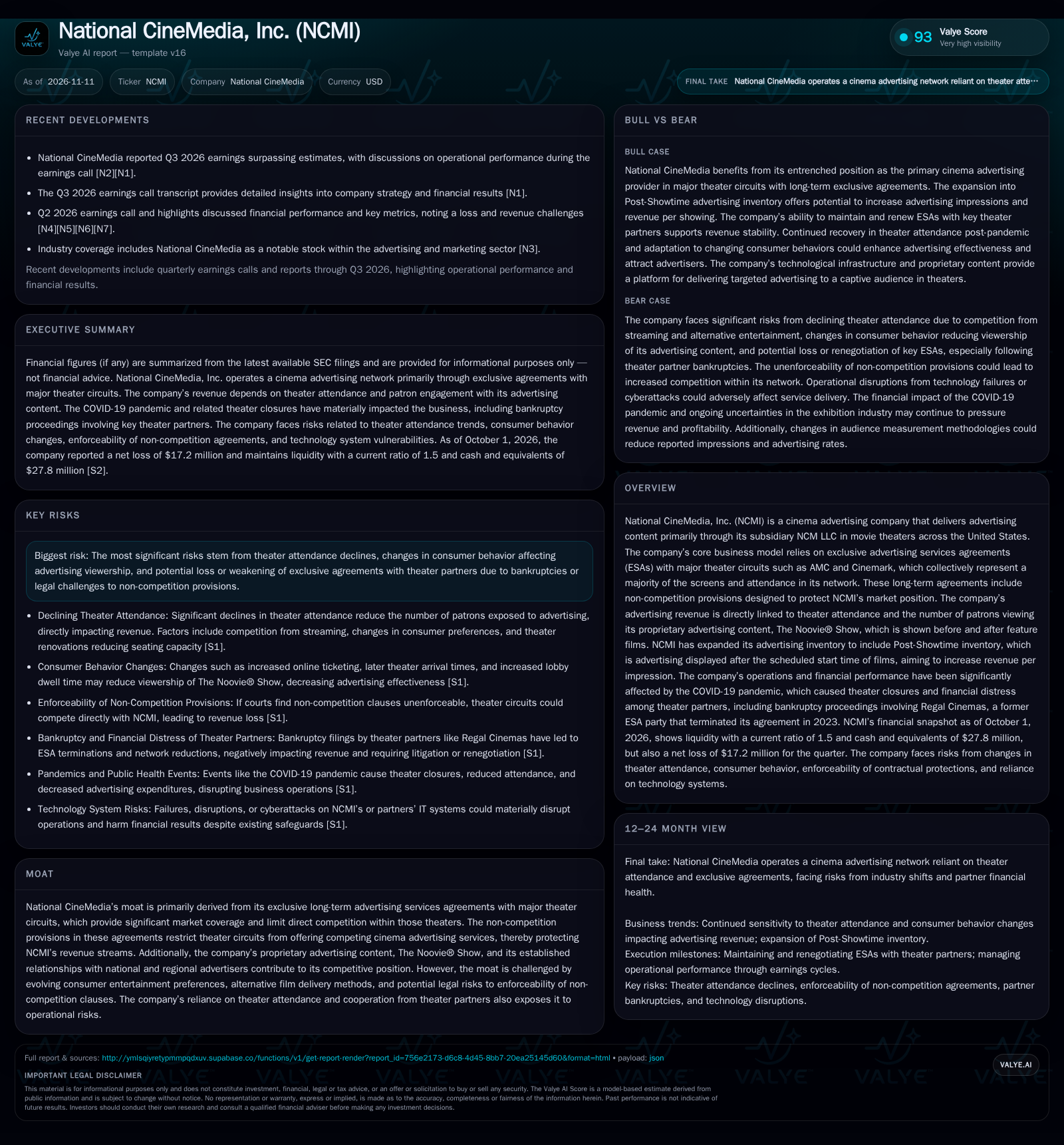
National CineMedia (NCMI) has broadened its platform through the acquisitions of Captivate and Spotlight, now spanning theaters, office buildings, and residential lobbies, with a combined 48,000 digital screens. While this positions the company as a leading premium out-of-home video advertising network, its economics remain highly sensitive to theater attendance, ESA stability, and the ability to monetize new inventory. The $272.4 million Captivate acquisition marks a strategic pivot, but with a Q3 2026 net loss of $17.2 million, the test is whether diversification can deliver sustainable margin improvement and revenue growth in the face of secular cinema risks and changing advertiser priorities. [S2]
National CineMedia, Inc. has historically occupied a unique position as the dominant cinema advertising platform in the U.S., with a business model deeply intertwined with the ups and downs of movie theater attendance and long-term exclusive agreements with major chains. The 2026 acquisition of Captivate and the prior addition of Spotlight mark a deliberate pivot: NCMI is now a premium out-of-home video advertising network spanning not only more than 17,600 cinema screens but also 27,000 elevator and lobby screens and hundreds of art house and luxury theaters. The company’s ability to translate this expanded digital footprint into sustainable revenue and margin gains, however, faces significant tests—most notably the secular headwinds buffeting traditional cinema, the challenge of integrating disparate audience environments, and the need to demonstrate that advertisers will pay premium CPMs for unified, multi-venue campaigns.
Strategic Expansion and Persistent Margin Pressure: The Latest Developments
Three developments stand out in National CineMedia’s current position. First, the September 2026 acquisition of Captivate for $272.4 million adds over 27,000 digital screens in 11,000 office and residential buildings, positioning NCMI as a leading premium out-of-home video network. Second, the post-acquisition platform now spans approximately 48,000 digital screens across theaters, offices, and residential properties in 185 DMAs, including all top 100 markets. Third, despite surpassing Q3 2026 earnings estimates, the company reported a net loss of $17.2 million and maintains a cash balance of $27.8 million, with a current ratio of 1.5 as of October 1, 2026. These facts highlight both the scale of NCMI’s transformation and the persistent challenge of restoring profitability amid integration costs and ongoing industry volatility. [S2]
How National CineMedia Monetizes Attention: Revenue Drivers and Cost Structure
NCMI’s core revenue engine is the sale of advertising inventory—measured in CPM (cost per thousand impressions)—delivered through exclusive, long-term ESAs with major theater chains such as AMC and Cinemark. These agreements, featuring non-compete clauses and multi-decade terms, provide access to a captive, high-attention audience for pre-show and, increasingly, post-show advertising. Revenue per showing is a function of both theater attendance and the proportion of patrons exposed to The Noovie® Show. The addition of Post-Showtime inventory and the Spotlight and Captivate networks diversifies the inventory pool, theoretically enabling a wider array of campaign formats and audience targeting options.
Variable costs are driven by content production, technology maintenance, and revenue-sharing with theater and venue partners, while fixed costs encompass platform operations and SG&A. The acquisition of Captivate introduces new fixed and variable cost layers, particularly around technology integration and venue partner agreements—though the 98% annual retention rate for building agreements suggests potential for stable, recurring revenue if CPMs hold. Operating leverage is substantial: incremental revenue from higher attendance or greater inventory utilization can flow disproportionately to the bottom line, but the reverse is also true during volume declines or when advertisers question measurement reliability. Capital needs are significant in years with acquisitions or major technology investments, but day-to-day working capital is moderate provided ESAs and venue contracts remain stable.
Exclusive Agreements and the Shifting Out-of-Home Landscape: Where NCMI Stands
NCMI’s primary moat has historically been its exclusive access to moviegoers through long-term ESAs with the two largest national theater chains. This exclusivity, reinforced by non-compete provisions, has shielded the company from direct in-cinema advertising competition. However, the termination of the Regal ESA in 2023 exposed the vulnerability of this model to partner bankruptcies or legal challenges, and raises questions about the enforceability of non-competition clauses going forward. The expansion into office and residential venues via Captivate and Spotlight reduces dependence on a single channel and may improve negotiating leverage with advertisers seeking cross-venue reach.
Competition is intensifying from digital out-of-home (DOOH) networks, streaming platforms, and programmatic advertising ecosystems that offer alternative ways to reach similar demographic segments. Substitutes for cinema advertising include streaming video, social media, and other experiential marketing channels. The ability to demonstrate higher engagement, attention, or purchase intent in theaters and premium venues remains crucial for CPM defense. NCMI’s future competitive edge may depend less on exclusivity and more on its capacity to deliver integrated, data-driven campaigns across high-attention environments—and to prove their incremental value relative to digital and streaming alternatives.
If Diversification Unlocks Premium CPMs: The Bullish Chain Reaction
The favorable scenario for NCMI hinges on three reinforcing dynamics. First, theater attendance stabilizes or grows modestly as blockbuster slates and event cinema draw audiences back, providing a reliable baseline for cinema inventory sales. Second, the expanded platform enables NCMI to sell integrated campaigns that reach premium audiences not only in theaters but also in offices and luxury residential properties, attracting new advertisers and commanding higher blended CPMs. Third, strong building agreement retention (currently 98%) and successful cross-selling allow the company to grow revenue faster than fixed costs, restoring positive operating leverage.
Confirmation would come from sustained increases in advertising revenue per attendee, rising CPMs for cross-venue campaigns, and sequential quarterly improvements in margin and free cash flow. Early evidence of new, multi-venue national brand deals, and disclosure of CPM uplift attributable to the combined platform, would strengthen the bullish case. Falsification would occur if CPMs in new venues erode or if advertisers fail to adopt the cross-platform offering, leaving the company with higher costs but no revenue diversification benefit.
Integrated Platform Delivers Incremental Gains, but Headwinds Remain
The most plausible trajectory is incremental improvement: the addition of Captivate and Spotlight broadens NCMI’s reach and offers advertisers more options, but cinema remains the core revenue and margin driver. Theater attendance stabilizes at a post-pandemic plateau, with occasional volatility tied to film releases and consumer preferences. The company succeeds in retaining most venue partners and leverages its platform to win some cross-venue campaigns, but CPM uplift is moderate and offset by ongoing margin pressure from integration costs and competitive pricing. Advertising revenue per attendee recovers slowly, but operating leverage is muted by a less robust theater rebound and the need to invest in technology and measurement to satisfy advertisers’ demands for transparency.
Evidence for this scenario includes steady but unspectacular revenue growth, gradual improvement in net losses, and stable cash balances. Falsification would occur if either cinema attendance resumes a steep decline or if cost synergies from acquisitions fail to materialize, leading to persistent or widening losses.
If Cinema Fundamentals Deteriorate: Erosion of Platform Economics
The adverse scenario is driven by renewed weakness in theater attendance, either from a disappointing film slate, a shift in consumer habits, or a new disruptive event (e.g., pandemic resurgence). This would diminish the value of NCMI’s largest advertising inventory pool and could trigger further renegotiations or terminations of ESAs with remaining major exhibitors. If advertisers perceive declining reach or viewership of The Noovie Show and equivalents, CPMs would come under pressure, and revenue per attendee would fall. At the same time, if the integration of Captivate and Spotlight fails to produce the anticipated cross-venue sales or if retention rates in office/residential venues drop, the company could be left with a higher fixed cost base and insufficient offsetting revenue.
Confirmation would be visible in sequential declines in advertising revenue, shrinking CPMs, higher churn in venue contracts, and negative free cash flow trends. Additional warning signs would include legal setbacks regarding non-compete enforceability or accelerated losses from technology or integration missteps.
Milestones and Metrics That Will Determine NCMI’s Strategic Payoff
Growth or decline in advertising revenue per attendee—especially in theaters, as this is the core sensitivity point for overall margin.
Quarterly trends in CPMs, both for cinema and for cross-venue campaigns involving Captivate and Spotlight; a useful metric would be the blended CPM uplift from integrated offerings, if disclosed.
Retention rates for office and residential building agreements post-Captivate acquisition—continued 98%+ levels would support recurring revenue assumptions.
Utilization rates and fill factors for Post-Showtime and new inventory segments, as higher utilization would signal successful advertiser adoption.
Evidence of new, multi-venue national advertising deals or expanded relationships with top brand advertisers.
Quarterly net leverage ratio and free cash flow, as indicators of whether integration costs are being controlled and new revenue is translating into cash generation.
Legal developments or renegotiations affecting the enforceability or economics of existing ESAs, especially with AMC and Cinemark.
Any disclosed changes in measurement methodology for audience impressions, as these could materially impact reported reach and revenue.
Disclaimer: This is research-only, informational analysis and not investment advice. It may include AI-generated interpretation and general industry context. Always verify important details using primary sources.

Comments