
Bionano Genomics: Platform Utilization, Consumables Growth, and the Financing Imperative
Bionano Genomics’ Optical Genome Mapping (OGM) ecosystem shows resilience in consumables and platform adoption, but persistent losses and a going-concern warning make capital access and revenue model evolution critical to the company’s long-term viability.
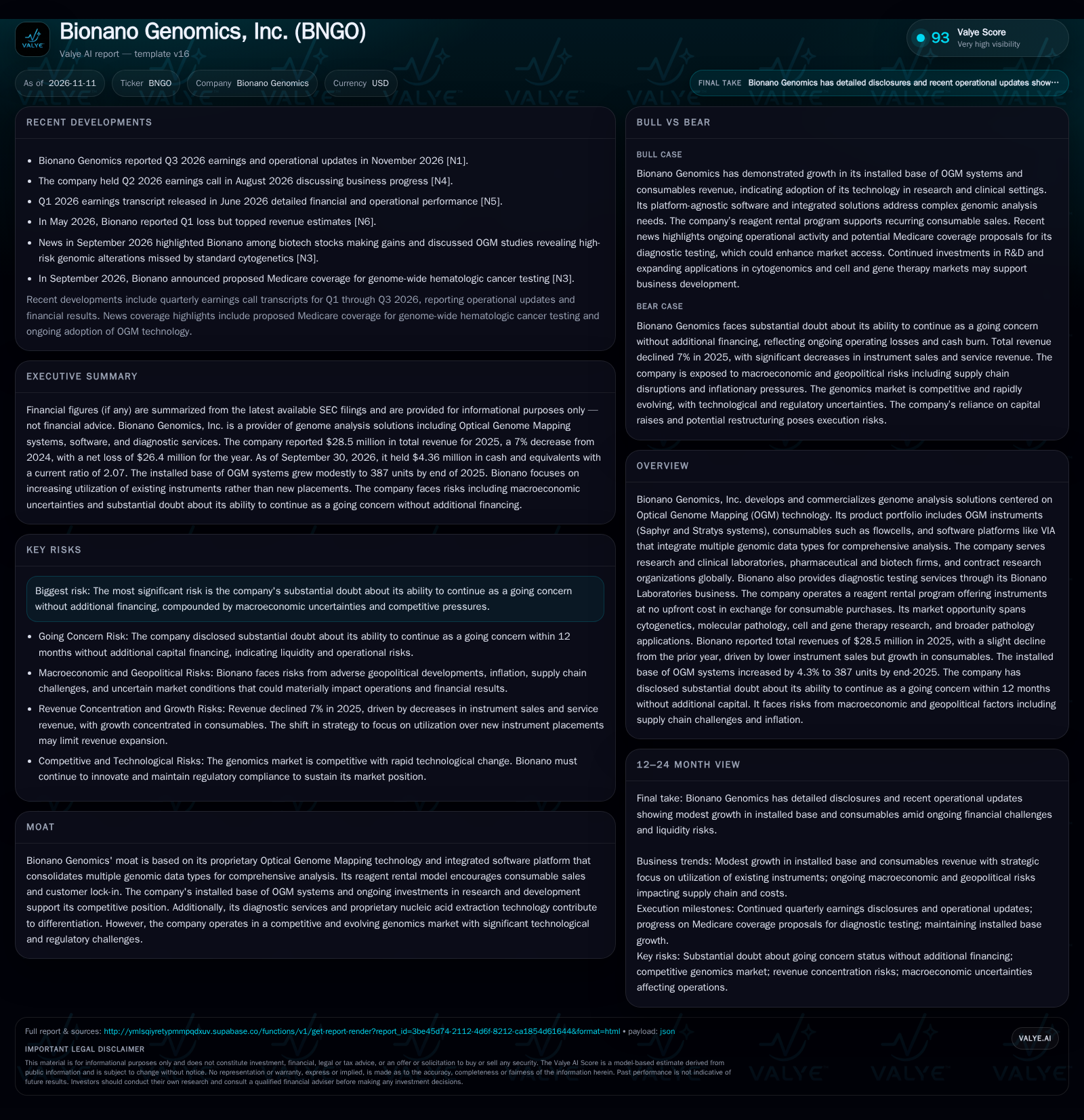
Bionano Genomics, Inc. is focusing on driving higher utilization of its existing OGM instrument base, evidenced by rising consumables revenue despite weak instrument sales and overall revenue contraction. The company’s cash position and explicit going-concern risk highlight an urgent need for new capital or a business model inflection. Platform-agnostic software and integration with clinical genomics workflows remain strategic assets, but the path to sustainable growth depends on converting installed base momentum into recurring, profitable revenue streams and navigating macro and market headwinds. [S2] [N1]
Bionano Genomics, Inc. stands at a critical juncture in the genomics tools market, balancing incremental growth in its Optical Genome Mapping (OGM) platform utilization against persistent operating losses and a pressing need for new capital. The company’s shift toward maximizing consumables sales from its modestly expanding installed base signals a strategic bet on recurring revenue, but headwinds from declining instrument sales, reduced service revenue, and a formal going-concern warning underscore the urgency for business model adaptation or external financing. [S2] [N1]
Recent Performance Highlights Platform Utilization and Liquidity Pressure
Bionano Genomics exited 2025 with 387 OGM systems installed, a 4.3% increase over the prior year. This modest expansion occurred even as instrument revenue fell 21% to $6.4 million, suggesting a pivot from new placements to driving higher usage of the existing base. The company’s consumables revenue rose 9% to $14.0 million, now representing more than half of product revenue, while service and other revenue declined sharply by 53% to $1.8 million. Total revenue contracted 7% to $28.5 million in 2025. The net loss narrowed substantially to $26.4 million, but the company ended Q3 2026 with just $4.36 million in cash and a current ratio of 2.07. Most critically, Bionano has disclosed substantial doubt about its ability to continue as a going concern within the next 12 months without securing new capital. [S2] [N1]
How the OGM Ecosystem Could Drive Recurring Revenue—and Where the Model Strains
Bionano’s revenue model blends instrument sales, consumables (primarily flowcells), and software, with an increasing emphasis on recurring consumables revenue as instrument growth slows. The reagent rental program—placing instruments at no upfront cost in exchange for minimum consumable purchases—aims to lower adoption barriers and create an annuity-like revenue stream. In principle, this model could deliver attractive gross margins if utilization per installed unit rises, as consumables have historically carried higher margins than capital equipment.
However, the model’s economics depend on growing sample volumes per system, customer retention, and the ability to upsell software and services. With instrument revenue declining and total revenue contracting, it is unclear whether the installed base is being fully monetized or if current users are underutilizing capacity. The contraction in service revenue may reflect pricing pressure, competitive alternatives, or a shift in customer preferences toward in-house data analysis. Continued losses, despite cost controls, highlight a need for either much higher throughput (volume) or a price/mix improvement—both of which may be constrained by market adoption rates and competitive pricing dynamics.
Capital requirements remain substantial, as ongoing product development, sales infrastructure, and support for the rental program all require upfront investment. The company reported cash and liquidity metrics for the period; these figures do not by themselves establish operating runway, investment capacity, financial flexibility, or financing capacity.
OGM Differentiation Meets a Crowded and Rapidly Evolving Genomics Landscape
Bionano’s core differentiation lies in its proprietary OGM technology, which can detect large structural variations missed by standard next-generation sequencing (NGS) and microarrays. Its VIA software platform is designed to integrate OGM, NGS, and microarray data, aiming to provide a comprehensive view for cytogenetics and clinical genomics applications. This integrated workflow could appeal to labs seeking to consolidate disparate data streams and improve diagnostic yield.
However, the genomics tools market is intensely competitive and innovation-driven. Large established players in NGS, cytogenetics, and molecular diagnostics (including instrument vendors and software ecosystem providers) continually raise the bar on throughput, accuracy, and cost per sample. Furthermore, new entrants and adjacent technology platforms (such as long-read sequencing or improved microarrays) represent plausible substitutes for certain OGM applications.
Bionano’s reagent rental model may create switching frictions by embedding instruments in lab workflows and tying customers to consumable purchases, but these frictions are only durable if OGM remains essential to lab operations. The company’s ability to secure Medicare coverage for genome-wide hematologic cancer testing could enhance its clinical relevance, but regulatory, reimbursement, and market adoption remain major external variables. [N3]
Unlocking Consumables Flywheel and Clinical Adoption Could Transform Economics
If Bionano succeeds in expanding clinical adoption of OGM—especially via positive reimbursement decisions such as Medicare coverage for hematologic cancer testing—sample volumes per installed system could rise substantially. This would accelerate consumables pull-through, increase software revenue (through data analysis and integration), and improve gross margins by leveraging the existing installed base.
In this scenario, the reagent rental program acts as a catalyst, lowering initial customer resistance and embedding OGM into standard diagnostic workflows. A positive inflection in recurring revenue per system, especially in large cytogenetics labs or cell/gene therapy applications, could enable operating leverage and reduce dependence on continual instrument placements or external financing.
Evidence that would confirm this scenario includes a sustained uptick in consumables revenue growth, disclosures of rising average samples per system, new clinical guidelines or major payer coverage decisions referencing OGM, and announcements of multi-site or reference lab adoption. Upward revisions to revenue guidance or a narrowing of operating losses without new capital raises would further validate the flywheel effect.
Incremental Gains in Installed Base and Utilization, but Financing Remains a Bottleneck
The most plausible short- to medium-term outcome is continued modest growth in the installed base, with incremental gains in consumables revenue offset by flat or declining instrument and service sales. The company continues to emphasize utilization and workflow integration, but broad clinical adoption—and the step-change in recurring revenue it would bring—remains slow.
Operating losses persist, though narrowed by cost controls, and cash burn continues. The reagent rental model helps maintain customer engagement, but may also constrain near-term cash inflows.
This scenario would be confirmed by stable or slightly rising consumables revenue, a flat installed base, continued going-concern disclosures, and periodic capital raises to extend runway. Lack of major clinical adoption announcements or reimbursement wins would further support this as the default trajectory.
Liquidity Crunch or Stalled Adoption Forces Strategic Retrenchment
If Bionano fails to secure new capital or a step-change in recurring revenue, the company could face a liquidity crisis within the next 12 months, as explicitly disclosed. In this scenario, weak instrument sales and stagnant consumables growth would compound cash burn, potentially forcing layoffs, asset sales, or restructuring. External shocks such as supply chain disruptions, unfavorable macroeconomic conditions, or reimbursement setbacks could accelerate this timeline.
Alternatively, if competitive technologies further erode OGM’s differentiation or customers revert to established platforms, Bionano could see utilization per system stagnate or decline, undermining the economics of the reagent rental model and further pressuring margins.
Confirmation of this scenario would include a rapidly declining cash balance, inability to raise new funds on favorable terms, negative trends in installed base or consumables revenue, management actions to reduce headcount or divest assets, or disclosures of default risk or restructuring efforts.
Milestones That Will Determine If Bionano’s Recurring Revenue Shift Is Sustainable
Quarterly growth rates in consumables revenue, especially per installed OGM system, would help test whether utilization is ramping as intended.
Average sample throughput per instrument (if disclosed) would clarify whether existing customers are increasing dependence on OGM.
Updates on Medicare or other payer coverage for OGM-based diagnostics—especially final decisions or inclusion in clinical guidelines—would serve as a catalyst for broader clinical adoption.
Announcements of large multi-site or reference lab contracts would signal commercial momentum beyond incremental placements.
Cash flow from operations and net cash burn per quarter will determine how much time Bionano has to execute its strategy before raising new capital.
Disclosures of new equity or debt financing rounds, including terms and dilution, will indicate market confidence and runway extension.
Any material changes in competitive positioning—such as new platform launches by major genomics players or meaningful technology partnerships—would affect OGM’s relevance and adoption curve.
Service revenue trends and customer retention metrics (if disclosed) would help clarify whether Bionano’s software and support offerings are sticky or at risk of commoditization.
Disclaimer: This is research-only, informational analysis and not investment advice. It may include AI-generated interpretation and general industry context. Always verify important details using primary sources.

Comments