
Chain Bridge Bancorp: Election-Driven Deposit Cycles, Digital Efficiency, and the Niche Banking Trade-Off
Chain Bridge Bancorp’s branchless, tech-focused model carves out a defensible niche serving political organizations and complex commercial clients, but faces pronounced deposit seasonality and competitive threats from both big banks and fintechs. The company’s balance sheet discipline and digital delivery support efficiency, yet geographic and client concentration pose ongoing challenges.
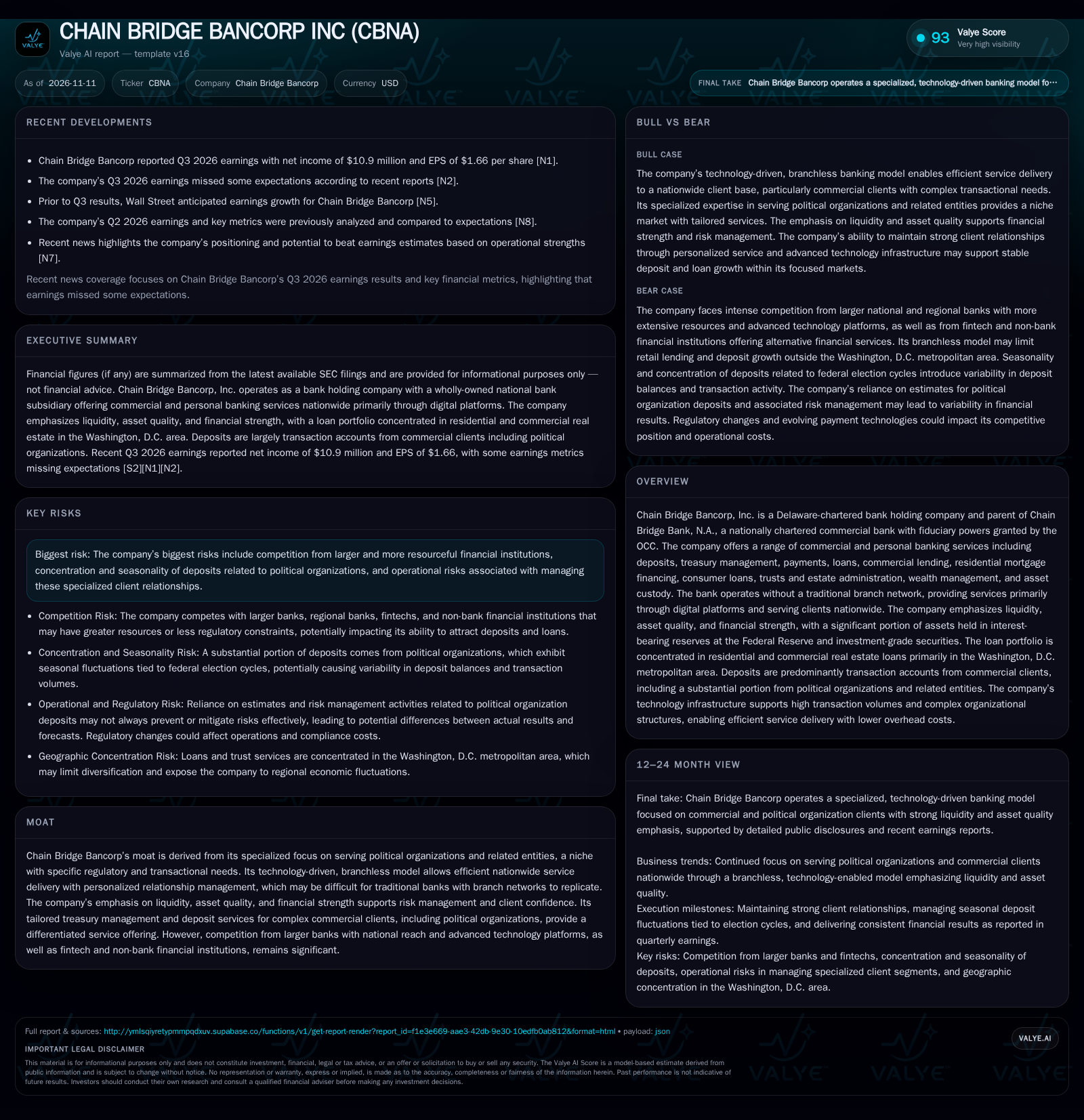
Chain Bridge Bancorp operates a branchless, technology-centric bank focused on commercial and political organization clients, with $1.8 billion in assets and $1.6 billion in deposits as of year-end 2025. The bank’s deposit base is heavily concentrated in transaction accounts from political organizations, making results highly seasonal around election cycles. Despite missing some Q3 2026 earnings expectations, the company maintains an emphasis on liquidity and asset quality. Its specialized service model enables efficient nationwide reach, but competition from larger banks and fintechs, as well as geographic and client concentration, remain key risks. [S2] [N1] [N2]
Chain Bridge Bancorp stands out as a digitally native, branchless bank built around the needs of political organizations and complex commercial clients nationwide. With the vast majority of its $1.6 billion in deposits coming from transaction accounts—primarily political entities—its results are highly sensitive to the rhythms of federal election cycles. As fintechs and large banks eye similar client segments, Chain Bridge faces the challenge of defending its niche while managing both geographic and client concentration risk. [S1] [S2] [N2]
Recent Results and Election-Driven Volatility Shape the Near-Term Landscape
As of December 31, 2025, Chain Bridge Bancorp reported $1.8 billion in total assets, including $586.6 million in cash and cash equivalents, with the vast majority ($580.9 million) held as interest-bearing reserves at the Federal Reserve. Deposits totaled $1.6 billion, with a striking 95.3% held in transaction accounts and a substantial portion sourced from political organizations. The company’s latest Q3 2026 earnings came in below some analyst expectations, with net income of $10.9 million and EPS of $1.66. This underperformance draws attention to the inherent seasonality and concentration risks, as deposits and transaction activity swell ahead of federal elections and recede afterward. These dynamics remain central to both the company’s short-term earnings variability and long-term strategic considerations. [S1] [S2] [N1] [N2]
Digital Delivery and Relationship Banking: The Economics of a Niche Strategy
Chain Bridge Bancorp’s branchless, technology-enabled model supports high operating efficiency, as the bank delivers services primarily via digital platforms and maintains only a single physical location. This reduces fixed overhead and allows for a lean cost structure compared to traditional banks with extensive branch networks. The core revenue engine is built on deposit gathering—primarily from commercial and political clients requiring sophisticated treasury management—and lending, with a portfolio dominated by residential and commercial real estate loans. The high proportion of transaction accounts suggests a lower cost of funds, yet the specialized client base introduces volatility and concentration risk.
A significant allocation to interest-bearing reserves and investment-grade securities supports liquidity and asset quality, but may also cap net interest margin in a low-rate environment. The focus on relationship-driven, specialized services for political organizations and complex commercial entities may enable premium pricing for certain treasury and payments solutions, but the scale is inherently limited by the niche market size. Seasonality, especially around federal election cycles, can create pronounced swings in deposit balances and related fee income, challenging consistent operating leverage and planning.
Capital needs are moderate, as the business model does not require ongoing investment in physical infrastructure, but technology upgrades and compliance with evolving regulatory standards remain recurring expenses. Operating leverage is achievable if digital volumes scale, but is undermined during non-election periods as deposit balances contract and transaction activity slows.
Defending a Specialized Niche Amid Encroaching Giants and Agile Fintechs
Chain Bridge Bancorp’s primary competitive moat derives from its expertise in serving political organizations and complex commercial clients with demanding treasury and transaction needs. These clients value regulatory fluency, confidentiality, and the ability to handle high transaction volumes and intricate organizational structures. The bank’s technology infrastructure is tailored to multi-user access and integration, supporting these requirements.
However, this niche is not unassailable. Large national and regional banks possess greater financial resources, more advanced technology platforms, and the ability to cross-sell a wider array of products, potentially eroding Chain Bridge’s differentiation over time. Fintechs and non-bank financial institutions are also targeting high-value commercial segments with specialized payments, treasury, and custody solutions, often leveraging lower costs and rapid innovation cycles.
Geographic concentration in the Washington, D.C. metro area further constrains diversification, exposing the bank to regional economic shocks. While the technology-driven, relationship-based model allows for some client stickiness, switching frictions are not insurmountable—particularly if competitors can offer superior integration or pricing. The ability to maintain and deepen relationships with key political and commercial clients will determine whether Chain Bridge’s niche remains defensible or gradually erodes.
Election Cycles and Digital Scale Unlock Higher Profitability
In a favorable scenario, Chain Bridge Bancorp leverages its specialized reputation and technology infrastructure to capture a growing share of political organization and high-complexity commercial clients nationwide. If federal election cycles continue to intensify in fundraising and spending, the bank could see even larger seasonal inflows, translating into higher fee income and greater float. Enhanced digital delivery, including expanded treasury management and payments services, could further increase average account balances and cross-sell opportunities.
Operating leverage would improve as technology investments scale across a larger transaction base without commensurate increases in fixed costs. If Chain Bridge successfully deepens wallet share with existing clients and attracts adjacent client segments (such as advocacy groups or national associations with similar needs), net interest margin and fee revenue could both expand.
Evidence confirming this scenario would include sustained growth in transaction account balances, rising non-interest income from treasury and payments services, and improved efficiency ratios. Additionally, market share gains in the political and high-complexity commercial space—especially outside the D.C. metro area—would be strong bullish signals.
Managing Seasonality and Concentration While Preserving Efficiency
The most plausible trajectory for Chain Bridge Bancorp is continued oscillation in deposit and transaction volumes tied to the federal election calendar, with the company maintaining its core client base but struggling to diversify meaningfully beyond its niche. The bank’s digital-first, branchless model allows it to operate efficiently and maintain strong asset quality, but growth is capped by both geographic and client concentration.
Margins and earnings will likely fluctuate in line with election cycles, with pre-election quarters delivering outsized deposit inflows and post-election periods seeing contractions.
Confirmation of this scenario would be a continued pattern of earnings and deposit volatility around elections, stable but not accelerating growth in core client segments, and persistent concentration in the Washington, D.C. market. Lack of significant expansion in non-political or non-regional segments would support this base case.
Deposit Volatility, Regulatory Shifts, and Competitor Inroads Erode the Franchise
In a negative scenario, Chain Bridge’s heavy reliance on political organization deposits backfires—either due to reduced campaign fundraising, regulatory changes restricting political banking flows, or reputational issues impacting client retention. The pronounced seasonality could intensify, with sharper post-election declines leading to periods of excess liquidity and suppressed margins.
Simultaneously, larger banks and fintechs could aggressively target the same client base, leveraging superior technology, broader product suites, or lower pricing to win away key relationships. Geographic concentration in the D.C. area could amplify losses if local real estate markets weaken or a regional downturn materializes.
Signs this scenario is playing out would include a significant, persistent drop in transaction account balances outside of normal election cycles, loss of major political or commercial clients, rising non-performing loans from local real estate exposures, or increased regulatory/compliance costs materially impacting profitability.
Testing the Niche Banking Thesis: What Will Determine Chain Bridge’s Next Chapter?
Quarterly trends in transaction account balances—especially the magnitude and timing of pre- and post-election swings—will reveal the degree of deposit seasonality and concentration risk.
Non-interest income from treasury management and payments services, if disclosed, would indicate the success of cross-selling and digital platform leverage.
Changes in the geographic mix of the loan and deposit portfolios would help assess diversification progress beyond the Washington, D.C. area.
Client retention and new client acquisition rates in the political and high-complexity commercial segments would provide signals on franchise durability.
Efficiency and expense ratios, particularly in non-election periods, will gauge the scalability and resilience of the digital-first model.
Regulatory developments or compliance cost disclosures affecting political organization banking could materially impact the risk/reward profile.
Loan quality and non-performing asset trends, particularly in the residential and commercial real estate segments concentrated in the D.C. metro, would serve as early warning indicators for credit risk.
Disclaimer: This is research-only, informational analysis and not investment advice. It may include AI-generated interpretation and general industry context. Always verify important details using primary sources.

Comments