
21Shares XRP ETF: Scale, Structural Integrity, and the Competitive Realities of Passive Crypto Exposure
21Shares XRP ETF delivers institutional-grade, regulated access to XRP via a passive, low-fee structure, but its fortunes are fundamentally tethered to the volatile and evolving digital asset market. Success will depend on its ability to maintain operational reliability, defend scale against rival products, and weather regulatory and extraordinary cost shocks.
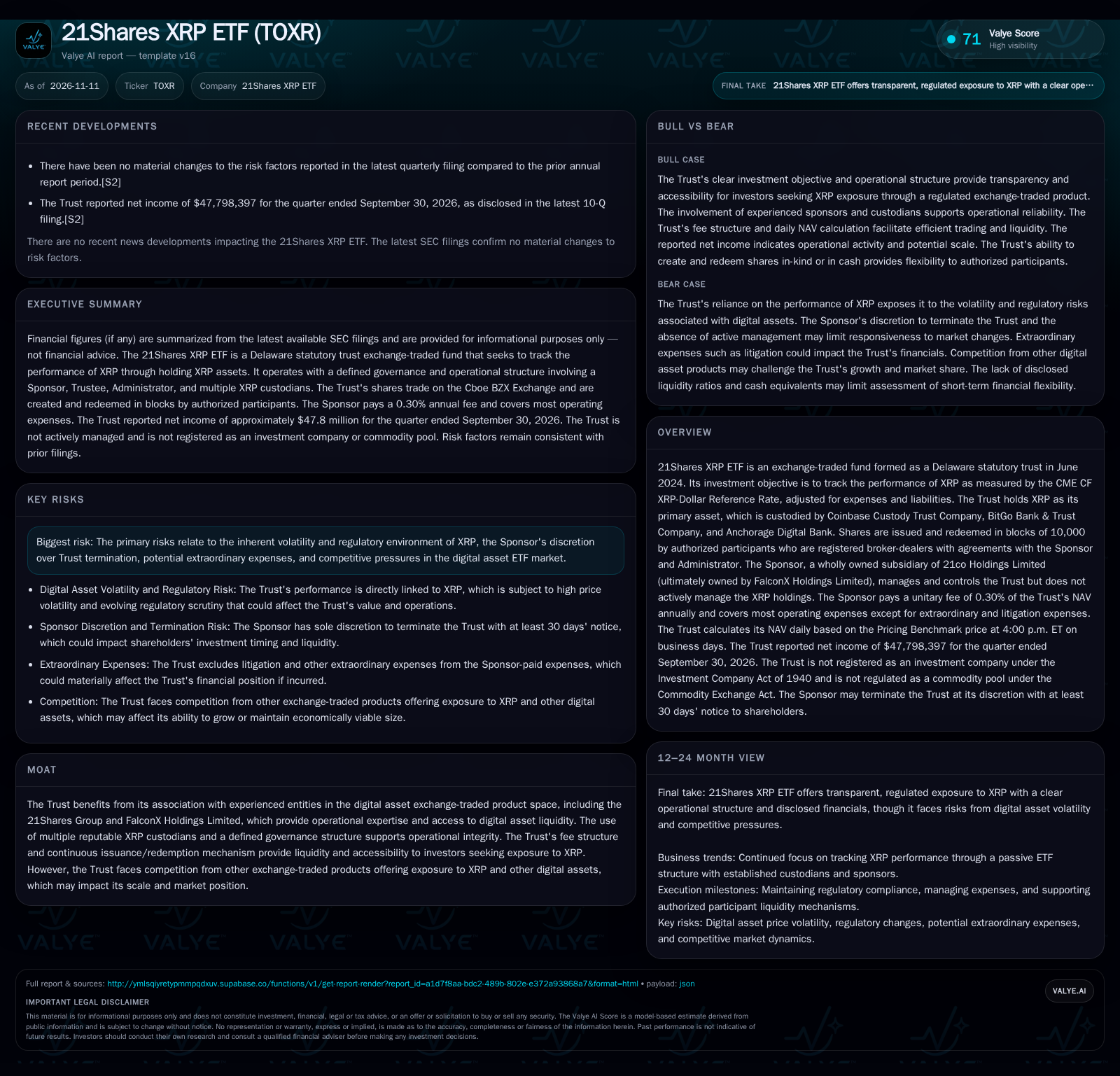
21Shares XRP ETF reported $47.8 million in net income for Q3 2026, reflecting substantial operational activity and scale. The ETF is structured as a Delaware trust, passively tracking XRP through a transparent NAV and low 0.30% fee, with custody diversified among leading digital asset custodians. Its economic model is simple, but exposes investors to XRP’s price volatility, regulatory flux, and competition from other crypto ETPs. The sponsor’s discretion over trust termination and exclusion of extraordinary expenses from covered costs add layers of risk.[S2]
21Shares XRP ETF has rapidly established itself as a prominent vehicle for institutional and retail investors seeking exposure to XRP, the digital asset associated with Ripple’s payments protocol. With $47.8 million in net income reported for the third quarter of 2026, the ETF demonstrates both scale and operational efficiency. However, its passive structure, low-fee model, and reliance on the volatile XRP market mean that investor outcomes are inextricably linked to broader crypto and regulatory cycles. The ETF’s competitive positioning and structural safeguards set it apart, but the path forward will be shaped by market share battles, regulatory developments, and the sponsor’s discretion.
Q3 Financials and Operational Structure: The State of the 21Shares XRP ETF
The 21Shares XRP ETF reported net income of $47,798,397 for the quarter ended September 30, 2026, underscoring robust operational activity and meaningful scale for a digital asset ETF.[S2] The ETF is a Delaware statutory trust, passively tracking the CME CF XRP-Dollar Reference Rate, with shares trading on the Cboe BZX Exchange. Its assets are held in custody by a triad of digital asset custodians—Coinbase Custody Trust Company, BitGo Bank & Trust Company, and Anchorage Digital Bank—helping reduce single-custodian risk. The Sponsor, a wholly owned subsidiary of 21co Holdings Limited, sets the ETF’s governance and pays a 0.30% annual unitary fee, covering all but extraordinary and litigation expenses. No material changes to risk factors have been reported since the prior annual filing.[S2]
How the ETF Makes Money: Fee Structure, Flows, and Scale Dependency
The business model is straightforward: 21Shares XRP ETF collects a 0.30% annual fee (accrued daily, paid weekly in XRP) on net asset value, which is the primary revenue stream for the Sponsor.[S1] This unitary fee covers nearly all operating expenses, allowing for predictable cost management at scale. The ETF’s profitability is thus a function of total assets under management (AUM), which is directly tied to net inflows and the market value of XRP.
Operational leverage is inherent, as incremental AUM—whether from rising XRP prices or new inflows—drives higher fee revenue without proportionally increasing costs. However, the ETF’s pass-through nature means it does not generate trading revenues or actively manage assets. Extraordinary expenses (such as litigation) are not covered by the Sponsor and could impact net income in adverse scenarios.[S1] [S2]
The company reported cash and liquidity metrics for the period; these figures do not by themselves establish operating runway, investment capacity, financial flexibility, or financing capacity. Instead, its economic resilience depends on continuous inflows, stable custody arrangements, and the absence of major extraordinary costs.
Defending Share of a Crowded Crypto ETF Market
The ETF landscape for digital assets is increasingly competitive, with multiple products vying for investor flows by offering exposure to XRP and other cryptocurrencies. 21Shares XRP ETF benefits from the operational expertise and track record of its sponsor group, which managed $7.56 billion in assets and 67 products across digital asset ETPs as of December 2025.[S1]
Key differentiators include the use of three separate custodians—mitigating single-point-of-failure risk—and a low, transparent fee. However, the ETF’s pure pass-through structure offers no active management or yield enhancement, and its performance is entirely dictated by XRP’s price movements. Competitors may seek to undercut fees, offer additional features (such as staking or lending), or market more aggressively.
Switching frictions for institutional investors are low, as most products offer similar liquidity and trading mechanics. The ETF’s ability to defend and grow its AUM will depend on maintaining trust in custody, operational reliability, and perceived regulatory safety. Any custody or operational lapses, or the entry of lower-fee or higher-liquidity rivals, could threaten its market share.
When Institutional Flows, Regulatory Clarity, and XRP Price Trends Align
A favorable scenario materializes if XRP enjoys sustained price appreciation (driven by adoption or regulatory clarity), sparking inflows from both retail and institutional investors seeking compliant, exchange-listed exposure. The ETF’s operational structure and established sponsor could position it as a preferred vehicle, leading to rising AUM and a compounding fee base.
Confirmation for this scenario would come from growing net inflows, increasing share creation by authorized participants, and a rising NAV. Additional evidence would include market-wide regulatory clarity on digital asset ETFs, positive custody audits, and the absence of extraordinary expenses. Conversely, stagnating inflows, regulatory setbacks, or custody incidents would undermine this outcome.
Passive Exposure in a Volatile Market: Most Likely Course
The most plausible path is that 21Shares XRP ETF continues to function as a low-cost, passive vehicle for XRP exposure, with AUM and income fluctuating in line with XRP’s price and broader crypto-asset sentiment. Fee revenue remains stable so long as custody is secure, operational processes are reliable, and the ETF can defend its share against comparable products.
This scenario is confirmed by stable or modestly growing AUM, consistent operational disclosures, and no major shifts in fee structure or extraordinary costs. It would be challenged if the ETF experiences net redemptions, faces significant regulatory headwinds, or is outcompeted on cost or liquidity by new entrants.
XRP Price Shocks, Regulatory Clampdowns, or Sponsor Discretion Triggering Unwind
Adverse outcomes could result from a sharp decline in XRP’s price, regulatory actions targeting XRP or digital asset ETFs, or a major custody/operational incident. Any of these could trigger significant net redemptions, eroding AUM and fee income. Because the ETF is not actively managed and the Sponsor retains discretion to terminate the Trust with 30 days’ notice, investor liquidity and timing could be at risk if confidence collapses.
Evidence of this scenario would include material outflows, a significant drop in NAV, news of regulator intervention or litigation, or a Sponsor-announced wind-down. Extraordinary expenses could further erode net income, and operational or custody failures could have an outsized impact given the concentrated asset base.
What Will Determine the ETF’s Staying Power and Investor Outcomes
Net asset value (NAV) trends: Sustained or growing NAV would indicate healthy market demand and operational execution; sharp declines would warrant caution.[S2]
Net flows and share creations/redemptions: If disclosed, rising net inflows and share creations would confirm ETF relevance and competitiveness.
Fee revenue as a percentage of AUM: A useful metric would be the persistence of the 0.30% fee and any compression due to competitive pressures.
Custody incidents or operational disruptions: Any reported custody breach or process failure would directly impact trust and market share.
Extraordinary expenses (litigation, regulatory fines): Because these are not covered by the Sponsor, any disclosure would be material to net income and investor returns.
Regulatory developments specific to XRP or digital asset ETFs: Watch for changes in the SEC’s treatment of XRP, ETF registration, or custody regulations.
Sponsor or affiliate actions: Announcements of Trust termination, changes in fee structure, or sponsor group financial distress would be highly material.
Disclaimer: This is research-only, informational analysis and not investment advice. It may include AI-generated interpretation and general industry context. Always verify important details using primary sources.

Comments