
Revvity’s Life Sciences and Diagnostics Engine: Profitability, Liquidity, and Strategic Drivers for Growth
Revvity, Inc. posts solid profitability and liquidity in Q3 2026, with its Life Sciences segment driving near-term momentum. The company’s diversified portfolio, robust operational execution, and innovation focus are counterbalanced by geographic, regulatory, and competitive risks that could reshape its growth profile.
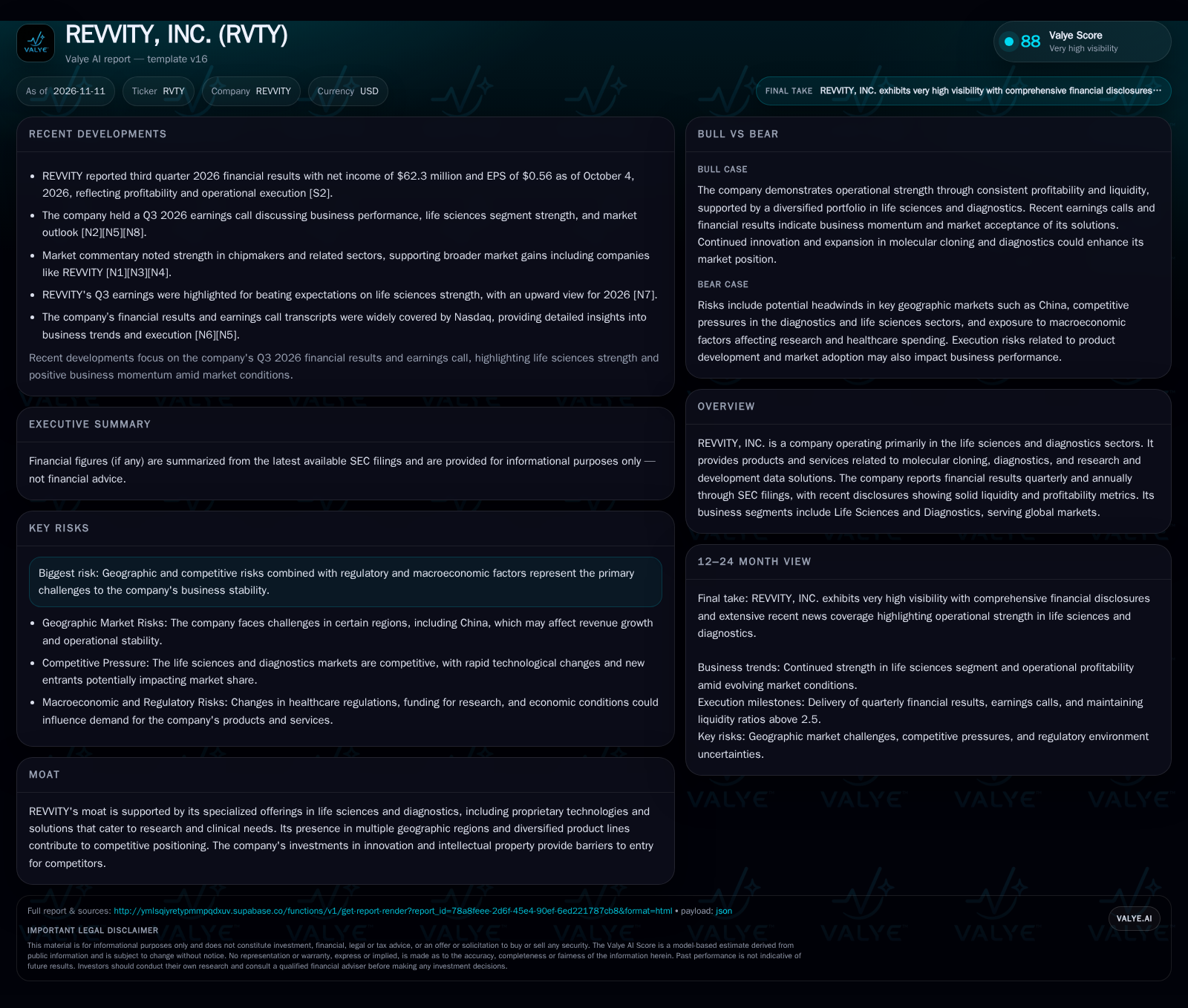
Revvity, Inc. reported Q3 2026 net income of $62.3 million and maintained reported liquidity position, with its Life Sciences segment fueling recent outperformance. While the company’s diversified offerings and operational execution underpin its profitability, future growth will depend on expanding high-margin, recurring revenue streams and successfully navigating geographic, regulatory, and competitive risks—particularly in volatile international markets.
Revvity, Inc. closed Q3 2026 with a clear demonstration of financial strength: $62.3 million in net income, a reported cash position, and a current ratio of 2.65. These headline numbers reflect not only operational discipline but also the company’s strategic positioning across life sciences and diagnostics—sectors characterized by rapid innovation cycles and intense global competition. With recent earnings calls emphasizing life sciences momentum and an upgraded near-term outlook, the question is how Revvity can continue converting its liquidity and product breadth into durable growth while navigating geographic and regulatory headwinds.
Q3 2026 Results Highlight Profitability and Liquidity Trends
Revvity reported net income of $62.3 million and earnings per share of $0.56 for the quarter ended October 4, 2026, reflecting consistent operational profitability [S2] [N6]. The company reported cash and liquidity metrics for the period; these figures do not by themselves establish operating runway, investment capacity, financial flexibility, or financing capacity. [S2] Financial commentary from the Q3 2026 earnings call and media coverage highlights outperformance in the Life Sciences segment and an improved outlook for the remainder of 2026 [N7]. These facts matter because they set a foundation of financial resilience and suggest that Revvity’s core business lines are weathering sector volatility—yet future growth will hinge on sustaining this momentum amid shifting market conditions.
For instance, free cash flow trends relative to net income would help assess the quality of earnings and the company’s ability to self-fund growth initiatives or debt reduction. Similarly, the balance between reinvestment in R&D and returns to shareholders through dividends or share repurchases could indicate management’s confidence in organic growth prospects versus capital efficiency. These insights are critical because liquidity alone does not guarantee strategic flexibility if cash is tied up in working capital or non-core assets.
Revvity’s Model: Leveraging Product Diversity for Earnings Strength
Revvity operates two primary business segments: Life Sciences and Diagnostics, selling products and services from molecular cloning tools to advanced diagnostics and research data solutions. Revenue is likely driven by a mix of consumables, instruments, and software/data offerings, implying a blend of recurring (consumables, services, software) and transactional (instruments, capital equipment) revenue streams. This structure can support both revenue stability and margin expansion if recurring components grow as a share of sales.
Gross margins in life sciences and diagnostics are often influenced by product mix: proprietary reagents and software typically carry higher margins than hardware. [S2] The key economic lever is sustaining high-margin product growth and recurring revenue, which can offset pricing pressure and input cost volatility.
The interplay between product lifecycle dynamics and revenue mix evolution is another key economic consideration. Consumables and software revenues typically benefit from recurring demand and lower volatility, but these streams require continuous innovation and customer engagement to prevent attrition. Conversely, capital equipment sales are often lumpy and sensitive to macroeconomic cycles or research funding availability. Therefore, the company’s ability to shift sales composition towards higher-margin recurring offerings while managing the timing and scale of capital equipment deployments will materially influence earnings stability and margin trajectories. Additionally, supply chain optimization and cost control initiatives can mitigate input cost inflation, preserving gross margins amid competitive pricing pressures.
Establishing Competitive Advantages in a Dynamic Market Landscape
Revvity’s competitive position is underpinned by specialized offerings in life sciences and diagnostics—areas where proprietary technology, regulatory expertise, and customer integration can create real switching costs. In molecular cloning and advanced diagnostics, intellectual property and deep relationships with research and clinical labs act as partial barriers to entry. However, the sector is crowded with large diversified players and focused disruptors, all vying for share as technologies evolve.
Key counterforces include rapid commoditization of hardware, the risk of disruptive innovation (such as new genomic technologies or AI-driven diagnostics), and the constant threat of pricing pressure from procurement-driven research and healthcare customers. Geographic diversification helps mitigate local shocks, but also exposes Revvity to regulatory and competitive dynamics in markets like China, where local players and policy shifts can reshape the landscape. The moat is defensible but not unassailable: ongoing investment in differentiated solutions and customer stickiness will be critical.
In assessing competitive positioning, it is important to consider the strategic value of ecosystem integration and platform-based solutions. Companies that can bundle instruments, consumables, and software into cohesive offerings often create higher switching costs and improve customer lifetime value. However, this model depends on seamless interoperability and ongoing service excellence, which require sustained investment and operational discipline. Moreover, geographic expansion strategies must balance the benefits of market diversification against the risks of regulatory complexity and local competition. In regions with aggressive domestic players or evolving regulatory frameworks, Revvity’s ability to adapt product portfolios and compliance approaches will be a critical determinant of market share retention and growth.
Innovation Scaling and Recurring Revenue as Catalysts for Margin Growth
A favorable outcome for Revvity would see continued strength in the Life Sciences segment, with new product launches and expanded adoption of proprietary solutions accelerating revenue growth and improving gross margins. If recurring revenue from consumables, data services, and software increases as a share of the mix, operating leverage could further boost profitability.
Confirmation of this scenario would come from sustained double-digit revenue growth in life sciences, rising gross margin percentages, and disclosures indicating an increasing proportion of revenue from recurring or subscription-like contracts. Additional signals would include new partnerships, successful R&D milestones, and further commentary on geographic expansion or regulatory clearances that open new markets.
Execution Consistency Navigates Sector Volatility and Regional Hurdles
The most plausible near-term trajectory is that Revvity continues to deliver moderate revenue and earnings growth, leveraging its reported liquidity position and operational discipline to weather sector-specific headwinds. Life Sciences remains the growth engine, offsetting slower or more volatile performance in Diagnostics, particularly if macroeconomic or regulatory pressures persist in key markets such as China.
This scenario is confirmed by stable or slightly improving profitability metrics, maintenance of liquidity ratios above 2.5, and ongoing product rollouts or incremental innovation. Any material slowdown in revenue growth, margin compression, or negative commentary regarding geographic segments would serve as early warning signs against this middle path.
Earnings and Flexibility at Risk from Geographic and Competitive Disruptions
An adverse scenario would involve significant headwinds in major geographic markets (such as regulatory tightening or economic slowdown in China), coupled with intensified competition or technological disruption in diagnostics. If Revvity is forced to lower prices, increase R&D spending to keep pace, or faces delays in regulatory approvals, margins could compress and earnings could decline.
Falsifying this downside would require evidence of stable or growing sales in at-risk geographies, resilience in diagnostic revenues, and continued profitability even as competitive intensity rises. Warning signs would include sharp declines in regional revenue, margin contraction, or management guidance pointing to delays or challenges in product adoption.
Key Developments Influencing Revvity’s Growth Trajectory
Revenue growth rates by business segment (Life Sciences vs. Diagnostics) if disclosed, to assess the sustainability of current momentum.
Gross margin trends and disclosures around product mix, as margin expansion would support the upside scenario.
Recurring revenue as a proportion of total sales, especially from consumables, software, and services, if disclosed.
Geographic revenue breakdowns, particularly exposure to and performance in China and other key international markets.
R&D investment levels and pipeline updates, as signals of future innovation and competitive differentiation.
Commentary on regulatory changes or market access issues, especially in international markets.
Management guidance or commentary on competitive dynamics and pricing pressure in core markets.
Disclaimer: This is research-only, informational analysis and not investment advice. It may include AI-generated interpretation and general industry context. Always verify important details using primary sources.

Comments