
Willow Lane Acquisition Corp. II: Cash Reserves and Disclosure Ambiguities Define SPAC Outlook
Willow Lane Acquisition Corp. II (WLII) enters late 2026 with reported liquidity position and positive net income, but its future trajectory hinges on executing a business combination—an outcome clouded by minimal public detail about target sectors, acquisition strategy, or competitive focus.
The company remains in the pre-acquisition phase typical of SPACs, with success dependent on its ability to source and close an attractive deal within regulatory timeframes. [S1]
Willow Lane Acquisition Corp. II (WLII) exemplifies the late-stage blank check company: flush with cash, compliant with public reporting, but strategically opaque as it seeks a suitable business combination. However, the absence of operational disclosures, sector focus, or acquisition targets leaves open questions about its ability to deliver long-term value. For investors, the central issue is not the balance sheet but whether management can identify, negotiate, and close a deal that justifies the trust placed in its SPAC structure.
Current Financial Standing and Disclosure Overview
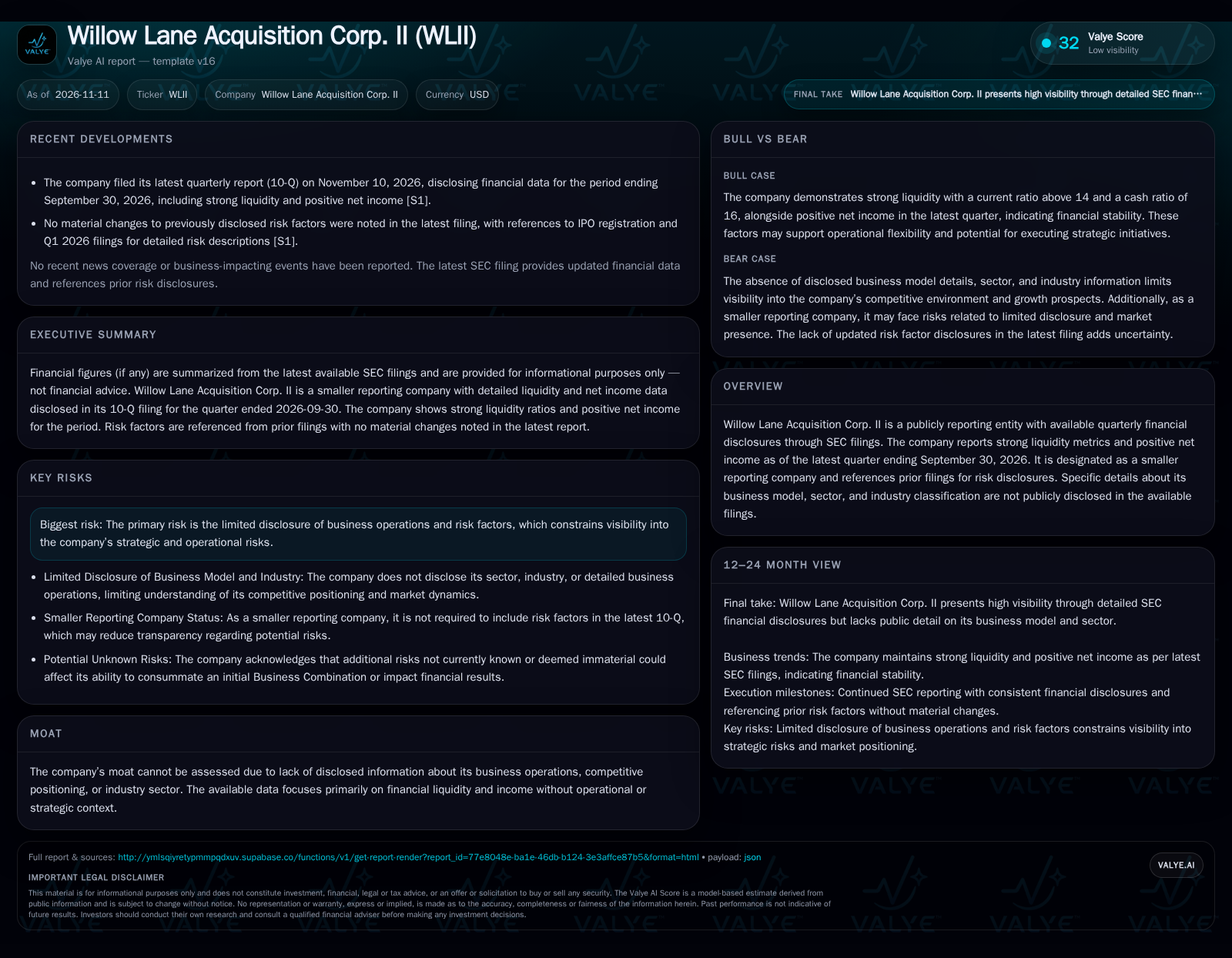
Willow Lane Acquisition Corp. II reported $1,447,573 in cash and cash equivalents and $1,270,534 in current assets as of September 30, 2026, with current liabilities of just $90,487. The company reported cash and liquidity metrics for the period; these figures do not by themselves establish operating runway, investment capacity, financial flexibility, or financing capacity. Net income for the period was $1,170,234. [S1]
Despite these financial strengths, the company provides no detail on its revenue streams, target sectors, or operational activities beyond its status as a blank check entity. There have been no material updates to risk factors in the latest filing, and the company continues to reference disclosures from its IPO and previous quarters. [S1]
WLII is classified as a smaller reporting company and is not required to include risk factors in its 10-Q, limiting insight into current strategic or operational risks. [S1]
Beyond the headline liquidity figures, a deeper analysis of WLII’s balance sheet composition and cash flow dynamics would be instructive. For instance, understanding the proportion of cash held in the trust account versus working capital reserves would clarify the operational runway and capacity to absorb transaction-related expenses. Additionally, assessing the timing and magnitude of any recurring administrative or compliance costs could help model how quickly the reported net income translates into sustainable cash flow, which is critical given the SPAC’s limited revenue-generating activities pre-acquisition.
Understanding SPAC Economics: Trust Funds, Cash Burn, and Value Creation
The core economics of WLII are defined by the typical SPAC lifecycle. The company raised $143.75 million in its February 2026 IPO, with proceeds placed in a trust account, and completed a simultaneous private placement of $5.14 million. [S1] Until a business combination occurs, WLII earns minimal interest on trust assets, while operating expenses (legal, advisory, compliance) are funded from a modest working capital reserve.
A SPAC's ability to create value depends almost entirely on sourcing and closing a business combination that delivers shareholder upside relative to the cash in trust. The immediate economics are largely fixed: sponsor and underwriter fees, ongoing listing and reporting costs, and minor administrative expenses. Variable costs will rise if due diligence or deal pursuit intensifies.
If a deal is consummated, the economics shift dramatically: the target's revenue, margin profile, and capital needs become central, and the SPAC structure may introduce dilution via warrants and sponsor shares. If no deal is found within the 36-month Nasdaq window, the trust is liquidated and funds are returned, with little or no value accruing to public shareholders beyond their pro rata trust share.
The economics of a SPAC like WLII also hinge on the structure and terms of the eventual business combination. For example, the dilution impact from sponsor promote shares and public warrants can materially affect post-merger shareholder value, especially if the target requires significant capital raises or experiences valuation compression. Understanding how these factors interplay with the target’s capital structure and growth trajectory is essential to modeling potential returns and downside risks.
Evaluating Market Position Amid SPAC Saturation and Differentiation Challenges
WLII’s competitive context is typical for a SPAC: it competes with other blank check companies for attractive acquisition targets, often in a crowded market. The absence of a stated sector focus or disclosed target profile means it lacks a visible differentiator or thematic edge.
The SPAC market has seen cycles of enthusiasm and skepticism. In a saturated environment, sponsor reputation, network access, and ability to execute complex deals become key differentiators. However, none of these factors are disclosed or apparent for WLII. The company’s only clear advantage at this stage is a full trust account and compliance with listing requirements.
Potential substitutes for SPAC funding include traditional IPOs, direct listings, or private equity buyouts. Targets with strong financials may have more attractive alternatives, making it harder for generic SPACs to secure deals without offering sponsor-friendly terms or significant upside potential.
Characteristics of a Successful Acquisition Outcome
The upside scenario for WLII depends on identifying and closing a business combination with a company that has established, growing revenues and a credible path to public-market growth. If management leverages its network to secure a deal in a sector with strong secular tailwinds—such as technology, healthcare, or industrials—a successful de-SPAC could deliver meaningful value to public shareholders.
Confirmation of this scenario would come from a definitive agreement announcement with a high-quality target, detailed pro forma financials showing attractive growth and margin prospects, and a clear post-merger business plan. Further validation would include positive market reaction to the announcement, minimal redemptions, and analyst coverage initiating with favorable outlooks.
A falsification of this scenario would be continued silence on acquisition progress, repeated extensions without deal announcements, or a proposed deal in a challenged sector or with a highly speculative target.
Maintaining Course: Regulatory Timelines and Target Search Progress
The most plausible outcome is that WLII continues to operate in search mode, incurring modest expenses while evaluating potential targets. As the 36-month post-IPO window approaches (by early 2029), pressure will mount to announce or close a deal or seek an extension from shareholders.
The base path would be confirmed by ongoing SEC filings showing low cash burn, continued references to the original trust structure, and no material developments on the acquisition front. If a target is announced late in the window, deal quality and market reception will be critical.
Evidence against this scenario would be an early, high-quality deal announcement or, conversely, a material adverse event such as loss of listing, regulatory action, or significant sponsor withdrawal.
Risks of Deal Collapse and Potential Liquidation Scenarios
The most adverse scenario is that WLII fails to identify or close a business combination within the required timeframe, triggering trust liquidation. In this case, public shareholders would receive their pro rata share of trust assets, but sponsor shares and warrants would likely become worthless.
Other risks include pursuing a suboptimal deal—overpaying for a weak target, or selecting a business in a sector facing headwinds or regulatory risk. Such deals often result in high shareholder redemptions, post-merger trading weakness, and potential litigation.
Confirmation of the downside would include announcements of deal terminations, inability to secure required approvals, or SEC filings indicating imminent trust liquidation or delisting.
Disclosure Updates and Milestones Shaping WLII’s Future
Announcement of a definitive business combination agreement, including target identity and sector.
Disclosure of detailed pro forma financials and growth projections for any proposed target.
Shareholder vote outcomes for any proposed business combination, including redemption rates (if disclosed).
SEC filings indicating any extension requests or amendments to the trust liquidation timeline.
Material changes in cash burn rate or operating expenses as a signal of deal pursuit intensity (if disclosed).
Changes in sponsor or management team composition, which could signal shifting deal prospects.
Any loss of listing status or regulatory action affecting the SPAC structure or trust account.
Disclaimer: This is research-only, informational analysis and not investment advice. It may include AI-generated interpretation and general industry context. Always verify important details using primary sources.

Comments