
First Community Corporation: Regional Banking Scale, Acquisition Integration, and the Local Advantage in a Competitive Landscape
With a $2.1 billion asset base, a multi-state branch network, and a recent acquisition in Georgia, First Community Corporation faces the core challenge of scaling its relationship-driven banking model amid persistent competition, regulatory constraints, and evolving customer expectations.
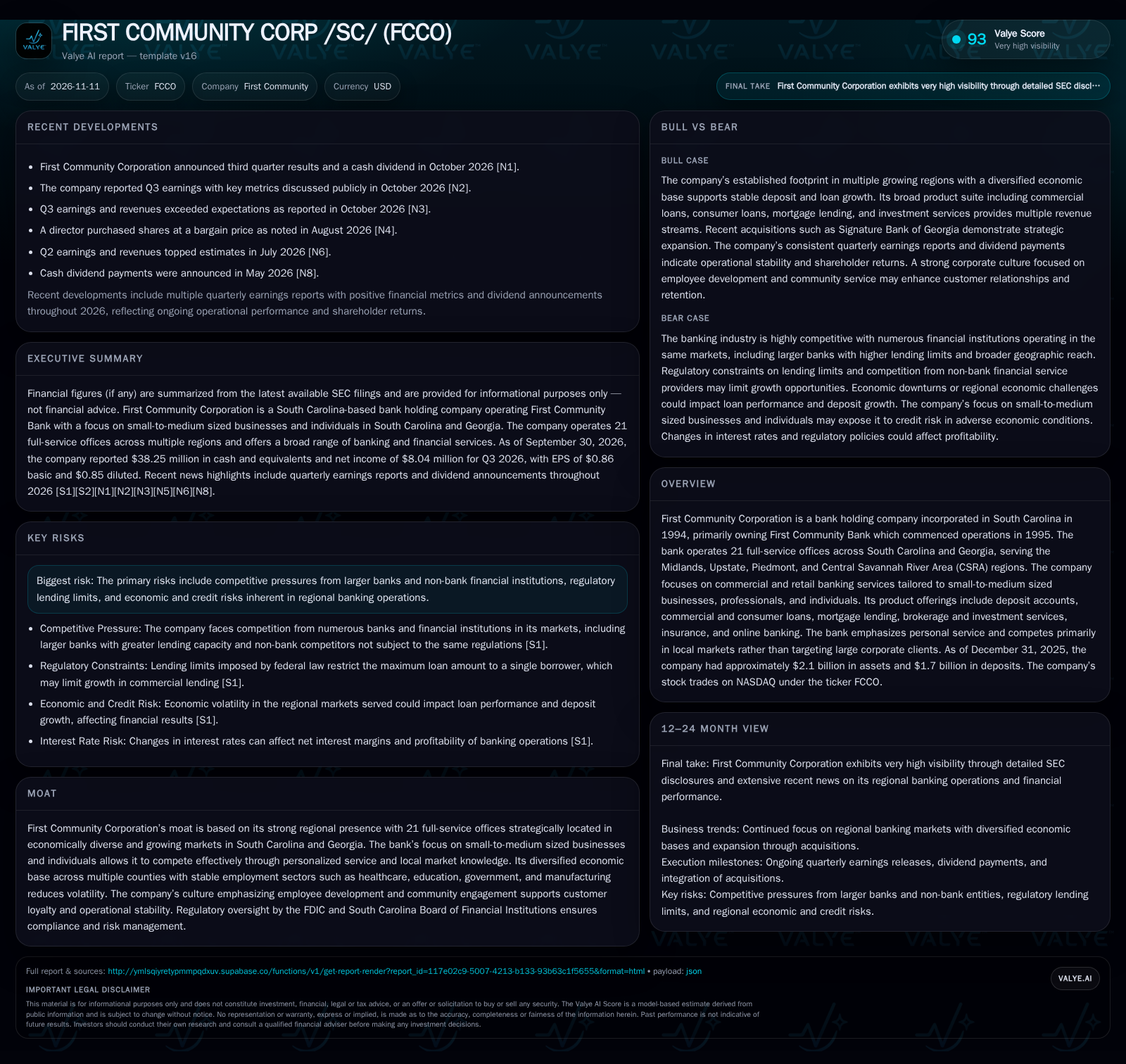
First Community Corporation (FCCO) operates 21 branches across South Carolina and Georgia, focusing on small-to-medium businesses and individuals. As of September 2026, the bank reported $2.1 billion in assets, $1.7 billion in deposits, and $8.04 million in Q3 net income. The January 2026 acquisition of Signature Bank of Georgia signals a growth-through-acquisition strategy. The business model’s success depends on sustaining loan and deposit growth, integrating acquisitions, and navigating competition from larger banks and fintechs [S1] [S2] [N1] [N2] [N3] [N5] [N6] [N8].
First Community Corporation’s strategy centers on leveraging its established regional presence and relationship-driven banking to capture share among small-to-medium businesses and individuals in South Carolina and Georgia. With $2.1 billion in assets and a recent expansion into Georgia via acquisition, the company must balance local service quality with the scale required to compete against both larger national banks and nimble fintech challengers. The next phase for First Community hinges on successful acquisition integration, organic loan growth, and defending its core franchise against evolving industry headwinds.
Recent Expansion and Financial Performance Shape the Strategic Backdrop
First Community Corporation reported $2.1 billion in assets and $1.7 billion in deposits as of December 31, 2025, marking it as a substantial regional player in the South Carolina and Georgia banking markets [S1]. The company’s net income for Q3 2026 was $8.04 million, with basic EPS of $0.86 and diluted EPS of $0.85, reflecting ongoing profitability [S2]. Its January 2026 acquisition of Signature Bank of Georgia marks a material expansion into metro Atlanta and the broader Georgia market, providing new customer relationships and lending opportunities. Consistent quarterly earnings beats and regular dividend payments through 2026 further reinforce an image of operational stability and shareholder orientation [N1] [N2] [N3] [N5] [N6] [N8]. These developments matter because they set the stage for both growth ambitions and the integration risks that often follow acquisitions in regional banking.
How Relationship Banking Drives Revenue and Cost Dynamics
First Community’s earnings are anchored in traditional spread banking: it collects low-cost deposits and lends to small-to-medium businesses, professionals, and local consumers. The ability to attract core deposits at favorable rates is central to net interest margin, which, while not disclosed here, typically faces pressure from both local competition and the broader interest rate environment. Non-interest income, such as fees from mortgage, brokerage, and insurance services, supplements core lending revenue and can buffer against margin compression in periods of rate volatility.
The company’s fixed cost base—driven by 21 branch offices and 265 full-time employees—suggests meaningful operating leverage if deposit and loan growth can be sustained. However, branch-based models also carry inherent rigidity: physical infrastructure and personnel costs may limit flexibility in the face of digital competition or shifting customer preferences. Capital needs are ongoing: regulatory requirements demand robust equity and liquidity, especially as the bank integrates new assets and risks from the Signature Bank of Georgia acquisition. If integration unlocks cross-selling or cost synergies, the incremental economics could improve, but acquisition-related costs and potential credit risk migration also bear watching.
Local Market Knowledge Versus Scale and Digital Disruption
First Community’s primary advantage lies in local market knowledge, personal service, and established community relationships—attributes that resonate with small businesses and professionals underserved by national banks. This localized approach can foster loyalty and retention, creating modest switching frictions. However, the company faces intense competition from both large regional/national banks with broader product sets and higher lending limits, and digital-first non-bank lenders offering speed and convenience.
Regulatory lending limits restrict First Community’s ability to pursue larger commercial deals, while larger competitors may leverage economies of scale to offer better rates or digital experiences. Fintechs and online banks, though not directly referenced in current disclosures, represent a growing threat in the small business and consumer segments, particularly as customer expectations evolve toward digital engagement. The question is whether First Community’s community focus can offset these scale and technology disadvantages, or if it must accelerate digital investments and product innovation to keep pace.
Acquisition Synergies and Core Market Growth Fuel Outperformance
A favorable trajectory for First Community would see the Signature Bank of Georgia acquisition rapidly integrated, with minimal customer attrition and effective cross-selling of the broader suite of banking, mortgage, and investment services. If new and legacy markets both deliver above-average loan and deposit growth—driven by continued economic strength in the Midlands, Upstate, and metro Atlanta regions—the bank could realize operating leverage benefits, expanding margins without proportionate increases in overhead.
Confirmation of this scenario would include sustained or accelerating net interest income, robust non-interest revenue growth, improving efficiency ratios, and minimal loan losses. Evidence of successful integration—such as cost savings, branch consolidation, or customer cross-sell rates—would further validate the upside case. Falsification would occur if post-acquisition costs spike, customer churn rises, or if the new Georgia markets prove less receptive to the First Community model than anticipated.
Sustaining Steady Growth Amid Competitive and Regulatory Constraints
The most plausible scenario is one in which First Community delivers moderate organic growth in its core South Carolina and Georgia markets, with the Signature Bank of Georgia acquisition contributing incrementally but without dramatic step-change. Net interest margins may remain under pressure from competitive pricing and fluctuating rates, while non-interest income provides partial offset. Regulatory lending limits and larger-bank competition constrain outsized commercial lending growth, but the bank’s relationship model and community positioning help defend its share among small businesses and professionals.
Falsification would involve a sustained margin decline, outsized credit losses, or evidence that larger competitors or fintechs are eroding share faster than anticipated.
Integration Pitfalls or Regional Downturns Expose Vulnerabilities
A negative sequence would see the Signature Bank of Georgia acquisition encounter meaningful integration challenges—ranging from customer attrition and cultural mismatch to unexpected credit issues in the acquired loan book. Simultaneously, if regional economic conditions deteriorate (e.g., a downturn in local industry or real estate), First Community could face rising loan delinquencies and slower deposit growth.
Additional risk stems from rapid shifts in customer preferences toward digital-first banking, where larger or nimbler competitors may have a decisive advantage. Confirmation of this scenario would be a spike in non-performing loans, increased credit loss provisions, declining net interest margins, and higher operating expenses tied to integration or technology catch-up. Falsification would require evidence of stable credit quality, successful acquisition execution, and resilience in deposit and loan growth despite external headwinds.
Milestones and Metrics That Will Define First Community’s Next Chapter
Trends in net interest margin and non-interest income, as disclosed in future earnings reports, will indicate whether the bank is managing competitive and rate pressures effectively.
Organic loan and deposit growth rates across legacy and newly acquired markets would help test whether the relationship model is still driving regional share gains.
Credit quality metrics—such as non-performing loan ratios and net charge-offs—will be crucial, especially post-acquisition and in the event of regional economic softness.
Efficiency ratio trends: improvements would suggest successful integration and operating leverage, while deterioration could flag cost or integration issues.
Customer retention and cross-sell rates in the acquired Georgia footprint, if disclosed, would clarify whether integration is unlocking value or encountering friction.
Branch consolidation progress and related cost savings, especially in overlapping markets, would signal execution on post-acquisition synergies.
Shifts in digital banking adoption among First Community’s customer base, or new digital product launches, would indicate response to fintech and large-bank competition.
Disclaimer: This is research-only, informational analysis and not investment advice. It may include AI-generated interpretation and general industry context. Always verify important details using primary sources.

Comments