
Silicon Labs: Renewed Profitability, AI Platform Growth, and the Critical Merger Phase
The outcome will hinge on execution in an evolving semiconductor landscape and the resolution of merger risks.
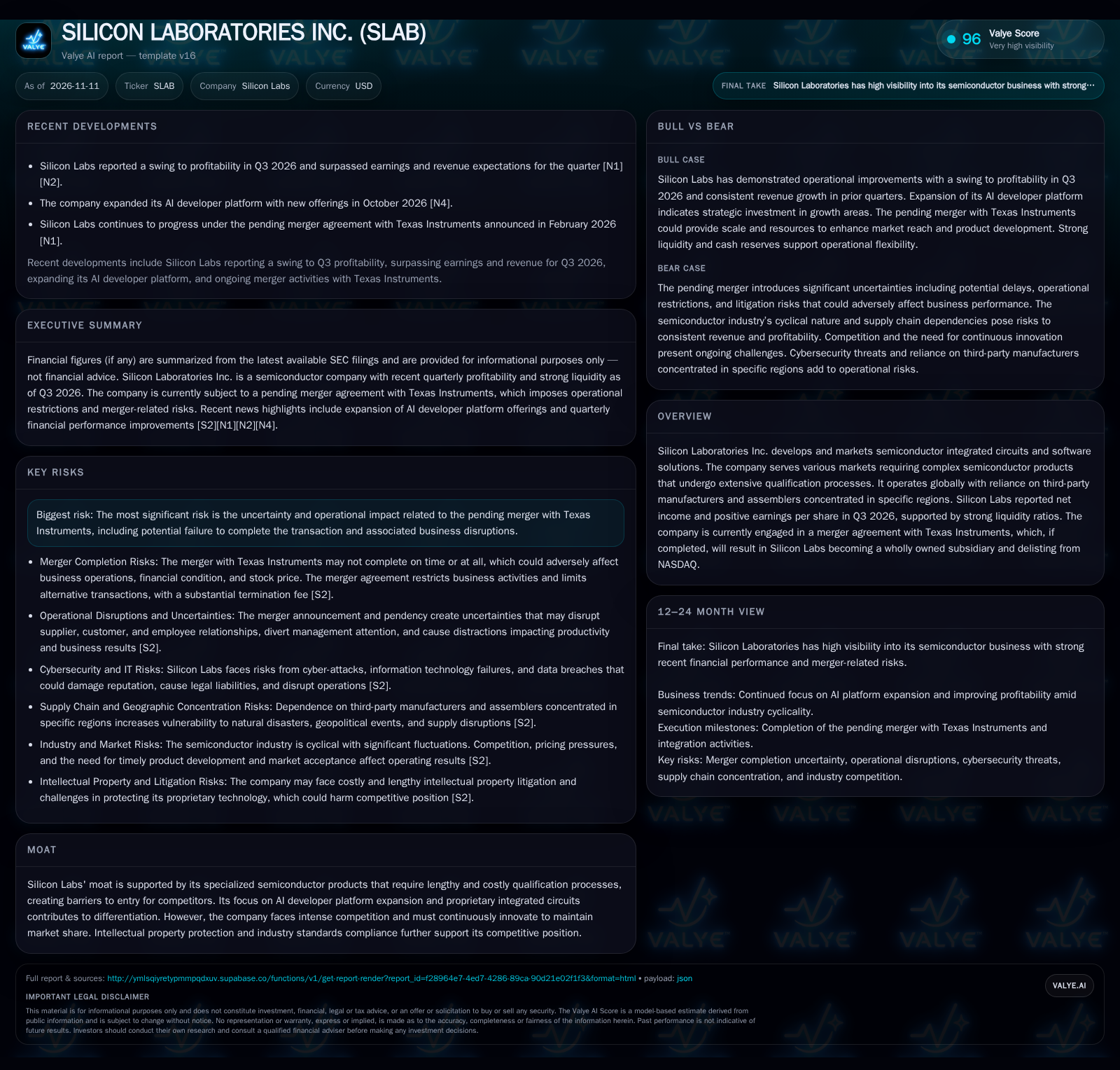
Silicon Labs returned to profitability in Q3 2026, supported by a reported balance sheet position and ongoing expansion of its AI developer platform. However, a pending $7.5 billion all-cash merger with Texas Instruments introduces operational restrictions and strategic uncertainty. The company’s ability to sustain momentum amid industry cyclicality and execute on growth initiatives will be tested as the merger process unfolds. [S2] [N1] [N4]
Silicon Labs stands at a pivotal moment in late 2026, having swung back to profitability and reinforced its financial base even as the semiconductor sector remains volatile. The company is simultaneously investing in AI developer tools to capture emerging growth, but its strategic trajectory is now dominated by the pending $7.5 billion acquisition by Texas Instruments. This deal introduces both a near-term operational straightjacket and the prospect of integration into a much larger entity, making the next several quarters a high-stakes test of Silicon Labs’ ability to maintain commercial momentum and manage risk during a period of profound transition.
Profitability Rebounds as Acquisition Looms
Silicon Labs reported net income of $8.85 million and basic earnings per share of $0.27 for the quarter ended October 3, 2026, marking a swing back to profitability after a period of narrowing losses earlier in the year. This turnaround comes alongside continued revenue growth and positive operating performance in prior quarters. As of the same date, Silicon Labs held $423 million in cash and cash equivalents, with a current ratio of 4.6, highlighting a reported liquidity position. These fundamentals provide a cushion against industry volatility and support ongoing investments, such as the recent expansion of its AI developer platform in October 2026. However, the company's immediate strategic landscape is dominated by the pending $7.5 billion all-cash merger with Texas Instruments, which imposes restrictions on business activities and limits alternative strategic options until the transaction is resolved. The merger introduces both opportunity and risk, with the future of Silicon Labs’ independence and innovation trajectory now intertwined with the deal’s outcome. [S2] [N1] [N4]
Silicon Labs’ Approach to IC Economics and Growth Initiatives
Silicon Labs generates revenue by designing and selling specialized semiconductor integrated circuits (ICs), often bundled with proprietary software, serving applications that require high reliability and compliance with exacting industry standards. These products typically command higher average selling prices (ASPs) and involve long qualification cycles, which can yield sticky customer relationships but also extend sales cycles and increase the risk associated with new product launches.
The company’s cost structure is a mix of substantial R&D and engineering investment—necessary for ongoing innovation and compliance—and variable costs tied to third-party manufacturing and assembly. Gross margins are partly protected by product complexity and customer switching costs, but pricing pressure and the cyclical nature of the industry can compress margins during downturns. Silicon Labs’ recent expansion into AI developer platforms suggests a push toward higher-value, potentially recurring software and services revenue, which could improve margin profile if adoption scales. However, the extent to which AI platform revenue is recurring or tied to hardware sales is not disclosed, so the impact on revenue visibility remains to be proven.
Capital needs are moderate for a fabless semiconductor model, with the main investments in R&D and working capital rather than heavy manufacturing assets. The company reported cash and liquidity metrics for the period; these figures do not by themselves establish operating runway, investment capacity, financial flexibility, or financing capacity.
Competitive Moats and Challenges from Major Industry Players
Silicon Labs competes in a crowded semiconductor landscape characterized by rapid technological change and intense pricing pressure from both diversified giants and nimble niche players. Its primary differentiation lies in developing specialized, highly integrated ICs that require lengthy, costly qualification processes—particularly for industrial, IoT, and infrastructure applications. This creates tangible switching frictions for customers, as redesigning and requalifying mission-critical hardware is expensive and time-consuming.
The expansion of its AI developer platform is a bid to embed Silicon Labs deeper into customer workflows, potentially increasing stickiness and building an ecosystem advantage. However, the effectiveness of this strategy depends on user adoption, integration with other industry platforms, and the ability to drive incremental value for both hardware and software customers.
Despite these advantages, the company faces formidable counterforces: industry giants with broader portfolios and deeper R&D budgets, the risk of technology substitution (such as advances in system-on-chip integration by competitors), and exposure to supply chain disruptions due to geographic concentration of manufacturing partners. The pending Texas Instruments merger adds a new dimension—if completed, Silicon Labs’ competitive position will be subsumed within a much larger entity, potentially diluting its unique culture and focus but offering greater scale and resources.
Potential for Value Creation Through Profitability and AI Expansion
A favorable outcome for Silicon Labs would see the company continue its profitability trend, driven by strong demand in core semiconductor markets and successful adoption of its AI developer platform. If the AI tools gain traction—evidenced by growing developer engagement, third-party integrations, and incremental revenue contribution—Silicon Labs could create a differentiated ecosystem, raising switching costs and improving pricing power.
Completion of the Texas Instruments merger on schedule, with minimal operational disruption and successful integration of Silicon Labs’ innovation pipeline, could unlock further value by leveraging TI’s scale, distribution, and manufacturing capabilities. Confirmation of this scenario would include continued outperformance on earnings, evidence of AI platform adoption (such as disclosed customer wins or partnership announcements), and a smooth regulatory approval process for the merger.
Operational Outlook Amid Integration and Market Cycles
The most plausible trajectory for Silicon Labs over the next few quarters is one of cautious execution. The company is likely to maintain profitability and positive operating cash flow, supported by its existing product portfolio and reported liquidity position. AI platform expansion may deliver incremental growth, but the full revenue impact is likely to be gradual given the long adoption cycles typical in semiconductor and industrial markets.
Operational constraints imposed by the merger agreement may limit Silicon Labs’ ability to pursue aggressive strategic initiatives or respond nimbly to competitive threats. The integration process with Texas Instruments could create temporary distractions for management and uncertainty for employees and customers. Confirmation of this scenario would come from stable financial results, incremental AI platform updates, and a merger timeline that proceeds without major setbacks or regulatory complications.
Risks from Merger Execution and Economic Volatility
The most adverse scenario would involve a significant delay or failure to complete the Texas Instruments merger, compounded by operational disruption, customer or talent attrition, or litigation arising from the deal’s uncertainty. Prolonged merger limbo could freeze decision-making, slow product development, and strain key relationships with suppliers and customers.
At the same time, industry-wide risks—such as a sudden downturn in semiconductor demand, intensified competitive pricing pressure, or supply chain interruptions due to geopolitical or natural events—could erode profitability. If AI platform initiatives fail to gain meaningful adoption or if integration efforts distract from core business execution, Silicon Labs could return to losses or see its market position weaken. Evidence supporting this scenario would include merger delays, declining order volumes, customer loss disclosures, or negative revisions to forward guidance.
Factors Influencing Silicon Labs’ Growth and Value After Merger
Quarterly revenue and net income trends, particularly any deviations from recent profitability, will be critical for assessing core business health. [S2]
Updates on the Texas Instruments merger timeline, regulatory approvals, and any disclosed integration plans will directly shape the company’s future structure and independence. [S2] [N1]
Evidence of AI developer platform adoption—such as customer announcements, usage metrics (if disclosed), or third-party partnerships—would help validate the growth thesis. [N4]
Gross margin trends, especially in the context of industry pricing pressure and product mix shifts, will indicate whether Silicon Labs can defend its economics.
Customer concentration and retention data (if disclosed) would reveal the degree of switching friction and recurring revenue stability.
Disclosures on supply chain resilience, including geographic diversification or risk mitigation efforts, would help assess vulnerability to external shocks.
Any litigation, regulatory, or operational disruptions related to the merger process should be closely monitored for impact on execution and stakeholder confidence.
Disclaimer: This is research-only, informational analysis and not investment advice. It may include AI-generated interpretation and general industry context. Always verify important details using primary sources.

Comments