
CalciMedica: Pipeline Reset, Capital Priorities, and the Clinical Risk-Reward Equation
With its KOURAGE trial halted and no products on the market, CalciMedica is redirecting efforts toward pulmonary hypertension and next-generation CRAC inhibitors. The company’s reported liquidity position funds near-term R&D, but its future hinges on clinical validation and new capital—raising the stakes for its mid-2027 milestones.
CalciMedica’s halted KOURAGE trial underscores the risks inherent in clinical-stage biotech. Success depends on clinical inflection points and the ability to secure additional capital.
CalciMedica’s journey as a clinical-stage biopharma has reached a critical juncture: the abrupt halt of its KOURAGE trial highlights the unpredictable nature of drug development and forces a strategic pivot toward pulmonary hypertension and new CRAC channel inhibitors. With a cash runway into late 2027 but no revenue or approved products, CalciMedica’s valuation now rests on near-term clinical milestones and its ability to attract new capital. The company’s fate will be shaped by safety and efficacy data from upcoming studies, as well as management’s success in navigating both the capital markets and the shifting regulatory landscape.
Pipeline Disruption and Strategic Refocus Define Current State
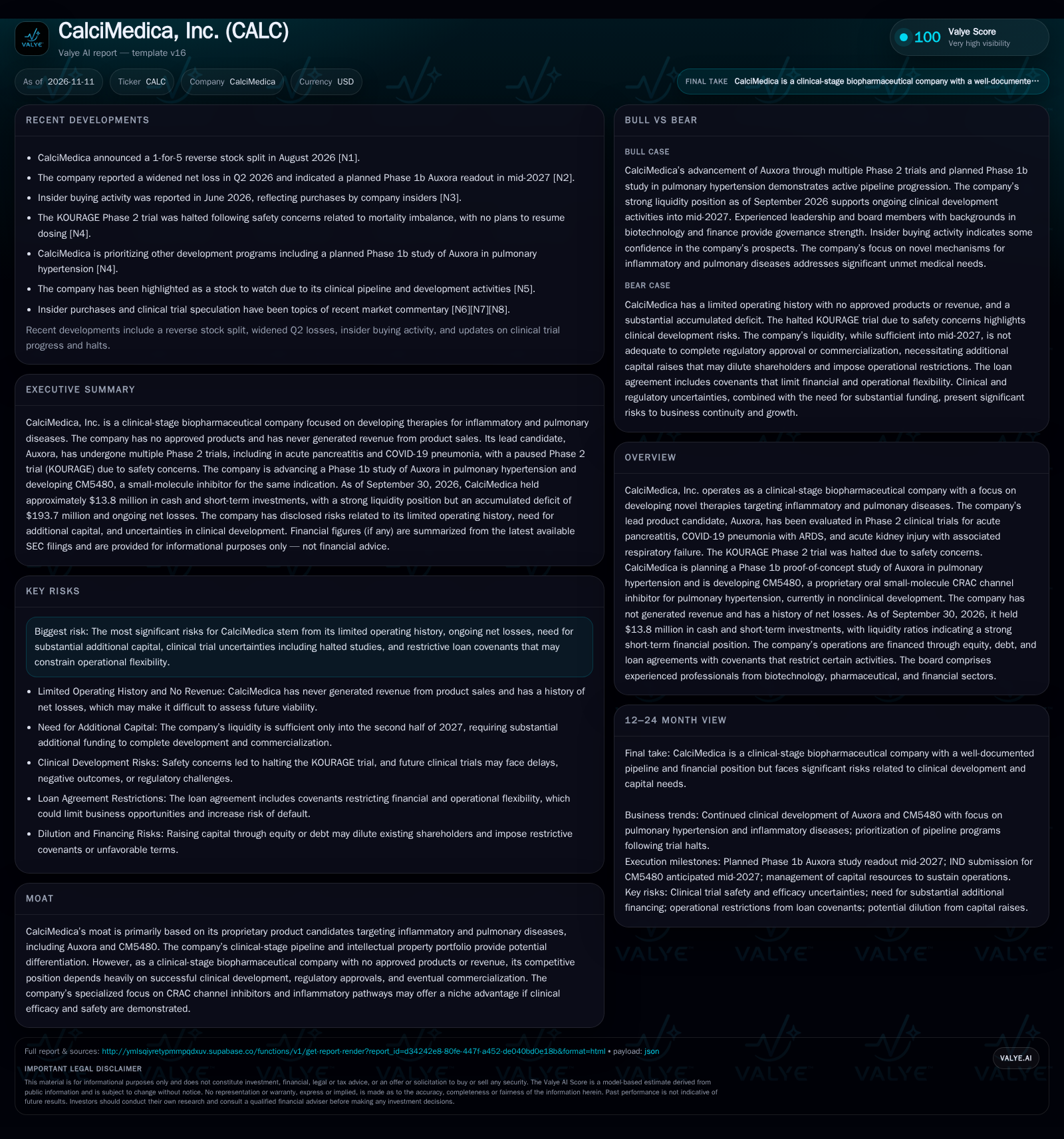
The most consequential recent event for CalciMedica was the suspension of enrollment in its KOURAGE Phase 2 trial for Auxora in acute kidney injury and acute hypoxemic respiratory failure, following a mortality imbalance that raised safety concerns. With no plans to resume this trial, the immediate opportunity for Auxora in these critical care settings is off the table [N4].
CalciMedica is now concentrating on a Phase 1b proof-of-concept study of Auxora in pulmonary hypertension, with initial data expected by mid-2027 [N2] [S2]. Alongside this, the company is advancing CM5480, a preclinical oral CRAC channel inhibitor, also targeting pulmonary hypertension with an IND submission planned for a similar timeframe [S2].
[S2] CalciMedica remains a pre-revenue entity with a cumulative deficit of $193.7 million and ongoing net losses [S2].
R&D-Driven Cost Structure and the Capital Intensity of Clinical Progress
CalciMedica’s economic model is typical of clinical-stage biotech: all expenditures are directed toward R&D, regulatory, and G&A activities, with no product revenue to offset costs. The company’s financial trajectory is defined by milestone-driven spending, where clinical trial progress and data readouts precipitate new funding needs. As of September 2026, the company’s net loss for the quarter was $1.67 million, reflecting ongoing development costs [S2].
The fixed cost base (management, core R&D personnel, facility costs) is complemented by variable expenses that scale up during active clinical enrollment or scale down when trials are paused or completed. The abrupt halt of the KOURAGE trial likely reduced near-term cash burn but also delays value-creating milestones.
This capital will likely come via dilutive equity raises or debt expansion, both of which could become more challenging if clinical progress stalls or safety concerns persist. Operating leverage is negative until (and unless) a product is approved and commercialized, at which point high gross margins typical of specialty pharmaceuticals could be realized if the company can successfully transition.
Niche Targeting in Inflammatory Pathways: Potential Differentiators and Hurdles
CalciMedica’s scientific focus is on CRAC channel inhibition—a mechanism with potential relevance across a spectrum of inflammatory and pulmonary diseases. This approach could provide differentiation if clinical efficacy and safety are established, particularly in indications with high unmet need, such as pulmonary hypertension and acute inflammatory syndromes.
However, the competitive landscape in rare and orphan pulmonary indications is intense, with multiple late-stage and commercial competitors targeting alternative pathways (e.g., endothelin receptor antagonists, PDE5 inhibitors, prostacyclin analogs in PH). Established companies may have deeper pipelines, commercial infrastructure, and more robust balance sheets, making it difficult for CalciMedica to compete unless its clinical data show compelling advantages in efficacy, safety, or convenience.
Switching costs in these indications are typically moderate: physicians may be willing to try new therapies, but only if they offer clear incremental benefit or address populations not well served by existing drugs. Intellectual property, if robust and enforceable, could provide some protection, but commercial success ultimately depends on clinical outcomes and payer acceptance.
Clinical Validation Unlocks Value and Funding Pathways
A favorable scenario for CalciMedica would see the Phase 1b Auxora study in pulmonary hypertension generate positive safety and efficacy signals by mid-2027, positioning the asset for larger, later-stage trials. Concurrently, successful IND submission and promising preclinical data for CM5480 would bolster the pipeline and provide optionality.
Such clinical progress could enable CalciMedica to attract non-dilutive funding (e.g., partnerships or grants) or to raise capital on improved terms. Positive data would also enhance the company’s negotiating position if it sought to out-license assets or enter joint ventures. In this scenario, the company’s valuation would likely benefit from renewed investor confidence and reduced perceived clinical risk.
Evidence confirming this scenario would include statistically and clinically meaningful improvements in pulmonary hypertension endpoints in the Phase 1b study, clear safety signals, and successful completion of IND-enabling studies for CM5480. External validation—such as partnership interest or buy-side research coverage—would further support the upside case.
Pipeline Progress Amid Funding Constraints and Clinical Uncertainty
The most plausible path forward is incremental progress: CalciMedica advances its planned Phase 1b trial of Auxora in pulmonary hypertension, achieves an IND for CM5480, and manages operating expenses to stretch existing liquidity into late 2027. However, major clinical inflection points (such as Phase 2 or pivotal data) and regulatory submissions remain out of reach without substantial new capital.
In this scenario, the company continues to operate as a pre-commercial biotech, dependent on the capital markets for survival. The longer it takes to achieve compelling clinical data, the greater the dilution risk for current shareholders. Meanwhile, management must balance the need to advance the pipeline with the imperative to conserve cash, all while navigating restrictive loan covenants.
Evidence supporting this scenario would be steady clinical enrollment and data generation, timely IND submission, and modest capital raises that extend runway but do not fundamentally change the risk profile. Falsifying evidence would be a failure to initiate or enroll the Phase 1b study, inability to file the CM5480 IND, or an inability to raise capital before existing funds run out.
Safety Setbacks or Capital Shortfalls Force Retrenchment or Strategic Alternatives
The principal risk is that Auxora’s safety concerns re-emerge in the pulmonary hypertension setting, or that efficacy signals fall short—leading to further trial halts, regulatory setbacks, or loss of investor confidence. Alternatively, if capital markets become less receptive, CalciMedica could struggle to raise the funds needed to continue even early-stage development.
In this scenario, the company may be forced to suspend additional programs, pursue asset sales, or explore strategic alternatives such as a merger or sale under distressed conditions. Shareholder dilution could become severe if capital is raised at depressed valuations. The risk of NASDAQ delisting or going-concern qualification would increase if liquidity falls below minimum thresholds.
Falsifying this downside would require clear evidence of safety and efficacy in early PH trials, successful capital raises at acceptable terms, or the emergence of a strategic partner willing to share development risk.
Milestones That Will Determine Whether CalciMedica Can Bridge the Clinical and Capital Gaps
Initiation and enrollment progress in the Phase 1b Auxora study for pulmonary hypertension; a useful metric would be patient recruitment rate and protocol adherence.
Timing and quality of the CM5480 IND submission; delays or regulatory feedback would help assess pipeline credibility.
Interim and final safety/efficacy data from the pulmonary hypertension study, especially any recurrence of safety signals seen in KOURAGE.
Changes in cash burn rate and quarterly operating expenses, especially as clinical activity ramps or pauses.
Announcements of new partnerships, licensing deals, or non-dilutive funding that could extend the company’s runway or validate the technology.
Capital raise timing, structure, and terms—particularly the degree of dilution and any new covenants or restrictions.
Updates on loan agreement compliance, including any waivers, amendments, or breaches that could impact operational flexibility.
NASDAQ listing compliance and any risk of delisting if liquidity or market cap falls below required thresholds.
Disclaimer: This is research-only, informational analysis and not investment advice. It may include AI-generated interpretation and general industry context. Always verify important details using primary sources.

Comments