
CitroTech’s Fire Retardant Ambitions: Capital, Seasonality, and the Realities of Scaling a Regulated Niche
With a recent public offering and insider buying, CitroTech seeks to extend its runway in the volatile, regulation-heavy fire protection market. The company’s high dependence on external funding, operational constraints, and unpredictable demand cycles frame both its upside and its existential risks.
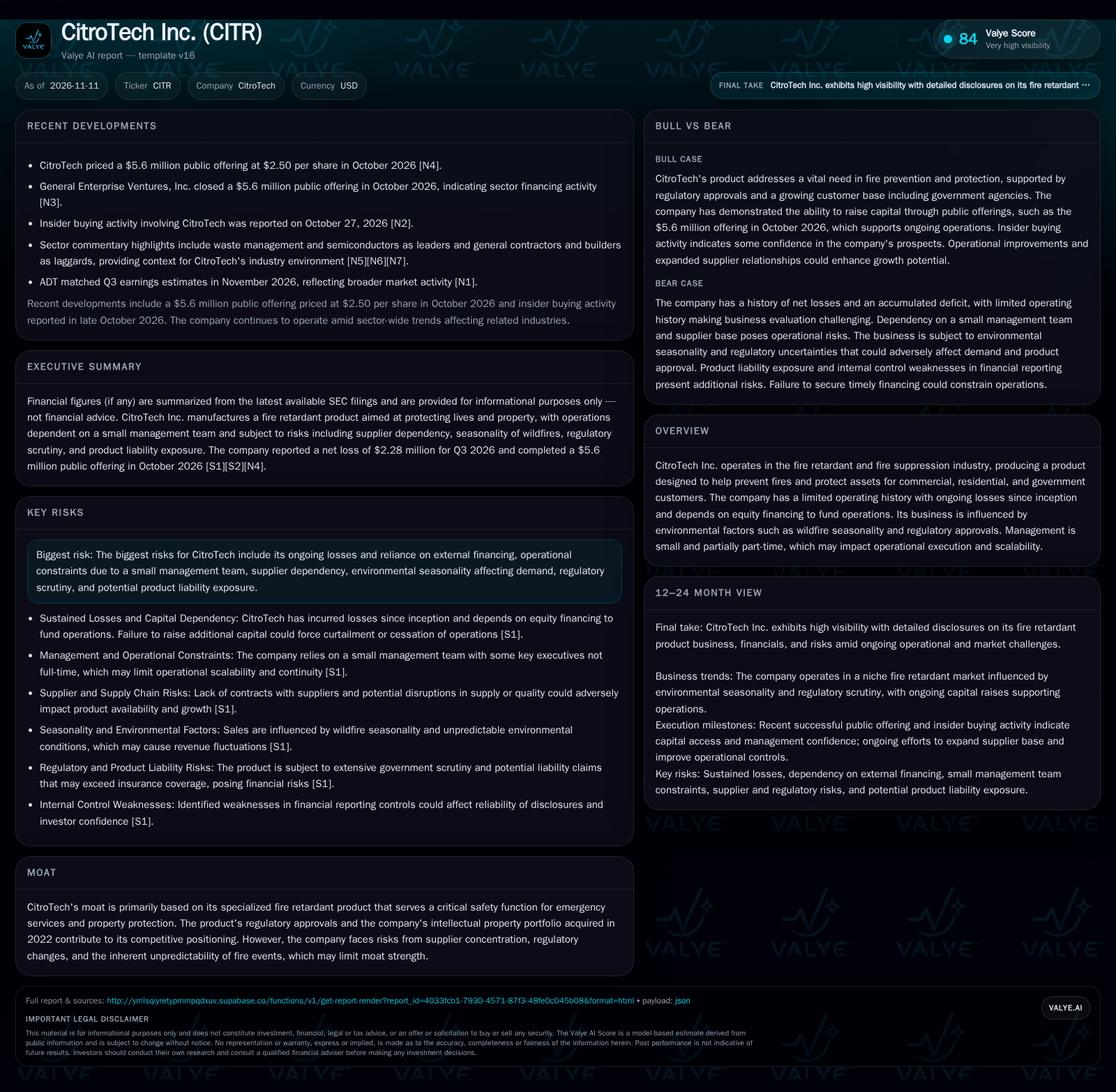
CitroTech manufactures a fire retardant product for commercial, residential, and government customers, but continues to post losses and depends on raising external capital. A $5.6 million public offering in October 2026 and insider buying have extended its financial runway, yet the company faces execution challenges from a lean management team, supplier dependency, and regulatory and environmental unpredictability. The outcome hinges on CitroTech’s ability to convert regulatory approvals and episodic demand spikes into a scalable, resilient business model while mitigating operational and financial risks. [S1] [S2] [N2] [N4]
CitroTech Inc. stands at a critical juncture in the fire prevention sector, having recently shored up its finances with a $5.6 million public offering and reported insider buying activity. While its specialized fire retardant product addresses a clear and growing need—particularly as wildfires intensify—CitroTech’s business model is shaped by persistent losses, capital dependency, operational constraints, and the erratic nature of its end markets. The next phase for CitroTech will test whether regulatory validation and episodic demand can be converted into durable, scalable growth, or whether the company’s inherent vulnerabilities will limit its trajectory.
Financial Extension and Operating Realities Define CitroTech’s Position
CitroTech’s most recent quarter closed with a net loss of $2.28 million and a cash balance of $1.09 million, against current liabilities of $782,922, yielding a current ratio of 2.99 and a cash ratio of 1.39 [S2]. The company reported cash and liquidity metrics for the period; these figures do not by themselves establish operating runway, investment capacity, financial flexibility, or financing capacity. The October 2026 public offering raised $5.6 million at $2.50 per share, temporarily extending the company’s financial runway [N4].
Insider transaction activity was reported in the cited source; this activity does not by itself establish insider confidence. [N2] Meanwhile, CitroTech’s lean management structure—with key executives not fully dedicated—limits execution bandwidth and the company’s ability to respond dynamically to market or operational shocks [S1].
The business remains exposed to environmental seasonality, with sales tied to unpredictable wildfire activity, and must operate within the strict confines of government regulation, including EPA and USDA Forest Service oversight [S1]. These realities frame both the near-term prospects and existential risks for the company.
How CitroTech’s Economics Are Shaped by Episodic Demand and Fixed Costs
At its core, CitroTech’s economics are defined by the intersection of unpredictable, event-driven demand (primarily from wildfires) and the fixed costs required to maintain readiness, regulatory compliance, and product liability coverage. The company’s fire retardant product must be manufactured, stored, and distributed in anticipation of peak fire seasons, creating potential for both inventory risk and underutilization of capacity.
Pricing power is theoretically supported by the critical safety function of the product and regulatory barriers to entry, but actual realized pricing may be pressured by budget cycles of government customers and the sporadic nature of large purchasing events. Volume spikes can occur in response to severe fire seasons, but these are difficult to forecast and may not align with inventory or production planning.
Fixed costs—such as regulatory compliance, product liability insurance, and core management—are relatively high for a company of CitroTech’s size, creating significant operating leverage. This means that while a surge in demand could rapidly improve margins, periods of average or below-average wildfire activity may exacerbate losses. The company’s ongoing net losses and accumulated deficit underscore the challenge of bridging fixed costs during off-peak periods [S1] [S2].
CitroTech’s capital needs remain acute, as evidenced by its recent equity raise. Without recurring, predictable revenue or contractual backlog, the company is likely to require further external financing unless it can achieve a step change in scale or customer diversification.
Regulatory Barriers and Supply Chain Risks Shape CitroTech’s Defensible Space
CitroTech’s competitive position is anchored in its regulatory approvals and intellectual property portfolio, which serve as hurdles for new entrants and help establish credibility with government and commercial buyers. However, these advantages are not absolute: established chemical, materials, and specialty fire safety firms may possess broader distribution, deeper regulatory relationships, and more robust supply chains.
The company’s supply chain is a notable vulnerability. Dependence on a small roster of suppliers—and the absence of formal supply contracts—exposes CitroTech to input shortages or quality disruptions that could impair its ability to fulfill orders, particularly during demand surges [S1]. Larger competitors with diversified sourcing and stronger balance sheets may be better positioned to weather such shocks.
In the broader fire retardant landscape, substitutes such as advanced sprinkler systems, alternative chemical blends, or emerging fire suppression technologies provide ongoing competitive pressure. The critical question is whether CitroTech’s product can demonstrate superior efficacy, safety, or cost-effectiveness relative to these alternatives—especially when procurement decisions are often influenced by government standards, liability concerns, and the urgency of fire events.
Surging Wildfire Activity and Regulatory Endorsement Propel a Step-Change in Demand
The most favorable scenario for CitroTech involves a confluence of severe wildfire seasons and increased regulatory or governmental endorsement, leading to a rapid spike in orders from both public agencies and private property owners. In this environment, CitroTech’s regulatory-compliant product and existing relationships could enable it to capture a disproportionate share of incremental demand.
This upside is further supported if the company can translate episodic volume into longer-term contracts or preferred-supplier status, smoothing out revenue volatility and improving planning. Successful expansion of the supplier base and operational improvements—particularly in inventory management and financial controls—would help the company capitalize on demand without bottlenecks or costly overruns.
Evidence that would confirm this scenario includes: a material increase in order volume following a major fire season, announcement of multi-year purchasing agreements with government agencies, and improved gross margin on higher sales. Disproving evidence would be muted sales response to fire events, ongoing supply chain disruptions, or inability to fulfill large orders due to operational constraints.
CitroTech Remains a Niche, Volatility-Prone Player Dependent on Episodic Funding
The most plausible trajectory for CitroTech is continued operation as a niche provider, with revenue and cash flows oscillating in response to unpredictable wildfire seasons and the timing of regulatory or budgetary decisions. The company may achieve periodic sales spikes but is unlikely to reach sustained profitability or scale without a structural change in demand or business model.
Capital raises remain a recurring feature, with CitroTech tapping equity markets as needed to fund working capital and regulatory compliance. Operational constraints from a lean management team and supplier dependencies persist, limiting the company’s ability to expand aggressively or respond to surges without additional investment.
This scenario would be validated by ongoing net losses, further equity offerings within the next 12-24 months, and a lack of announced multi-year or recurring revenue contracts. Conversely, evidence of operational scale-up, supplier diversification, or recurring government contracts would begin to challenge this baseline outlook.
Capital Shortfall or Supply Disruption Forces Retrenchment or Exit
Either event could force a curtailment of operations, asset sales, or even liquidation.
Further compounding the risk: regulatory setbacks (such as delayed approvals or product recalls) or a liability claim exceeding insurance coverage could create sudden, unmanageable financial exposure. The company’s small management team may also struggle to respond effectively to simultaneous crises, increasing execution risk.
Evidence supporting this scenario includes a rapid decline in cash reserves, disclosure of supplier or regulatory setbacks, and announcements of workforce reductions or strategic alternatives. Falsifying evidence would be new financing rounds, successful supply chain expansions, or regulatory wins that unlock new sales channels.
Milestones That Will Determine CitroTech’s Trajectory in the Fire Prevention Market
Announcement of multi-year or recurring revenue contracts with government agencies or large commercial customers would help test the company’s ability to build predictable cash flow.
A material increase in order volume or backlog, if disclosed, following a severe wildfire season would signal demand sensitivity and operational readiness.
Updates on supplier diversification efforts or the signing of formal supply contracts would address a key operational vulnerability.
Disclosures regarding improvements in internal financial controls and remediation of identified weaknesses would inform the reliability of financial reporting.
Evidence of expanding the management team or recruiting full-time operational leadership would gauge scalability and execution depth.
Insider transaction activity was reported in the cited source; this activity does not by itself establish insider confidence.
Any regulatory developments—such as new approvals, compliance issues, or product recalls—would directly impact market access and reputational standing.
If available, gross margin trends during periods of elevated sales would clarify the impact of operating leverage and cost structure.
Disclaimer: This is research-only, informational analysis and not investment advice. It may include AI-generated interpretation and general industry context. Always verify important details using primary sources.

Comments